Baseball is not dying. No longer dominant? Sure, I suppose, at least on a national level. But MLB remains a powerful entity in America despite nearly two decades of incompetence at the leadership level, cheating and scandals, and prolonged periods without flashy superstars or with flashy superstars that simply don’t crave attention (and that’s ok, Mike Trout). But baseball remains either king or queen at the U.S. regional level – depending on your locality’s connection to the NFL – and is a force in Latin America and Asia. Coming out of COVID and an avoidable lockout, MLB should be on an upswing for the foreseeable future and the game has plenty of bright faces and reasons for excitement – including a first wave of action-oriented rule changes for the 2023 season. Youth engagement, both on and off the field, is trending in a positive way. There remains plenty of work to do – the sharp decline of African-American players in the league stands out – but the impending funeral of baseball that your co-worker who doesn’t know sports talks about isn’t coming anytime soon, barring Rob Manfred opening his mouth in public a few more times.
This isn’t to suggest that MLB can’t use a shot in the ass, FIGURATIVELY SPEAKING, as MLB turned a blind eye to that literal outcome 15 years ago for the short-term boost in popularity. I also certainly do not intend to suggest that MLB is on the right path towards modernization and global interest by streaming random Friday night games on Apple TV. There is definitely an element of staleness to the league as a whole. Some good steps have been taken; the elimination of the DH for the National League and the best-of-three Wild Card rounds have been fun. But the time is nigh to enact much grander action. I’m talking…
- Expansion
- Globalization
- Relegation
…and I’ll break it down over the course of five-year windows, starting in 2030.
I can assure you that MLB will expand soon. I’m not sure if it will happen by 2030 like I propose here, but it’s going to happen and it’s rather inexcusable that we’re approaching a 30-year gap between additional teams in the league. It’s beyond me how baseball and its grassroots allowed the NFL and the NHL (!!) to bypass MLB as the leader among the Big 4 in total teams, but that’s in the past now and I would hope that the next expansion era is more of a wave than a ripple. I’m calling for MLB to add six teams and I’m giving the league a seven-year headstart. While that might sound like a drastic amount, honestly, it was harder to narrow the initial list to six than it was to choose six worthy markets.
2030: First Expansion Wave
Each division gains one extra team, the league grows from 30 to 36 clubs, and the playoff format doesn’t change at all. I promise you it won’t be this simple in the next two rounds, so stick with me.
By the way, I’m treating the A’s-to-Vegas as a done deal.
- Charlotte, NC – AL East
Why Charlotte? Already home to NFL’s Panthers and NBA’s Hornets, 22nd largest U.S. metropolitan area and 4th in growth among Top 25, Charlotte Knights (Triple-A affiliate of Chicago White Sox) finished 6th in Minor League Baseball total attendance in 2022.
- Montreal, Canada – NL East
Why Montreal? Home to MLB’s Expos from 1969-2004 until the team relocated to D.C. and became the Nationals, lost an MLB franchise in the first place mainly because they were swindled by Jeffrey Loria who bought the team just to tear everything down and use the profits to buy the Marlins, 2nd largest Canadian metropolitan area (would rank 15th in the U.S. between Detroit and Seattle), Rays’ ownership recently proposed a plan to MLB to split a home schedule between Tampa and Montreal; MLB rejected the plan.
- Salt Lake City, UT – AL Central
Why Salt Lake City? Home to NBA’s Jazz, the potential ownership group is already established, and MLB insiders seem to believe that the league is interested in some Utah baseball for real.
- Nashville, TN – NL Central
Why Nashville? If you have to ask this question, then you probably haven’t been to Broadway. Besides already being home to NFL’s Titans and NHL’s Predators, the Nashville Sounds (Triple-A affiliate of Milwaukee Brewers) led all of Minor League Baseball in total attendance in 2022. I guarantee you that a Nashville club with a ballpark across the river would rank among the league leaders in road attendance every year.
- Portland, OR – AL West
Why Portland? It’s one of the bigger American cities without an MLB team and Portlanders love their Trail Blazers and even their Timbers! Not to mention, a crisp summer evening in Portland could make for the ideal baseball aesthetic.
- Vancouver, Canada – NL West
Why Vancouver? It’s certainly a big enough city with the necessary demand – its population would rank 26th in the U.S. – and a Pacific Northwest rivalry between Vancouver, Seattle, and Portland would be incredible. For what it’s worth, MLB seems to be test driving this concept; MiLB’s Vancouver Canadians were upgraded from a short-season team to the High-A affiliate of the Blue Jays in 2021. They promptly led their league in attendance and even outperformed some Triple-A teams.
2035: Latin Expansion, 5-Year Relegation Window Begins
It’s time for baseball to properly embrace its roots in beisbol, and I sure as hell don’t mean an international draft as the best way to do so. One of the coolest things about the game of baseball is its cultural significance across a variety of otherwise different cultures in North America, and the league could acknowledge as much through expansion while turning a massive profit and keeping the bulk of the action within the U.S. The Dodgers and Giants left NYC for California in the 50s, MLB headed north of the border to Canada in the 70s, Florida was granted its first two teams in the 90s…and now we’re a few decades behind but the pattern resumes with the Caribbean and Mexico getting their first tastes of full-time MLB action.
This brings MLB to 42 teams which, honestly, is still feasible under its current format. There is so much worthy talent out there waiting and fighting for a big league call-up – even more so if MLB front offices were to dive deeper into foreign markets as the league continues to globalize. In a crucial change to the first wave of expansion though, this is where the first mention of “relegation” takes place. It doesn’t happen immediately; traditional divisions grow to 7 teams apiece, and MLB could temporarily expand the postseason field to account for that.
In a five-season span from 2035-2039, each division’s bottom two teams in the aggregate over that period are relegated without exception and play the 2040 season in MLB2 (this is what we’re calling the second-level league). The newly formed Caribbean and Mexican teams are at somewhat of a disadvantage by playing for their futures with expansion rosters, but hey…they have a shot.
- Puerto Rico (San Juan) – AL East
Why Puerto Rico? For starters, because it’s not outside of America! If Puerto Rican players are subjected to the MLB Draft – which, they are – then it’s not invalid to put some pressure on MLB to invest deeper into the island. San Juan has the population (2.2 million, which would rank 32nd between Kansas City and Columbus) and Puerto Rico has already hosted the 2003-2004 Expos for 22 games each season, other MLB regular season series twice, and the World Baseball Classic three times.
- Dominican Republic (Santo Domingo) – NL East
Why Dominicana? Besides the MLB history book owing chapters upon chapters to the insurmountably positive impact of Dominican players on the game? Ok, then: all 30 MLB clubs now have official academies in the Dominican Republic that train prospects awarded signing bonuses, and the Dominican Winter League (LIDOM) annually features past, present and future MLB players among its six teams and frankly features baseball in its purest and most energetic form. Santo Domingo is also the largest metropolitan area in the Caribbean with a population of 3.0 million (would rank 19th in the U.S. between Tampa and Denver) and the tourism boom of a Dominican MLB stadium would do economic wonders.
- Yucatan, Mexico – AL Central
Why Yucatan? The vacations! Just imagine the vacations! An MLB team in Merida (comparable population to Memphis) on the same peninsula as Cancun and Tulum? Just a two-hour flight from Houston and Miami, this would immediately become the preeminent fan destination in MLB. On top of that, Leones de Yucatán might be the most popular team in the Mexican League (and they are the reigning champs).
- Cuba (Havana) – NL Central
Why Cuba? This one would require some progress at the political level, given that professional baseball is currently outlawed under Cuba’s communist rule. There are silver linings of hope when it comes to MLB and Cuban baseball though, with the free agency pipeline legally reestablished to prevent players from needing to defect to play in MLB and the recent decision by the U.S. to allow Cuban players to represent their home country in the World Baseball Classic. Very few countries have richer baseball backgrounds than Cuba, and it’s a shame that MLB doesn’t hold more of a presence there – outside of one exhibition game in 2014 attended by President Obama – for reasons that largely have nothing to do with baseball.
- Monterrey, Mexico – AL West
Why Monterrey? Second largest city in Mexico with a population that would rank 10th in the U.S. between Miami and Phoenix, one of Mexico’s most developed cities, has the largest baseball stadium in Mexico that has already hosted several MLB regular season games. When MLB does make the official move to Mexico City, it wouldn’t surprise me if Monterrey is included in that expansion as well.
- Mexico City, Mexico – NL West
Why Mexico City? It’s one of the ten most populated cities in the world and American professional sports are coming there. Between the NFL, NBA and MLB, whatever league makes the first move will likely be followed shortly after by the other two.
2040: Small Market Expansion, MLB2 Begins
Expansion concludes with this final wave of six cities who mostly have proof of concept as a hub for professional sports. They are too big for minor league baseball yet deemed too small for major league baseball by MLB’s current standards. This brings the total to 48 teams, which sounds crazy compared to what we’ve come to accept for league sizes. Honestly though, this would be fine and I’m confident it would work. 1) There is an existing soccer model across the pond that has only reinforced the popularity and cultural fabric of England’s national pastime. 2) There are 150 baseball teams today between MLB and the top four levels of Minor League Baseball. The Minors are a good and important system, though one can admit that it’s bloated while putting all appreciation for them aside. Players in the Minors are drastically underpaid and too many are stuck in the “Quadruple-A” purgatory as top MiLB players who can’t crack the Majors. Well, more teams equals more opportunities, and no sport routinely uncovers diamonds in the rough among players more than baseball.
The following six cities get the metaphorical “call to the big leagues” in being granted expansion teams, though they each spend their inaugural seasons in MLB2. I’ll get into more detail on how relegation would work.
This entire plan, by the way, is only realistic with league-wide buy-in on 20k-30k ballpark capacities instead of 50k capacities in every ballpark. Empty ballparks are depressing and increasingly too common for smaller market clubs that snaked local governments into convincing them that they’d suddenly become the Dodgers with a shinier home funded by taxpayers. Beyond bad optics it’s also bad business for those teams, for whom less would be more by shrinking dimensions to create more raucous and fan-friendly environments that would certainly resonate with players too.
- Indianapolis, IN – AL East
Why Indianapolis? Great sports town that’s already home to NFL’s Colts and NBA’s Pacers, 33rd largest U.S. metropolitan area (right above Cleveland), Indianapolis Indians (Triple-A affiliate of Pittsburgh Pirates) finished 3rd in total attendance among all minor league teams in 2022.
- Louisville, KY – NL East
Why Louisville? It feels wrong that MLB isn’t already in Louisville, doesn’t it? I’d like to believe that Cooperstown would have a pro team if it had the 45th largest population in the country. The Louisville Slugger museum isn’t exactly on par with the Hall of Fame, but the point being that Louisville is large enough and ingrained enough into the fabric of baseball that MLB should be the league to usher pro sports into Kentucky.
- Austin, TX – AL Central
Why Austin? Largest city in the U.S. without a Big 4 team – sorry MLS – and just ask the Vegas Golden Knights how important it is to get to a market first. 28th largest U.S. metropolitan area (nearby San Antonio is 24th), single highest growth among Top 50 U.S. metropolitan areas, and regionally does well in baseball attendance with Round Rock Express (Triple-A affiliate of Texas Rangers) and University of Texas.
- New Orleans, LA – NL Central
Why New Orleans? BOURBON STREET, BEIGNETS, AND BASEBALL: THAT’S WHAT NEW ORLEANS DOES. An MLB team in New Orleans would likely require a dome on the smaller side – unless the Saints were to get a new stadium and the MLB team could claim and renovate the Superdome – but it would be so worth it for yet another must-visit destination for fans.
- Oakland, CA – AL West
Why Oakland? Because baseball is better with the A’s in Oakland. I’ll avoid getting too glossy-eyed over the city and market’s role in their impending departure from the Golden State, but John Fisher certainly was the biggest problem towards the team’s chances of remaining in Oakland. With new ownership and this league-wide commitment to middle-market teams, the A’s could return over a decade later to their rightful home and reassume their history, while the Vegas version of the team begins their own. Kinda like the NFL’s Browns/Ravens situation in the late 90s.
- Honolulu, HI – NL West
Why Honolulu? Population wise, this proposal is the biggest stretch…but it’s not THAT big of a stretch. Urban Honolulu has over 1mil people, which would make it somewhat comparable to Buffalo having an NFL team. This would be cool enough to justify any lengths to make it feasible. Hawaii should be brought into the fold of American sports beyond a college basketball invitational tournament and the Pro Bowl in the 80s and 90s. Can you imagine the betting action on late night Hawaii baseball games? This would immediately become the favorite team of degenerates and insomniacs across the country.
Relegation: Explained
I’ll spare my word count and allow this clip from Welcome to Wrexham to better explain how the system of promotion and relegation works. TL;DR: British soccer leagues are stacked on top of one another, and the best teams from lower leagues move up to the next league while the worst teams in the top leagues move down to the next league. It’s a magnificent system that rewards success and, more importantly, incentivizes not being a bad team. Naturally it’s a massive undertaking to implement relegation into an American sports league that has maintained the same shape for decades; the NBA has admitted to considering it but wasn’t “deadly serious” about it. MLB is absolutely, without a doubt, the best-suited American professional sports league for relegation. For starters, like I wrote earlier, there are 150+ TEAMS in the American professional baseball system. There’s a reason that the Welcome to Wrexham clip above uses baseball as a metaphor; the volume isn’t all that different to English soccer. The main difference is the interconnectivity in English soccer as opposed to the Minor Leagues being a feeder system to the Majors. Introducing promotion and relegation to baseball wouldn’t eradicate the Minor Leagues; players absolutely still require development before reaching the big leagues. It would merely trim the size of the Minors to introduce MLB2 into the “pyramid” between MiLB and MLB. For instance, you could just merge Single-A and High-A into one level and the work is complete.
The other key reason why MLB is best fit for relegation is that the sport has a black cloud of unseriousness franchises that the other leagues don’t have to deal with. The NFL is nearly perfect, the NBA has the most tanking but there’s at least strategy behind it, and the NHL does have less powerful teams than others but even those teams contend at a fine enough clip. There’s nothing like what has persisted in MLB over the course of the 21st century. Multiple billionaire owners hide behind the cover of the “small market” label and MLB’s league office not only enables them but rewards them via revenue sharing. The Oakland A’s had a team payroll last season that was less than some individual players earned in salary. The Pittsburgh Pirates, who play in the same city as two powerhouses in the Steelers and Penguins, have never cracked a payroll of $100mil. The Baltimore Orioles willingly went 253-455 (35.7%) over a five-year period from 2017-2021 because, if they weren’t going to contend with the Yankees and Red Sox, then why spend on talent at all? And I could come up with shameful thesis statements on behalf of the Guardians, Reds, Marlins, and Rays too. You want to keep up those shenanigans and prioritize your net wealth over investment into the baseball product and community? Fine, have fun doing that in MLB2.
On the flip side of that coin, there’s a reason that select MLB front offices get away with the blatant frugality largely unseen in other leagues: it can kinda work. That’s not to say that pinching pennies makes teams better, but there’s long-documented proof in the pudding that low payroll teams can hang with the big bankrollers through savvy trades, rookie contracts, etc. Just in this 2023 season, two teams with bottom-4 payrolls – the Rays and Orioles – are threatening 100 wins. And all three of the teams with the top-3 payrolls – the Mets, Yankees, and Padres – are going to miss the playoffs. It’s an ugly truth of MLB finances and operations, but it’s a truth that nonetheless justifies adding more teams, even if they hover around the payrolls in the bottom half of the league.
Below is a guideline for how an MLB relegation system would unfold and structure. For ease of understanding, I’ll refer to MLB as we know it as “MLB1.”
- MLB1 division losers participate in the single-elimination year-end tournament. BESIDES:
- Top division loser receives one-year protection from relegation.
- Bottom division loser does not participate in the tournament and is automatically relegated.
So, for the 2023 season, the Red Sox would avoid relegation despite finishing last in the AL East, and the A’s would be automatically relegated due to owning the worst record in MLB.
In the 2023 MLB1 Divisional Losers tournament, the Cardinals would host the Royals and the Nationals would host the Rockies in a winner-take-all bracket of four. The winner of the MLB1 Divisional Losers tournament receives one-year protection from relegation.
- If the MLB1 team that receives one-year relegation protection finishes last in division again the following season, that team is relegated regardless of division ranking. If that team qualifies for the MLB1 Divisional Losers tournament, they are replaced with a bye.
So hypothetically, looking at the 2022-23 final standings, the 2023 Red Sox would automatically be relegated for finishing last in the AL East in consecutive seasons, even though they were the top last place team. And say that the 2022 Rockies won the MLB1 Divisional Losers tournament, they wouldn’t be able to participate in the 2023 version since they finished last in the NL West again.
- Non-protected MLB1 division losers are each replaced by the first place finishers in corresponding MLB2 divisions.
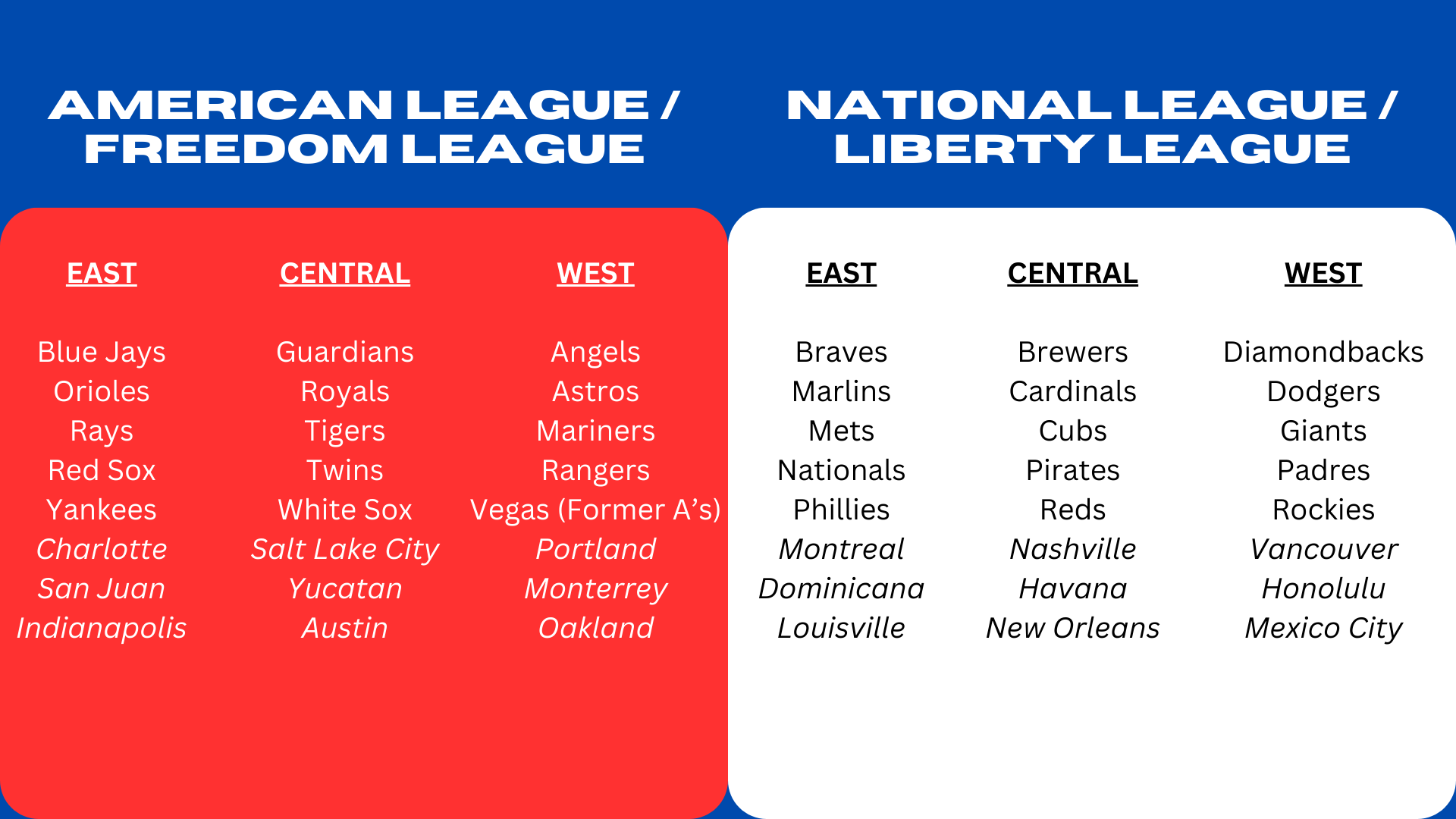
Here is the proposed MLB1/MLB2 tier system, with the corresponding leagues to the American League and National League in MLB2 being called the Freedom League and the Liberty League.
- MLB2 Playoff Format:
- The top division winner in the Freedom League and the Liberty League receives a bye to the FLCS/LLCS.
- On each league’s side of the bracket, the second-best division winner hosts the second-best Wild Card team in a first round, best-of-three series.
- On each league’s side of the bracket, the third-best division winner hosts the top Wild Card team in a first round, best-of-three series.
So, 10 of the 18 teams in MLB2 reach those playoffs, with 6 being the winners of the three-team MLB2 divisions, and the other 4 being the best of the rest.
You might be wondering – if you’re hopefully still following along – what are the stakes of the MLB2 Playoffs if the MLB2 division winners are promoted to MLB1 the following season anyway?
- If the winner of MLB2 Playoffs is a Wild Card team, that team is subject to promotion in place of the winner of that team’s MLB2 division.
Say that Mexico City wins the LL West regular season division title but Vancouver (same division) wins the MLB2 Playoffs as a Wild Card, Mexico City remains in MLB2 for the following season while Vancouver instead takes their place in MLB1.
- The MLB2 Champions immediately qualify for that season’s MLB1 Playoffs, drawing the third-best MLB1 division winner from their respective MLB1 league in a first round, best-of-three series. Only two Wild Card teams from that league reach the playoffs, as opposed to the typical three teams in the other league.
This is perhaps my favorite rule of this entire exercise, one that brings a layer of American sports drama that our British counterparts don’t have in their relegation system: you can theoretically win the World Series as a team that begins the season in MLB2. The odds are against you, needing to be the 1 of 18 MLB2 teams to win it all at that level and THEN advancing through the MLB1 postseason as an underdog. But hey, there’s a chance, one that would bring some hope to all 48 teams on Opening Day and prevent fans of MLB2 teams from completely throwing in the towel with any demotion to that league. (From this point, by the way, the MLB1 Playoffs are the MLB Playoffs as we know them.)
So, what do you think? Are these 4,000 completely unhinged words? Or did I just revolutionize American professional sports as we know them?






 Epiblogue