The MVP decisions in baseball this season will inevitably go down as some of the least dramatic in the history of the sport: Aaron Judge will win in the American League and Shohei Ohtani will win in the National League.
And yet, while Ohtani has been the NL’s frontrunner for months now, his coronation wasn’t such a sure thing a few weeks ago. Francisco Lindor kept the race alive with his excellent and often clutch two-way play leading the Mets’ late charge into the playoff picture. Ohtani shut the door on debate with his otherworldly September, but not early enough for me – and likely others – to ask the question: can we quantify Lindor’s impact on Mets wins compared to Ohtani’s impact on Dodgers wins?
It’s not only a fair proposition with Ohtani being a full-time DH in 2024 compared to Lindor being a shortstop (and an elite one); it’s also a mostly fair question to pose on the basis of the Dodgers not exactly needing Ohtani heading into this season. They have Mookie Betts and Freddie Freeman and Teoscar Hernandez and Will Smith in the lineup too, and they had made the playoffs in 11 consecutive seasons with NL West titles in 10 of them. The Mets, on the other hand, have only made the playoffs twice since 2015, and they didn’t escape the Wild Card Round in either of those years. And while they have several above-average offensive players, Lindor is basically lapping his next-closest teammates in overall value on the season.
That note on player value brings us to WAR (Wins Above Replacement), which I have zero intent of dissing in this exercise. WAR, simply put, is one of the greatest statistical advancements in MLB’s long history. It does an excellent job of encapsulating one player’s total and well-rounded worth to his team’s win/loss record compared to the average Triple-A player they could call up in his place. Award voting in baseball still has its blemishes, but WAR has led the charge away from the days of MVP travesties like Justin Morneau over Derek Jeter or Juan Gonzalez over Alex Rodriguez because the winning players drove in more runs.
And yet, it does feel like we’ve entered a realm where the pendulum has swung too far and WAR is now the end-all-be-all stat for MVP discourse. Like I’ve established, it’s a great stat, but there is admittedly something lame about a baseball stat that you can’t visualize on the field itself. Also, it’s definitely weird that WAR is defined differently, and not minor differences in some cases, by its two sources: Baseball Reference and FanGraphs. Add in the consideration that advanced defensive stats, albeit improving yet still murky at best, are a key component of WAR, and it’s not hard to understand why it would be nice to have an alternate counter for player wins.
That brings us to WPA (Win Probability Added), another imperceivable yet valuable and easy to understand stat: how much – by fractions of 100% – did a player’s directly responsible plays add or detract from his team’s mathematical odds of winning that game? Cumulative WPA is a solid stat and does receive some attention from voters during awards season, but I chose to instead investigate WPA on a game-by-game basis. Because, at the end of the day, baseball is unique in its 162-game season that still always comes down to 1 or 2 games for many teams on either the right or wrong side of the postseason bracket.
Also, I do think it’s fun that MLB currently faces somewhat of an inverse groupthink situation compared to other sports, including football at both the professional and college levels. In those sports, to much public outcry, the MVP/Heisman is usually handed to the quarterback on the best team regardless if he was actually the “best” player in the sport. Meanwhile, largely due to WAR in baseball, MVPs are usually given to the most dominant player across all innings regardless of his circumstances. There is practically nonexistent distinction for whether WAR-generating plays occurred in the 1st vs 9th innings or in back-and-forth vs blowout contests. Moments should matter though, and – aside from usually rewarding a player from a playoff team – we have lost sight of that in recent years.
Without further ado, the Win/Loss Project aims to give “wins” to ANY player – not just a pitcher like in standard baseball scorekeeping – with the most WPA in a team win. “Losses,” therefore, are handed to ANY player with the most reduced WPA in a team loss.
Below are the standings for each of MLB’s 12 playoff teams for the 2024 season (with bonus inclusion for the on-the-bubble Arizona Diamondbacks eliminated on the final Monday of the regular season). You’ll find individual “wins” as its own category, especially worthwhile for anyone like myself who has not thought about pitcher wins in at least a decade. More significantly, however, should be the “win/loss differential” statistic; in its ideal and intended use case, you can stack that number directly against WAR to measure individual player value in a different way. (Example, Aaron Judge is an 11 WAR player and a 9 WPA W/L player.)
NEW YORK YANKEES (94-68)
TOP 5, WINS
Aaron Judge: 12
Carlos Rodon: 9
Juan Soto: 8
Nestor Cortes: 8
Luis Gil: 7
TOP 5, WIN/LOSS DIFFERENTIAL
Aaron Judge: +9
Juan Soto: +7
Ian Hamilton: +4
Luis Gil: +3
Alex Verdugo: +3
Austin Wells: +3
BOTTOM 5, WIN/LOSS DIFFERENTIAL
Marcus Stroman: -2
Tommy Kahnle: -2
Anthony Rizzo: -2
Caleb Ferguson: -2
Victor Gonzalez: -2
Will Warren: -3
Clay Holmes: -5
CLEVELAND GUARDIANS (92-69)
TOP 5, WINS
Jose Ramirez: 10
David Fry: 8
Josh Naylor: 8
Tanner Bibee: 7
Andres Gimenez: 6
Emmanuel Clase: 6
Jhonkensy Noel: 6
TOP 5, WIN/LOSS DIFFERENTIAL
David Fry: +8
Jose Ramirez: +7
Josh Naylor: +6
Emmanuel Clase: +6
Jhonkensy Noel: +6
BOTTOM 5, WIN/LOSS DIFFERENTIAL
Logan Allen: -3
Xzavion Curry: -3
Gavin Williams: -4
Scott Barlow: -4
Nick Sandlin: -5
Carlos Carrasco: -7
HOUSTON ASTROS (88-73)
TOP 5, WINS
Framber Valdez: 12
Hunter Brown: 11
Ronel Blanco: 9
Yordan Alvarez: 8
Alex Bregman: 7
TOP 5, WIN/LOSS DIFFERENTIAL
Framber Valdez: +9
Hunter Brown: +5
Ronel Blanco: +5
Yordan Alvarez: +5
Alex Bregman: +5
BOTTOM 5, WIN/LOSS DIFFERENTIAL
Justin Verlander: -2
Kyle Tucker: -2
JP France: -2
Rafael Montero: -2
Tayler Scott: -3
Ryan Pressly: -3
Spencer Arrighetti: -4
Bryan Abreu: -4
BALTIMORE ORIOLES (91-71)
TOP 5, WINS
Anthony Santander: 10
Gunnar Henderson: 7
Albert Suarez: 7
Ryan Mountcastle: 6
Cole Irvin: 6
TOP 5, WIN/LOSS DIFFERENTIAL
Anthony Santander: +7
Gunnar Henderson: +6
Adley Rutschman: +4
Cedric Mullins: +4
Ryan Mountcastle: +3
Heston Kjerstad: +3
Zach Eflin: +3
Ryan O’Hearn: +3
BOTTOM 5, WIN/LOSS DIFFERENTIAL
Yennier Cano: -2
Cionel Perez: -2
Tyler Wells: -2
Trevor Rogers: -2
Cade Povich: -3
Keegan Akin: -4
Dean Kremer: -5
Craig Kimbrel: -5
KANSAS CITY ROYALS (86-76)
TOP 5, WINS
Seth Lugo: 11
Bobby Witt Jr: 9
Sal Perez: 8
Brady Singer: 8
Michael Wacha: 7
Cole Ragans: 7
TOP 5, WIN/LOSS DIFFERENTIAL
Bobby Witt Jr: +8
Seth Lugo: +6
Sal Perez: +4
Michael Wacha: +4
Adam Frazier: +4
BOTTOM 5, WIN/LOSS DIFFERENTIAL
Alec Marsh: -3
Sam Long: -3
Will Smith: -3
Angel Zerpa: -3
Chris Stratton: -4
James McArthur: -6
DETROIT TIGERS (86-76)
TOP 5, WINS
Tarik Skubal: 13
Wenceel Perez: 6
Colt Keith: 6
Riley Greene: 4
Matt Vierling: 4
Beau Brieske: 4
Keider Montero: 4
TOP 5, WIN/LOSS DIFFERENTIAL
Tarik Skubal: +11
Wenceel Perez: +5
Colt Keith: +4
Matt Vierling: +3
Andy Ibanez: +3
BOTTOM 5, WIN/LOSS DIFFERENTIAL
Reese Olson: -2
Will Vest: -2
Joey Wentz: -2
Andrew Chafin: -3
Alex Faedo: -4
Shelby Miller: -5
Kenta Maeda: -6
LOS ANGELES DODGERS (98-64)
TOP 5, WINS
Shohei Ohtani: 11
Teoscar Hernandez: 10
Gavin Stone: 7
Will Smith: 7
Freddie Freeman: 5
James Paxton: 5
Max Muncy: 5
Mookie Betts: 5
Tyler Glasnow: 5
Kike Hernandez: 5
TOP 5, WIN/LOSS DIFFERENTIAL
Shohei Ohtani: +10
Teoscar Hernandez: +8
Will Smith: +6
Freddie Freeman: +4
Max Muncy: +4
Kike Hernandez: +4
BOTTOM 5, WIN/LOSS DIFFERENTIAL
Walker Buehler: -3
Daniel Hudson: -3
Michael Grove: -3
Yohan Ramirez: -3
Bobby Miller: -4
PHILADELPHIA PHILLIES (95-67)
TOP 5, WINS
Zack Wheeler: 11
Ranger Suarez: 9
Aaron Nola: 7
Christopher Sanchez: 7
Alec Bohm: 7
TOP 5, WIN/LOSS DIFFERENTIAL
Zack Wheeler: +7
Alec Bohm: +7
Kyle Schwarber: +5
Christopher Sanchez: +4
Ranger Suarez: +3
Nick Castellanos: +3
BOTTOM 5, WIN/LOSS DIFFERENTIAL
Seranthony Dominguez: -1
Connor Brogdon: -1
Jose Ruiz: -1
Johan Rojas: -1
Seth Johnson: -1
Michael Mercado: -2
Jeff Hoffman: -3
Taijuan Walker : -6
MILWAUKEE BREWERS (93-69)
TOP 5, WINS
Willy Adames: 9
William Contreras: 8
Rhys Hoskins: 8
Jackson Chourio: 7
Tobias Myers: 7
TOP 5, WIN/LOSS DIFFERENTIAL
William Contreras: +6
Jackson Chourio: +6
Tobias Myers: +6
Rhys Hoskins: +5
Willy Adames: +3
Christian Yelich: +3
Blake Perkins: +3
Sal Frelick: +3
BOTTOM 5, WIN/LOSS DIFFERENTIAL
Joe Ross: -2
Joel Payamps: -2
Carlos Rodriguez: -2
Brice Turang: -3
Hoby Milner: -4
Elvis Peguero: -6
SAN DIEGO PADRES (93-69)
TOP 5, WINS
Dylan Cease: 12
Michael King: 10
Jurickson Profar: 8
Jackson Merrill: 8
Jake Cronenworth: 7
TOP 5, WIN/LOSS DIFFERENTIAL
Dylan Cease: +7
Jackson Merrill: +7
Jurickson Profar: +6
Jake Cronenworth: +4
Michael King: +3
Fernando Tatis Jr: +3
Kyle Higashioka: +3
BOTTOM 5, WIN/LOSS DIFFERENTIAL
Matt Waldron: -2
Randy Vasquez: -2
Jhony Brito: -2
Stephen Kolek : -2
Yuki Matsui: -2
Adam Mazur: -2
Enyel De Los Santos: -3
Wandy Peralta : -3
ATLANTA BRAVES (89-73)
TOP 5, WINS
Chris Sale: 10
Reynaldo Lopez: 8
Max Fried: 8
Spencer Schwellenbach: 7
Charlie Morton: 6
Matt Olson: 6
TOP 5, WIN/LOSS DIFFERENTIAL
Chris Sale: +8
Reynaldo Lopez: +6
Jarred Kelenic: +5
Max Fried: +4
Raisel Iglesias: +4
Travis d’Arnaud: +4
BOTTOM 5, WIN/LOSS DIFFERENTIAL
Pierce Johnson: -2
Bryce Elder: -2
Grant Holmes: -2
Whit Merrifield: -2
Aaron Bummer: -2
Allan Winans: -2
Jesse Chavez: -2
Hurston Waldrep: -2
Joe Jimenez: -3
NEW YORK METS (89-73)
TOP 5, WINS
Francisco Lindor: 9
Luis Severino: 8
JD Martinez: 6
Jose Quintana: 6
Brandon Nimmo: 6
TOP 5, WIN/LOSS DIFFERENTIAL
Francisco Lindor: +7
JD Martinez: +6
Brandon Nimmo: +6
Jeff McNeil: +4
Pete Alonso: +4
Francisco Alvarez: +4
BOTTOM 5, WIN/LOSS DIFFERENTIAL
Huascar Brazoban: -2
Jake Diekman: -2
Jorge Lopez: -2
Michael Tonkin: -2
Reed Garrett: -3
Christian Scott : -3
Edwin Diaz: -5
Adrian Houser: -6
ARIZONA DIAMONDBACKS (89-73)
TOP 5, WINS
Zac Gallen: 10
Christian Walker: 7
Brandon Pfaadt: 6
Eugenio Suarez: 6
Ketel Marte: 6
TOP 5, WIN/LOSS DIFFERENTIAL
Christian Walker: +6
Zac Gallen: +5
Ketel Marte: +5
Corbin Carroll: +3
Joc Pederson: +3
Randal Grichuk: +3
Adrian Del Castillo: +3
Gabriel Moreno: +3
BOTTOM 5, WIN/LOSS DIFFERENTIAL
Ryan Thompson: -2
Tommy Henry: -2
Bryce Jarvis: -2
Jordan Montgomery: -3
Justin Martinez: -4
Slade Cecconi: -5
For kicks, here’s how I would vote for the four major awards:
Baseball is not dying. No longer dominant? Sure, I suppose, at least on a national level. But MLB remains a powerful entity in America despite nearly two decades of incompetence at the leadership level, cheating and scandals, and prolonged periods without flashy superstars or with flashy superstars that simply don’t crave attention (and that’s ok, Mike Trout). But baseball remains either king or queen at the U.S. regional level – depending on your locality’s connection to the NFL – and is a force in Latin America and Asia. Coming out of COVID and an avoidable lockout, MLB should be on an upswing for the foreseeable future and the game has plenty of bright faces and reasons for excitement – including a first wave of action-oriented rule changes for the 2023 season. Youth engagement, both on and off the field, is trending in a positive way. There remains plenty of work to do – the sharp decline of African-American players in the league stands out – but the impending funeral of baseball that your co-worker who doesn’t know sports talks about isn’t coming anytime soon, barring Rob Manfred opening his mouth in public a few more times.
This isn’t to suggest that MLB can’t use a shot in the ass, FIGURATIVELY SPEAKING, as MLB turned a blind eye to that literal outcome 15 years ago for the short-term boost in popularity. I also certainly do not intend to suggest that MLB is on the right path towards modernization and global interest by streaming random Friday night games on Apple TV. There is definitely an element of staleness to the league as a whole. Some good steps have been taken; the elimination of the DH for the National League and the best-of-three Wild Card rounds have been fun. But the time is nigh to enact much grander action. I’m talking…
Expansion
Globalization
Relegation
…and I’ll break it down over the course of five-year windows, starting in 2030.
I can assure you that MLB will expand soon. I’m not sure if it will happen by 2030 like I propose here, but it’s going to happen and it’s rather inexcusable that we’re approaching a 30-year gap between additional teams in the league. It’s beyond me how baseball and its grassroots allowed the NFL and the NHL (!!) to bypass MLB as the leader among the Big 4 in total teams, but that’s in the past now and I would hope that the next expansion era is more of a wave than a ripple. I’m calling for MLB to add six teams and I’m giving the league a seven-year headstart. While that might sound like a drastic amount, honestly, it was harder to narrow the initial list to six than it was to choose six worthy markets.
2030: First Expansion Wave
Each division gains one extra team, the league grows from 30 to 36 clubs, and the playoff format doesn’t change at all. I promise you it won’t be this simple in the next two rounds, so stick with me.
By the way, I’m treating the A’s-to-Vegas as a done deal.
Charlotte, NC – AL East
Why Charlotte? Already home to NFL’s Panthers and NBA’s Hornets, 22nd largest U.S. metropolitan area and 4th in growth among Top 25, Charlotte Knights (Triple-A affiliate of Chicago White Sox) finished 6th in Minor League Baseball total attendance in 2022.
Montreal, Canada – NL East
Why Montreal? Home to MLB’s Expos from 1969-2004 until the team relocated to D.C. and became the Nationals, lost an MLB franchise in the first place mainly because they were swindled by Jeffrey Loria who bought the team just to tear everything down and use the profits to buy the Marlins, 2nd largest Canadian metropolitan area (would rank 15th in the U.S. between Detroit and Seattle), Rays’ ownership recently proposed a plan to MLB to split a home schedule between Tampa and Montreal; MLB rejected the plan.
Salt Lake City, UT – AL Central
Why Salt Lake City? Home to NBA’s Jazz, the potential ownership group is already established, and MLB insiders seem to believe that the league is interested in some Utah baseball for real.
Nashville, TN – NL Central
Why Nashville? If you have to ask this question, then you probably haven’t been to Broadway. Besides already being home to NFL’s Titans and NHL’s Predators, the Nashville Sounds (Triple-A affiliate of Milwaukee Brewers) led all of Minor League Baseball in total attendance in 2022. I guarantee you that a Nashville club with a ballpark across the river would rank among the league leaders in road attendance every year.
Portland, OR – AL West
Why Portland? It’s one of the bigger American cities without an MLB team and Portlanders love their Trail Blazers and even their Timbers! Not to mention, a crisp summer evening in Portland could make for the ideal baseball aesthetic.
Vancouver, Canada – NL West
Why Vancouver? It’s certainly a big enough city with the necessary demand – its population would rank 26th in the U.S. – and a Pacific Northwest rivalry between Vancouver, Seattle, and Portland would be incredible. For what it’s worth, MLB seems to be test driving this concept; MiLB’s Vancouver Canadians were upgraded from a short-season team to the High-A affiliate of the Blue Jays in 2021. They promptly led their league in attendance and even outperformed some Triple-A teams.
2035: Latin Expansion, 5-Year Relegation Window Begins
It’s time for baseball to properly embrace its roots in beisbol, and I sure as hell don’t mean an international draft as the best way to do so. One of the coolest things about the game of baseball is its cultural significance across a variety of otherwise different cultures in North America, and the league could acknowledge as much through expansion while turning a massive profit and keeping the bulk of the action within the U.S. The Dodgers and Giants left NYC for California in the 50s, MLB headed north of the border to Canada in the 70s, Florida was granted its first two teams in the 90s…and now we’re a few decades behind but the pattern resumes with the Caribbean and Mexico getting their first tastes of full-time MLB action.
This brings MLB to 42 teams which, honestly, is still feasible under its current format. There is so much worthy talent out there waiting and fighting for a big league call-up – even more so if MLB front offices were to dive deeper into foreign markets as the league continues to globalize. In a crucial change to the first wave of expansion though, this is where the first mention of “relegation” takes place. It doesn’t happen immediately; traditional divisions grow to 7 teams apiece, and MLB could temporarily expand the postseason field to account for that.
In a five-season span from 2035-2039, each division’s bottom two teams in the aggregate over that period are relegated without exception and play the 2040 season in MLB2 (this is what we’re calling the second-level league). The newly formed Caribbean and Mexican teams are at somewhat of a disadvantage by playing for their futures with expansion rosters, but hey…they have a shot.
Puerto Rico (San Juan) – AL East
Why Puerto Rico? For starters, because it’s not outside of America! If Puerto Rican players are subjected to the MLB Draft – which, they are – then it’s not invalid to put some pressure on MLB to invest deeper into the island. San Juan has the population (2.2 million, which would rank 32nd between Kansas City and Columbus) and Puerto Rico has already hosted the 2003-2004 Expos for 22 games each season, other MLB regular season series twice, and the World Baseball Classic three times.
Dominican Republic (Santo Domingo) – NL East
Why Dominicana? Besides the MLB history book owing chapters upon chapters to the insurmountably positive impact of Dominican players on the game? Ok, then: all 30 MLB clubs now have official academies in the Dominican Republic that train prospects awarded signing bonuses, and the Dominican Winter League (LIDOM) annually features past, present and future MLB players among its six teams and frankly features baseball in its purest and most energetic form. Santo Domingo is also the largest metropolitan area in the Caribbean with a population of 3.0 million (would rank 19th in the U.S. between Tampa and Denver) and the tourism boom of a Dominican MLB stadium would do economic wonders.
Yucatan, Mexico – AL Central
Why Yucatan? The vacations! Just imagine the vacations! An MLB team in Merida (comparable population to Memphis) on the same peninsula as Cancun and Tulum? Just a two-hour flight from Houston and Miami, this would immediately become the preeminent fan destination in MLB. On top of that, Leones de Yucatán might be the most popular team in the Mexican League (and they are the reigning champs).
Cuba (Havana) – NL Central
Why Cuba? This one would require some progress at the political level, given that professional baseball is currently outlawed under Cuba’s communist rule. There are silver linings of hope when it comes to MLB and Cuban baseball though, with the free agency pipeline legally reestablished to prevent players from needing to defect to play in MLB and the recent decision by the U.S. to allow Cuban players to represent their home country in the World Baseball Classic. Very few countries have richer baseball backgrounds than Cuba, and it’s a shame that MLB doesn’t hold more of a presence there – outside of one exhibition game in 2014 attended by President Obama – for reasons that largely have nothing to do with baseball.
Monterrey, Mexico – AL West
Why Monterrey? Second largest city in Mexico with a population that would rank 10th in the U.S. between Miami and Phoenix, one of Mexico’s most developed cities, has the largest baseball stadium in Mexico that has already hosted several MLB regular season games. When MLB does make the official move to Mexico City, it wouldn’t surprise me if Monterrey is included in that expansion as well.
Mexico City, Mexico – NL West
Why Mexico City? It’s one of the ten most populated cities in the world and American professional sports are coming there. Between the NFL, NBA and MLB, whatever league makes the first move will likely be followed shortly after by the other two.
2040: Small Market Expansion, MLB2 Begins
Expansion concludes with this final wave of six cities who mostly have proof of concept as a hub for professional sports. They are too big for minor league baseball yet deemed too small for major league baseball by MLB’s current standards. This brings the total to 48 teams, which sounds crazy compared to what we’ve come to accept for league sizes. Honestly though, this would be fine and I’m confident it would work. 1) There is an existing soccer model across the pond that has only reinforced the popularity and cultural fabric of England’s national pastime. 2) There are 150 baseball teams today between MLB and the top four levels of Minor League Baseball. The Minors are a good and important system, though one can admit that it’s bloated while putting all appreciation for them aside. Players in the Minors are drastically underpaid and too many are stuck in the “Quadruple-A” purgatory as top MiLB players who can’t crack the Majors. Well, more teams equals more opportunities, and no sport routinely uncovers diamonds in the rough among players more than baseball.
The following six cities get the metaphorical “call to the big leagues” in being granted expansion teams, though they each spend their inaugural seasons in MLB2. I’ll get into more detail on how relegation would work.
This entire plan, by the way, is only realistic with league-wide buy-in on 20k-30k ballpark capacities instead of 50k capacities in every ballpark. Empty ballparks are depressing and increasingly too common for smaller market clubs that snaked local governments into convincing them that they’d suddenly become the Dodgers with a shinier home funded by taxpayers. Beyond bad optics it’s also bad business for those teams, for whom less would be more by shrinking dimensions to create more raucous and fan-friendly environments that would certainly resonate with players too.
Indianapolis, IN – AL East
Why Indianapolis? Great sports town that’s already home to NFL’s Colts and NBA’s Pacers, 33rd largest U.S. metropolitan area (right above Cleveland), Indianapolis Indians (Triple-A affiliate of Pittsburgh Pirates) finished 3rd in total attendance among all minor league teams in 2022.
Louisville, KY – NL East
Why Louisville? It feels wrong that MLB isn’t already in Louisville, doesn’t it? I’d like to believe that Cooperstown would have a pro team if it had the 45th largest population in the country. The Louisville Slugger museum isn’t exactly on par with the Hall of Fame, but the point being that Louisville is large enough and ingrained enough into the fabric of baseball that MLB should be the league to usher pro sports into Kentucky.
Austin, TX – AL Central
Why Austin? Largest city in the U.S. without a Big 4 team – sorry MLS – and just ask the Vegas Golden Knights how important it is to get to a market first. 28th largest U.S. metropolitan area (nearby San Antonio is 24th), single highest growth among Top 50 U.S. metropolitan areas, and regionally does well in baseball attendance with Round Rock Express (Triple-A affiliate of Texas Rangers) and University of Texas.
New Orleans, LA – NL Central
Why New Orleans? BOURBON STREET, BEIGNETS, AND BASEBALL: THAT’S WHAT NEW ORLEANS DOES. An MLB team in New Orleans would likely require a dome on the smaller side – unless the Saints were to get a new stadium and the MLB team could claim and renovate the Superdome – but it would be so worth it for yet another must-visit destination for fans.
Oakland, CA – AL West
Why Oakland? Because baseball is better with the A’s in Oakland. I’ll avoid getting too glossy-eyed over the city and market’s role in their impending departure from the Golden State, but John Fisher certainly was the biggest problem towards the team’s chances of remaining in Oakland. With new ownership and this league-wide commitment to middle-market teams, the A’s could return over a decade later to their rightful home and reassume their history, while the Vegas version of the team begins their own. Kinda like the NFL’s Browns/Ravens situation in the late 90s.
Honolulu, HI – NL West
Why Honolulu? Population wise, this proposal is the biggest stretch…but it’s not THAT big of a stretch. Urban Honolulu has over 1mil people, which would make it somewhat comparable to Buffalo having an NFL team. This would be cool enough to justify any lengths to make it feasible. Hawaii should be brought into the fold of American sports beyond a college basketball invitational tournament and the Pro Bowl in the 80s and 90s. Can you imagine the betting action on late night Hawaii baseball games? This would immediately become the favorite team of degenerates and insomniacs across the country.
Relegation: Explained
I’ll spare my word count and allow this clip from Welcome to Wrexhamto better explain how the system of promotion and relegation works. TL;DR: British soccer leagues are stacked on top of one another, and the best teams from lower leagues move up to the next league while the worst teams in the top leagues move down to the next league. It’s a magnificent system that rewards success and, more importantly, incentivizes not being a bad team. Naturally it’s a massive undertaking to implement relegation into an American sports league that has maintained the same shape for decades; the NBA has admitted to considering it but wasn’t “deadly serious” about it. MLB is absolutely, without a doubt, the best-suited American professional sports league for relegation. For starters, like I wrote earlier, there are 150+ TEAMS in the American professional baseball system. There’s a reason that the Welcome to Wrexham clip above uses baseball as a metaphor; the volume isn’t all that different to English soccer. The main difference is the interconnectivity in English soccer as opposed to the Minor Leagues being a feeder system to the Majors. Introducing promotion and relegation to baseball wouldn’t eradicate the Minor Leagues; players absolutely still require development before reaching the big leagues. It would merely trim the size of the Minors to introduce MLB2 into the “pyramid” between MiLB and MLB. For instance, you could just merge Single-A and High-A into one level and the work is complete.
The other key reason why MLB is best fit for relegation is that the sport has a black cloud of unseriousness franchises that the other leagues don’t have to deal with. The NFL is nearly perfect, the NBA has the most tanking but there’s at least strategy behind it, and the NHL does have less powerful teams than others but even those teams contend at a fine enough clip. There’s nothing like what has persisted in MLB over the course of the 21st century. Multiple billionaire owners hide behind the cover of the “small market” label and MLB’s league office not only enables them but rewards them via revenue sharing. The Oakland A’s had a team payroll last season that was less than some individual players earned in salary. The Pittsburgh Pirates, who play in the same city as two powerhouses in the Steelers and Penguins, have never cracked a payroll of $100mil. The Baltimore Orioles willingly went 253-455 (35.7%) over a five-year period from 2017-2021 because, if they weren’t going to contend with the Yankees and Red Sox, then why spend on talent at all? And I could come up with shameful thesis statements on behalf of the Guardians, Reds, Marlins, and Rays too. You want to keep up those shenanigans and prioritize your net wealth over investment into the baseball product and community? Fine, have fun doing that in MLB2.
On the flip side of that coin, there’s a reason that select MLB front offices get away with the blatant frugality largely unseen in other leagues: it can kinda work. That’s not to say that pinching pennies makes teams better, but there’s long-documented proof in the pudding that low payroll teams can hang with the big bankrollers through savvy trades, rookie contracts, etc. Just in this 2023 season, two teams with bottom-4 payrolls – the Rays and Orioles – are threatening 100 wins. And all three of the teams with the top-3 payrolls – the Mets, Yankees, and Padres – are going to miss the playoffs. It’s an ugly truth of MLB finances and operations, but it’s a truth that nonetheless justifies adding more teams, even if they hover around the payrolls in the bottom half of the league.
Below is a guideline for how an MLB relegation system would unfold and structure. For ease of understanding, I’ll refer to MLB as we know it as “MLB1.”
MLB1 division losers participate in the single-elimination year-end tournament. BESIDES:
Top division loser receives one-year protection from relegation.
Bottom division loser does not participate in the tournament and is automatically relegated.
So, for the 2023 season, the Red Sox would avoid relegation despite finishing last in the AL East, and the A’s would be automatically relegated due to owning the worst record in MLB.
In the 2023 MLB1 Divisional Losers tournament, the Cardinals would host the Royals and the Nationals would host the Rockies in a winner-take-all bracket of four. The winner of the MLB1 Divisional Losers tournament receives one-year protection from relegation.
If the MLB1 team that receives one-year relegation protection finishes last in division again the following season, that team is relegated regardless of division ranking. If that team qualifies for the MLB1 Divisional Losers tournament, they are replaced with a bye.
So hypothetically, looking at the 2022-23 final standings, the 2023 Red Sox would automatically be relegated for finishing last in the AL East in consecutive seasons, even though they were the top last place team. And say that the 2022 Rockies won the MLB1 Divisional Losers tournament, they wouldn’t be able to participate in the 2023 version since they finished last in the NL West again.
Non-protected MLB1 division losers are each replaced by the first place finishers in corresponding MLB2 divisions.
Here is the proposed MLB1/MLB2 tier system, with the corresponding leagues to the American League and National League in MLB2 being called the Freedom League and the Liberty League.
MLB2 Playoff Format:
The top division winner in the Freedom League and the Liberty League receives a bye to the FLCS/LLCS.
On each league’s side of the bracket, the second-best division winner hosts the second-best Wild Card team in a first round, best-of-three series.
On each league’s side of the bracket, the third-best division winner hosts the top Wild Card team in a first round, best-of-three series.
So, 10 of the 18 teams in MLB2 reach those playoffs, with 6 being the winners of the three-team MLB2 divisions, and the other 4 being the best of the rest.
You might be wondering – if you’re hopefully still following along – what are the stakes of the MLB2 Playoffs if the MLB2 division winners are promoted to MLB1 the following season anyway?
If the winner of MLB2 Playoffs is a Wild Card team, that team is subject to promotion in place of the winner of that team’s MLB2 division.
Say that Mexico City wins the LL West regular season division title but Vancouver (same division) wins the MLB2 Playoffs as a Wild Card, Mexico City remains in MLB2 for the following season while Vancouver instead takes their place in MLB1.
The MLB2 Champions immediately qualify for that season’s MLB1 Playoffs, drawing the third-best MLB1 division winner from their respective MLB1 league in a first round, best-of-three series. Only two Wild Card teams from that league reach the playoffs, as opposed to the typical three teams in the other league.
This is perhaps my favorite rule of this entire exercise, one that brings a layer of American sports drama that our British counterparts don’t have in their relegation system: you can theoretically win the World Series as a team that begins the season in MLB2. The odds are against you, needing to be the 1 of 18 MLB2 teams to win it all at that level and THEN advancing through the MLB1 postseason as an underdog. But hey, there’s a chance, one that would bring some hope to all 48 teams on Opening Day and prevent fans of MLB2 teams from completely throwing in the towel with any demotion to that league. (From this point, by the way, the MLB1 Playoffs are the MLB Playoffs as we know them.)
So, what do you think? Are these 4,000 completely unhinged words? Or did I just revolutionize American professional sports as we know them?
That got me thinking: who are the hitters that do both of those things well? And who among them is doing so under the radar? The following piece won’t necessarily center on the Yankees, rather hitters who deserve more quality results to match their quality swings. (And if the Yankees decide to target anyone among them, so be it!)
There are a few different ways to categorize bad discipline at the plate, whether that be impatience, chase rate, etc. In this particular case, the definition behind “poor swing decisions” will apply to the proportion of total swings to swings on pitches in the strike zone. Basically, are you swinging when it’s most advantageous to swing? This is a good barometer for plate discipline without any context, though the context here is that the Yankees swung at only two-thirds of pitches in the zone in 2022 – second worst in baseball ahead of only the Pirates. Here is that Top 10, converted into a plus statistic to make it more digestible. (As a refresher, a player with a 120+ rating is 20% above league average at that stat.)
Brandon Belt (SFG): 147
Kyle Tucker (HOU): 147
Ji-Man Choi (TBR, now PIT): 140
Alex Bregman (HOU): 136
Jesse Winker (SEA, now MIL): 134
Luke Voit (SDP/WAS, now FA): 134
JD Davis (NYM/SFG): 133
Chris Taylor (LAD): 132
Ronald Acuna Jr (ATL): 132
George Springer (TOR): 131
You think the modern Astros have a type? Three of the key cogs of their fake pseudo dynasty appear in this Top 10, including Kyle Tucker tied for the top spot. It’s wildly impressive how much of an edge the 25 year-old Tucker has over his peers; Brandon Belt, the only other batter in his tier, is a decade older than Tucker and has already begun to fall off a cliff. Tucker had his BABIP fall from .303 in 2020 and .304 in 2021 to .261 in 2022, and he is also among the elite in the league when it comes to K:BB rate. He’s going to keep getting on base via hits and walks while seldom striking out, and he pairs that up with 30 homer, 25 steal ability. I’d consider Tucker a strong MVP candidate over the next few seasons.
It’s not a coincidence that four of the ten hitters on this list have been traded within the past 365 days: Choi, Winker, Voit and Davis. Hitters can adjust launch angle and study film and trends as much as they’d like, but this level of split-second recognition and decision-making can’t really be taught. It makes sense that teams target this skill and hope that better results in other departments follow.
It’s pretty shocking to me that Luke Voit remains a free agent. You’d think that a slugger who’s this good at taking hacks at pitches in the zone to go along with his raw power would have been scooped up quickly, especially after he was non-tendered by the Nationals. He doesn’t offer any defensive versatility and he’s mediocre at first base, but Voit could realistically pop 40 homers with a clean bill of health and he’s likely available for around $5mil.
It’s terrifying that Ronald Acuna Jr. is this good at identifying meaty pitches. A multitude of injuries totally robbed him of his power in 2022, with his ISO falling from .331 in 2020 and .313 in 2021 to just .148 in 2022. Assuming better health moving forward, Acuna could be the next player to hit 50 longballs in a season.
Chris Taylor’s inclusion on the list isn’t meaningless, given that it’s a primary reason why a player of his stature has two seasons of 20+ homers to his name. That said, Taylor basically swings at everything – as evidenced by his 35.2% K% (worst in MLB for players with as many PA).
For good measure, here are the Bottom 10 hitters in this department. Eh, let’s make Bottom 11 to include one specific guy who I may or may not tweet about incessantly.
336. Jose Trevino (NYY): 54
335. Francisco Mejia (TBR): 59
334. Jose Iglesias (COL, now FA): 59
333. Diego Castillo (PIT, now ARI): 61
332. Joey Wendle (MIA): 61
331. Javy Baez (DET): 62
330. David Fletcher (LAA): 63
329. Oneil Cruz (PIT): 64
328. Daniel Vogelbach (PIT/NYM): 66
327. Luis Garcia (WAS): 68
326. Isiah Kiner-Falefa (NYY): 69
No stat alone defines the worth of a hitter, this one included. To give a more well-rounded – yet still not totally comprehensive – definition behind swing value, let’s address that secondary issue of “lack of quality contact” mentioned earlier by incorporating Expected Batting Average. xBA isn’t an Epiblogue Original (™); it’s a Statcast metric that expands upon batting average with historical defensive outcomes, exit velocity, launch angle and Sprint Speed. The leaderboard is linked here, and for quick viewing here is the top of it:
Yordan Alvarez (HOU): .329
Freddie Freeman (LAD): .313
Michael Brantley (HOU): .310
Aaron Judge (NYY): .305
Tim Anderson (CHW): .302
Jose Abreu (CHW, now HOU): .296
Christian Arroyo (BOS): .292
Alec Bohm (PHI): .290
Vinnie Pasquantino (KCR): .289
Yandy Diaz (TBR): .288
Bryce Harper (PHI): .288
Luis Arraez (MIN): .287
With this data, next turned into another plus statistic, we can better answer the final question of: who is swinging at the optimal pitches AND who is doing the most with them? Like I said earlier, these results aren’t comprehensive; power is namely the outlier here. Still, power is probably the easiest tool within a hitting profile to peg, whether it be by home run count or the much-simpler “just look at him.” Also, xBA heavily weighs exit velocity so you’ll find sluggers like Alvarez and Judge ahead of slap-hitters like Arraez and David Fletcher despite similar actual batting averages. There is a fairly clear top tier once the plus statistics of swings-to-zone swings and xBA are combined, with the top two in a tier of their own:
Kyle Tucker (HOU): 255
Freddie Freeman (LAD): 255
Yordan Alvarez (HOU): 249
Corey Seager (TEX): 245
Bryce Harper (PHI): 245
Ronald Acuna Jr (ATL): 245
Aaron Judge (NYY): 243
Alex Bregman (HOU): 243
George Springer (TOR): 241
Well, that’s an encouraging end result for this research if I’ve ever seen one! Basically a “who’s who” of the purest hitters in the game. Let’s dig deeper for hidden gems now that this methodology checks out. Below is the list of the 26 hitters who were at least 10% above league average when it came to both swings-to-zone swings and xBA. The names in bold are those who come as a surprise listed among the best hitters in the game, so I’ll go into a bit of detail on each.
Freddie Freeman, Yordan Alvarez, Corey Seager, Bryce Harper, Ronald Acuna Jr, Aaron Judge, George Springer, Andrew Benintendi, Jeff McNeil, Vinnie Pasquantino, Yandy Diaz, Shohei Ohtani, Ryan Mountcastle, Austin Riley, Bryan De La Cruz, Manny Machado, Max Kepler, Bo Bichette, Josh Bell, Vladimir Guerrero Jr, Taylor Ward, Brendan Rodgers, Mike Trout, Justin Turner, Danny Jansen, Juan Soto
Vinnie Pasquantino’s inclusion within this threshold is remarkable. Pasquantino just completed his rookie season in Kansas City and this list is comprised almost entirely of veteran players; in fact, there are only two other players on this list who debuted since 2020. Pasquantino earned Top 100 prospect status behind his plus hit tool, but that he stepped right into MLB batter’s boxes and didn’t miss a beat is extremely rare. He also walked more than he struck out (1 of 8 hitters) and was on pace for 20 homers across a full season of at bats. It’s normally easy to poke holes in a rookie’s slash line when it looks like .295/.383/.450, but everything about it seems legit for Pasquantino. If you are betting on the next Freddie Freeman, look no further.
I’ve come to respect Ryan Mountcastle’s game as someone who watches a ton of AL East baseball, but his ranking here insinuates that bigger things may be ahead for him. If you tighten the parameters to 15% above league average for both stats, Mountcastle still qualifies as only 1 of 8 hitters among this rare company: Freeman, Seager, Harper, Judge, McNeil, Pasquantino, Ohtani. (He’s identical to Ohtani in both stats.) Unlike Pasquantino though, Mountcastle posted relatively normal base-level offensive production in 2022 with a .250/.305/.423 slash line, with a wRC+ slightly above average and rRC+ slightly below average. I’m bigly buying the breakout here though. Normally, Statcast’s “Expected Home Runs by Park” tool is more for fun than anything, but its disparities by ballpark are jarring in Mountcastle’s case. He hit 22 homers in 2022, though Statcast says that he would have hit forty in Cincinnati, 36 in Houston, 35 in Colorado, 32 in Anaheim, etc. Basically, he got totally screwed by the Orioles’ decision to push back the leftfield wall outside of the city limits. Video examples like this are plentiful. There isn’t much of a weakness in Mountcastle’s swing, he handles all pitches types, and he isn’t too slow. At only 25 years old in a blossoming Baltimore lineup, he might be on the cusp of becoming a .270 hitter with 35 home run power. That’s basically Austin Riley.
If there is one of these hitters who truly stunned me – someone who logs hours looking at baseball stats – by being here, it’s Bryan De La Cruz. I’ll be honest; I don’t know much about De La Cruz beyond the box score outside of a few live reps at nearby Nationals Park. He had a sneaky strong rookie season in 2021 but then had only underlying reasons for excitement in 2022, posting a pedestrian .252/.294/.432 slash line across a larger sample size. Data is data and De La Cruz’s is strong; he even put up a great Barrel% of 11.9% too. Considering his lack of pedigree and that he was a 26 year-old sophomore, I’m tempted to say that this is fluky. Still, De La Cruz is absolutely worth keeping an eye on going into 2023, and he’s just about the only Marlins hitter that can be said about.
The Red Sox have been crushed for their offseason, rightfully so for multiple reasons. I think their addition of Justin Turner was a shrewd move, though. Turner is a known commodity but his consistency within the Dodgers’ machine has been taken for granted. Turner is no longer the sneaky MVP candidate that he was in 2017-2018, but since 2019 he’s remained firmly above average at the plate with nearly identical results each year. His power is probably dwindling, which – duh, he’s old. But his decision to move to Fenway at the twilight of his career was smart, since the Green Monster will compensate for that fading power with an increase in pulled singles and doubles. I’d wager that Turner does a good Xander Bogaerts impression with his bat in 2023.
This last group is more of a bucket of guys that I have covered in detail across a variety of my blogs this offseason: Max Kepler, Josh Bell, Danny Jansen and Brendan Rodgers. Still, despite having already written about him more than the others, I chose to put Rodgers’ name in bold because I didn’t expect to see him here. I knew that Bell and Jansen are underrated and that Kepler is a god of underlying stats, but I’d previously praised Rodgers for other reasons: defense, offensive production compared to other second baseman, opposite field power, etc. But to see him here too among other flat-out hitters, positional and ballpark factors stripped away? Please save this man from the Colorado Rockies. Time to meme:
New Year, New Positive PJ that only writes about the good in players. Nah, not really. But still, I’ll condense this section of red flags within the swing data to a lightning round:
There is minimal reason for hope behind Jose Trevino’s bat. This shouldn’t come as much of a shock to Yankee fans after Trevino crashed back down to earth in the second half of the season, with a .626 OPS compared to a .714 OPS in the first half. It’s also not that much of a concern given that Trevino was literally the best defensive player in the league, but it spotlights the need for the team to continue to bolster its offense around him.
Even if Oneil Cruz is a total alien when it comes to his arm and exit velocities, I’d be nervous about banking much of my organizational future on him. He’s still very young, sure, but he’s basically swinging blindfolded at the moment and his xBA has no business being subpar given how fast and strong he is. Considering he’ll likely call a corner outfield position home in his near future instead of shortstop, Cruz might be on a trajectory similar to that of Joey Gallo. Pittsburgh may be internally ok with that, but that might sound harsh to most fans given the hype around Cruz.
There are only 7 hitters who finished at least 10% below league average when it came to both swings-to-zone swings and xBA, and most of them won’t come as a surprise to baseball fans: Adam Duvall, Eddie Rosario, Joey Bart, Jose Siri, Brian Serven, and Pavin Smith. But then there is also…Daulton Varsho, who was just traded to Toronto for one of the best catching prospects in years in Gabriel Moreno. I get it that Varsho’s value is closely tied to his glove and that pull power isn’t well reflected in this analysis…but yikes.
If you are looking for a superstar-caliber player that this exercise comes closest to exposing, it’s likely Michael Harris of the Braves. I have no agenda to crap on a 21 year-old kid who just won Rookie of the Year, and I think Harris will remain a valuable contributor for the Braves with an awesome glove in centerfield and a lefty bat atop the lineup. His plate discipline is just quite bad at the moment, with poor pitch selection on top of poor walk and strikeout rates. Even if Harris can fly, his .361 BABIP is inflated and his 19 homers were an aberration compared to his power in the minors (7 HRs in 101 A+ games in 2021). He’s also bound to get peppered with breaking balls moving forward, concerning given that he batted .375 with a .708 SLG against four-seamers and .238 with a SLG closer to .400 against sliders and curveballs. Perhaps Harris is a true outlier, but it’s not wise to bet on outliers so fresh into a player’s career. If he settles in as a good centerfielder who averages between 10-15 HRs and SBs per season while batting around .250 with low OBPs, I wouldn’t be surprised. (That’s also 2015-2017 Michael A. Taylor.)
Thank you, as always, for reading! Follow on Twitter @Real_Peej
The Yankees are just about batting 1.000 so far this offseason with Aaron Judge opting to return and Carlos Rodon heading eastbound following a dominant season in San Francisco. It’s a pet peeve of sports fandom to read “winners and losers” columns with the listed winners inevitably being those who spent the most; like, I certainly would not consider the Padres as winners for giving Xander Bogaerts an 11-year contract. In the case of the Yankees, however, they appear to have crushed it as much as a team possibly can in guaranteeing over half a billion dollars to two players. They withstood the hometown push from the Giants and the financial push from the Padres to keep Judge, who presumably will become the team’s first captain since Derek Jeter. A nine-year commitment to a 31 year-old with Judge’s body might not end gracefully, but that’s a pretty obvious concession. If Judge performs at even an All Star level or close to it, let alone an MVP level, over the next five years, then this deal will have been worth it. Giancarlo Stanton’s contract expires following the 2027 season and by that time Judge should either 1) be a Frank Thomas type of mid-30s hitter who has taken a physical toll but still controls the plate or 2) a player like Stanton currently, with low batting averages and high strikeouts but enough power and hard contact to offset becoming an offensive liability. Also, and I say this with enough self-awareness, a luxury of being the Yankees is the ability to withstand a player or two who doesn’t perform to the standard of his contract. As for Rodon, it’s hard not to look at his 6yr/$162mil contract and insinuate that Brian Cashman won a staring contest versus Scott Boras. That’s certainly not a meager amount of money, but it’s great business in this ultra player-rich market for one of the select few arms in baseball who can qualify as a true ace right now. And if that sounds like an overreaction for Rodon, it’s not. Here are his ranks among the 49 pitchers who have thrown 300+ innings over 2021-2022:
ERA: 4th (2.67)
K%: 1st (33.9%)
K-BB%: 4th (26.8%)
Batting Average Against: 2nd (.196)
FIP: 1st (2.42)
Rodon has been in complete control since his return from Tommy John surgery, and that complete control is ballpark-neutral and has occurred across time in both leagues. He has a lengthy injury history, yes, but honestly what pitchers don’t at this point – especially those who hit free agency? Pairing the oft-unhittable Rodon with Gerrit Cole’s consistency atop the rotation is an absolute worthy gamble by the Yankees, and it came with a price tag closer to the one Madison Bumgarner was paid by the Diamondbacks than what Stephen Strasburg was paid by the Nationals.
Alas, Judge and Rodon are done deals for the Yankees; the question is what happens next? As much as the Yankees’ offseason is worth celebrating through the first few weeks, the team really hasn’t addressed any of the issues that derailed them last season. Judge is back and that should not be taken for granted, but he is the incumbent Yankees rightfielder; he only would have impacted the status quo with a departure. Rodon’s arrival is a massive shake-up, yes, but his signing is more of a luxury than a necessity. The Yankees arguably had the best starting pitching in baseball across the 2022 regular season and it fared quite well in October too. Only Jameson Taillon is gone from that staff, so depth was not an issue. Therefore, roster holes and weaknesses remain; here’s how I’d rank them by importance:
Left Field
Bad Contracts
Prospects
Outfield Depth
No position has plagued the recent Yankees like left field. Ever since Brett Gardner’s glory days, the Yankees have tried a washed-up Gardner, Clint Frazier, Mike Tauchman, Joey Gallo, Miguel Andujar, and Aaron Hicks out there; nothing worked even a little bit. The midseason trade for Andrew Benintendi was seemingly going to plug the hole for at least the remainder of the 2022 season, but he broke his wrist and his impact prior to injury was overrated. Oswaldo Cabrera handled himself fairly well at the position but he needs to be a true utility man for the Yankees, not an Opening Day starter at a specific position – let alone one that’s not the most natural to him. The Yankees are long overdue to move beyond stopgaps. An available free agent like David Peralta could be decent for the 2023 Yankees, and for what it’s worth I can envision the team actually signing him, but I’d just really like them to aim higher. Signing Michael Conforto to even a one-year deal would be too much of an experiment for my liking. Jurickson Profar is the only true LF option still on the market who should command a multi-year contract, but I have enough reservations about him too to also hope that the Yankees try to do better. The time has come to address the left field vacancy with one meaningful and lasting acquisition.
There are actually a few good candidates who are the subject of trade rumors, though teams always overvalue their own assets and the Yankees aren’t the only contender seeking to add a corner outfielder. Bryan Reynolds is the best option and has already requested a trade, but the asking price from the Pirates is reportedly laughable. The Yankees aren’t going to trade Anthony Volpe for anyone and after him the farm system is relatively thin at the top. If Reynolds is eventually traded, a team with several blue-chip prospects like the Dodgers is better suited to pull it off. I have almost zero interest in trading for Ian Happ despite his 3.5 WAR season in 2022. I have a hard time envisioning him topping that production and his downside is rather large. The Yankees cannot afford to repeat the Joey Gallo disaster and Happ, who the Cubs surprisingly held onto at the last trade deadline, would likely cost a significant package of prospects to pry him from Chicago. Max Kepler is intriguing with his lefty pull power and bright red Statcast page, and he should be traded this offseason now that the Twins signed Gallo. As he enters his Age 30 season though, you just have to wonder why he’s perennially a guy that we ask ourselves, “why isn’t he better?” In 2022 he even flattened out his swing and cut down on strikeouts in the process – all the way down to a 14.8% K rate – yet his expected stats remained far superior to his standard stats. The appeal is obvious; he’s an exceptional athlete, very good defensively in right field and has a 36 homer season under his belt. I just think the Yankees would be forcing things if they penciled in Kepler as their everyday leftfielder. I think he’s a better fit for a team like the Phillies who could use a RF upgrade in Bryce Harper’s absence.
That brings us to the Diamondbacks who, after Corbin Carroll – arguably the top prospect in baseball – have three other young and exciting outfielders: Daulton Varsho, Alek Thomas and Jake McCarthy. A team finalizing its rebuild like Arizona might opt to keep all of the young talent they can get but I expect them to make a bigger push for 2023 than recent years, and their recent trade for another outfielder in Kyle Lewis has turned their trade talks from a presumption into an expectation. Varsho’s trade value is likely astronomical and I’d be content with the Yankees deciding that his price is too high. I get the appeal and I’m sure GMs from the Rays’ school of thought drool over him; he’s an elite outfield glove who’s versatile enough to play catcher and also hit 27 homers from the left side of the plate. He also batted .235 with a .302 OBP in this “breakout” season and, unlike Thomas and McCarthy, is about to enter his arbitration eligibility. Debate between Thomas and McCarthy is fascinating. I figure that the Diamondbacks will lean in the direction of protecting Thomas, and I’d understand that. He struggled as a rookie in 2022 but has much more pedigree than McCarthy and will still be only 22 years old by next Opening Day. Arizona shouldn’t panic over Thomas’ debut season, but they also shouldn’t ignore that he was abused by MLB fastballs and had poor chase and walk rates as a result. That matters to me, and it triggers something I fall back on a lot when I’m researching for the NFL Draft. “Upside” is generally associated with raw athleticism in sports yet, while applicable in select cases, the more appropriate and more common way to judge upside is to weigh how capable a player is of repeating his top production. I say all of this to say that McCarthy, despite ranking lower than Thomas on every prospect list, might actually have the higher upside between the two. He batted .283/.342/.427 as a rookie across 354 PA, and that was following a 165 PA sample size in Triple-A where he slashed an obscene .369/.457/.596. He doesn’t hit the ball particularly hard or barrel with regularity so he’ll have his detractors for that, but McCarthy might just be a damn ballplayer. And his Statcast page isn’t exactly an analytical graveyard. McCarthy’s speed is in the jaw-dropping tier; it’s a small club of players who have reached sprint speeds of 30.0+ feet/second. Most of them are slap-hitters, yet McCarthy hit a ball 451 feet last year. It’s an even smaller club when you limit who has done so from 2020-2022 with an average exit velocity that tops McCarthy’s in 2022: Trea Turner (2020-2022), Byron Buxton (2020-2021), and Bobby Witt Jr. (2022). That’s the entire list. When you ease the parameters a bit you also get qualifiers like Adam Engel and Adalberto Mondesi who never matched their tools with production, so there could be reason for worry that McCarthy ends up more like them as his sample size grows larger. But I’m skeptical of that. Engel has never hit above .242 in his four seasons with 200+ PA and Mondesi barely topped a .300 OBP only once; McCarthy flew past both of those markers in 2022. It might not be a perfect comparison but I could see McCarthy developing into an awesome player like Charlie Blackmon, while Thomas is less likely to “bust” but also could become a merely solid pro. I’d rather the Yankees target McCarthy in a vacuum, and I think he’d be cheaper to obtain anyway. Here’s the proposed trade framework courtesy of BaseballTradeValues.com:
This one is a banger with multiple well-known names included. Along with McCarthy, I have the Yankees acquiring Joe Mantiply from the Diamondbacks. I have to imagine that Brian Cashman is feeling quite rosy about the state of his roster following the Judge and Rodon signings, but he’s probably itching to add another lefty reliever. Wandy Peralta is good but almost too good for strictly lefty-on-lefty usage, and Lucas Luetge is likely out-of-favor with this regime after he was left off the ALCS roster. There are actually a few good lefty relievers still available on the free agent market, like Andrew Chafin and Matt Moore. But I’d take Mantiply over them, and he remains on a minimum salary through the upcoming season. A 32 year-old soft-tossing southpaw isn’t particularly exciting, but Mantiply had the second lowest xFIP among lefty relievers versus lefty hitters (2.11) in 2022. He’s a weapon and one that the Yankees are familiar with; he made one appearance in pinstripes in 2019.
The package going back to Arizona brings us to the aforementioned Achilles’ heel of bad contracts, in this case the worst of the bunch belonging to Josh Donaldson. Re-litigating the trade with the Twins that brought Donaldson to the Yankees alongside Isiah Kiner-Falefa is a waste of space here; it obviously didn’t work out and Brian Cashman placed the burden on himself to rid the team of the final year on Donaldson’s contract worth $27mil ($21mil salary for 2023 with a $6mil buyout for 2024). It will be extremely difficult to dump Donaldson but, unlike Aaron Hicks, the Yankees need to trade him. Things soured so badly with Donaldson in the lineup and clubhouse towards the end of the season that he could potentially derail the 2023 season if he stuck around. There will be a limited list of takers for Donaldson’s – let’s call it “brash” – personality, and that’s with the Yankees inevitably paying down a majority of the remaining money owed to him. Still, Donaldson’s glove at the hot corner remains tremendous; he finished sixth and eighth, respectively, in Outs Above Average and Defensive Runs Saved among all third basemen in 2022. It doesn’t take a front office analyst to observe that Donaldson is falling off a cliff with his bat – though his underlying metrics do also support that. Donaldson did stay healthy across 2022 and his standard stats were fine enough though to make it possible to trade him at a fraction of his cost for the receiving team, either by the Yankees taking back a different bad contract or beefing up the package with valuable assets. There are a couple of scenarios where Donaldson could be the everyday 2023 third baseman for a team that also dumps a contract on the Yankees: the Giants and Brandon Crawford, White Sox and Yoan Moncada, Royals and Hunter Dozier, etc. But taking back another bad contract is besides the point here. Alternatively, one could argue that a defense-oriented team like Arizona, who topped the league in Outs Above Average as a team by a healthy margin but had negative results at third base from Josh Rojas, could make more sense as the recipient of Donaldson. I would agree with that claim and would rather the Yankees shed themselves of dead weight on the active roster once and for all anyway – even if that means dealing away good players from areas of strength.
In this case, I have the Yankees trading Jonathan Loaisiga to the Diamondbacks. I’ll clarify this at the top: I do not expect the Yankees to actually trade Loaisiga. Brian Cashman collects relievers like Infinity Stones, and Johnny Lasagna is one of the elite relievers in the game when he’s on. But if you want to acquire a player like McCarthy who’s under team control through 2028, you’re gonna have to crack some eggs. And the truth of the matter is that the Yankees have stockpiled enough bat-cracking setup men, especially righties, to make at least one of them expendable. Clay Holmes is the frontrunner to close games and isn’t going anywhere, and Wandy Peralta has proved himself worthy of getting any batter out at any point in a game. The Yankees also just signed Tommy Kahnle to a two-year deal, traded for Lou Trivino at the last trade deadline, claimed Junior Fernandez off waivers in November…you get it, they’re deep – and that’s without mention of Ron Marinaccio’s 2.05 ERA in 40 games as a rookie. The Diamondbacks might have the worst projected bullpen in baseball at the moment, so Loaisiga would immediately become their best reliever and likely closer. But the Yankees would be able to sustain his loss, particularly with Michael King set to return in 2023 and Scott Effross in 2024. Loaisiga is only under contract for two more seasons too. I also have the Yankees including Clarke Schmidt and Everson Pereira in this package to meet the value for McCarthy and Mantiply. I feel like I’ve written about Schmidt’s trade eligibility multiple times now, but it feels even likelier now that the Yankees won the sweepstakes for Rodon. Schmidt would crack Arizona’s rotation right away. Pereira is one of the Yankees’ more talented kids and is a fringe guy on Top 100 Prospects lists, but McCarthy would ideally hold down an outfield spot across from Aaron Judge for a half-decade and Pereira is a level below Jasson Dominguez and Spencer Jones when it comes to Yankees’ outfield prospects. Arizona, who needs right-handed power now and presumably will in two years too, should value an outfield prospect who isn’t quite big-league ready yet with their current logjam.
The other egregiously bad contract on the Yankees belongs to Aaron Hicks, who still has 3yr/$30mil remaining on his deal. Nobody is taking that on in full for this version of Hicks, whose inconsistency and power outage at the plate has become too much to stomach for the Yankees. If the team eats half of his due money though, I think they could find a taker. He’s a switch-hitting veteran who gets on base at an elite clip; his 13.7% walk rate finished 12th in MLB. Defensively, his days in centerfield are numbered but he finished fourth among all LFs in Defensive Runs Saved in 2022 and still has the arm for right field too. Still, Brian Cashman shouldn’t wait by the phone for teams to inquire about a paid-down Hicks; he’s more of the “sure, we’ll take him too” type. The Yankees are likely desperate to trade Hicks before this season as he’ll earn his 10-and-5 Rights to veto any trade during the 2023 season, so every player in the organization should be subject to a pros and cons list for joint inclusion in a trade package with Hicks.
When I go through that exercise, I land on Gleyber Torres as the Yankee it makes most sense to trade now. It would understandably sting most of the fanbase to trade Gleyber, especially since he’s coming off his best season since 2019. He was great defensively following his return to second base, and he rediscovered the pop he lost from 2020-2021 en route to 24 homers. In the Relative Runs Created stat that I coined, Gleyber’s rRC+ of 139 was actually identical to that of Bryce Harper. Still, I think it’s important to remember the conversation surrounding Gleyber from one year ago to date, when it was subject to heavy debate over whether the Yankees could trade Gleyber for anything. Now that Torres has reestablished value, it could be a timely decision to trade him as he only gets more expensive. Also, while Gleyber’s strong exit velocity metrics suggest he wasn’t overly lucky in 2022, he did post an expected batting average of just .244 – placing him firmly in the 30th percentile among qualified hitters. When people complain about the Yankees as a team that strikes out too much and is overly reliant on the longball, frankly I’m not too sure what they’re talking about since that hasn’t really been the case since 2019. The Yankees are close to league-average when it comes to contact and strikeouts nowadays; the real problem – well, one of them – is the lack of quality contact on a regular basis, of which the hot-and-cold Torres has been a contributor.
The online reception to the Yankees trading a borderline All Star in Gleyber Torres for a prospect at the Single-A level would be…chilly, to say the least. However, this type of move typically favors the team planning for the long haul, and in this case it would be advantageous to deal with the Angels. They are just about as all-in on the upcoming season as a team can be, with it likely being Shohei Ohtani’s final season in Anaheim. They have been aggressive this offseason in acquiring good players on fairly high but short-term salaries, like Hunter Renfroe and Gio Urshela. Torres has two years left on his contract but he still fits that description. The Angels also have Mickey Moniak slated as their Opening Day OF4, so Hicks would likely play quite often for them. Edgar Quero was named the 2022 Minor Leaguer of the Year for the Angels, slashing .312/.435/.530 from both sides of the plate as a catcher. They traded for Logan O’Hoppe last year though, who figures to be the centerpiece of their impending rebuild. The Yankees, meanwhile, have extremely little to point to when it comes to catchers in their farm system. Austin Wells is a top prospect but a catcher in name only, and Antonio Gomez is a great defensive prospect whose bat is light years away from being major league ready. Quero would become the best bet as the Yankees’ catcher of the future.
To quickly wrap up trade proposals, I have the Yankees moving on from Lucas Luetge and Isiah Kiner-Falefa via trade. Luetge has real value; he was the top pitcher in limiting hard hit balls in all of baseball last season (23.5% of balls in play). You’ll regularly find a few Brewers pitchers atop the soft contact leaderboard, and Luetge could do a good impression of the recently departed Brent Suter for Milwaukee. The Yankees opted to avoid arbitration with IKF and instead retain him for $6mil, because Brian Cashman apparently can’t let anyone walk for nothing. It’s honestly not that big of a deal but it was still a dumb decision, as it will be difficult to trade him and it’s likely that will be the team’s intent once Anthony Volpe joins the club – hopefully right out of Spring Training. In that event, I could see Pittsburgh being open to IKF with the second highest team strikeout rate in baseball and the Oneil Cruz experiment at shortstop unlikely to last long. The Yankees will probably have to eat money to trade IKF with similar options available in free agency.
After the Hunter Renfroe trade and the Rule 5 Draft, Milwaukee currently has a whopping eleven starting pitchers on their 40-man roster, all between the ages of 25-30. The Yankees, meanwhile, have six pitchers who fit that description – including Clarke Schmidt. NYY’s Triple-A pitching depth has been gutted over the past 365 days and reinforcements are needed. Ethan Small, who was Milwaukee’s first round pick in 2019, has his arrow pointing down after a second consecutive season of sky-high walk rates in the high minors. Now 25, his best-case outcome is likely that of a back-end rotation arm, and Milwaukee has other more promising options in its system for that role now.
Nobody is going to trade a true prospect, meaning one without need for 40-man roster protection yet, to the Yankees for IKF. Looking through Pittsburgh’s farm, a realistic ask for one cheap season of IKF’s services could be Jared Triolo, a glove-first third baseman who’s blocked at the big league level by Ke’Bryan Hayes basically forever.
On to free agency! With an enormous amount of money allocated to Judge and Rodon in recent days, in addition to the depth chart being mostly fleshed out, any final additions in free agency will be less splashy and more low-key depth moves. Earlier I acknowledged that the lack of consistent quality contact is a big problem for the Yankee lineup, and that’s true. However, the biggest offensive issue that the Yankees must address is the team’s collective poor swing decisions, as evidenced by the Yankees ranking second-to-last in percentage of swings at pitches in the zone (66.2%, ahead of only the Pirates). The Aaron Boone Yankees have always been extremely patient at the plate, and that has led to some good outcomes like high walk rates and opposing pitch counts. It’s just gone way too far; the approach has become patient to a fault. If you look at the leaderboard for total swings compared to swings in the zone, right near the bottom of it is a bunch of Yankees. Jose Trevino is dead last, IKF is in the Bottom 10, and in the Bottom 30 are both DJ LeMahieu and Harrison Bader. Almost worse than that, there isn’t a single Yankee who ranked in the Top 40 in the league in 2022. They need a presence, even a bat off the bench, who can be counted on to take hacks at mistake pitches. I don’t think the Yankees are going to get Kyle Tucker – who tops that list – but coming in at 22nd out of 358 hitters is Brian Anderson, formerly of the Marlins. Anderson has lost plenty of shine since he produced back-to-back quality seasons for Miami from 2018-2019, culminating in a surprising decision to DFA him this offseason. Anderson has dealt with nagging back and shoulder injuries and his availability and production have dipped as a result, but cutting him at 29 years old has more to do with the Marlins’ financial woes than him as a player. There is still plenty to like here, including that plate discipline as well as an above-average barrel rate and true 3B/RF versatility. I think it’s fair to estimate that Anderson just had a down year in 2022, and some team will give him what the Marlins were too cheap to do. If it’s the Yankees, he would give them stability at third base with DJ LeMahieu’s toe injury and a strong bat off the bench that could get even stronger in a part-time role.
Wrapping it up, I’m calling for the Yankees to sign AJ Pollock as their primary backup outfielder; FanGraphs’ crowdsource results pegs him for a 1yr/$8mil deal. Pollock is past his prime but still does some things very well at 35 years old. One, he annihilates fastballs and handles heavy heat well too; his slash line of .302/.375/.492 against pitchers throwing 95+ MPH puts him in the 90th percentile. He also kept up his career trend of absolutely destroying left-handed pitching in 2022 despite an otherwise down season, with a .935 OPS and 161 wRC+ against southpaws. In theory it would be preferable for the Yankees to add a lefty hitter as their fourth outfielder, but beggars can’t be choosers and they should prioritize filling the roster with players with unique skill sets rather than trying to fit a square peg into that left-handed round hole. Also, for what it’s worth, Anthony Rizzo, Oswaldo Cabrera, and now Jake McCarthy would give the Yankees three regular lefties at the plate, and Aaron Judge and Giancarlo Stanton have reverse-leaning splits too.
So there you have it! Summing up all of these moves, we end with seven additions – four on the active roster, three in the minor leagues – and eight subtractions from the 40-man roster. This flurry of transactions would save the Yankees roughly $13mil in 2023 and at least $16mil across 2024-2025. I’m not in the business of keeping extra money in Hal Steinbrenner’s bank account, but the Yankees could either allocate that surplus for trade deadline acquisitions or look to extend a key player or two before Opening Day; Wandy Peralta and Harrison Bader are entering contract years. Even with that reduced payroll, I believe this would leave the Yankee organization in a better place for 2023 and beyond.
Thank you, as always, for reading! Follow on Twitter @Real_Peej
Baseball has hundreds of stats to measure players’ value and performance, and on top of that we’ve added an “x” or another variable on top of those stats in recent years to measure how players should be valued and should have performed. It’s all good information, yes, but it’s a lot to keep track of – even for the most engaged fans in baseball analytics. Despite this overload of readily available information, it’s a common occurrence in the baseball community – from the broadcast booth to the nerdiest of comment sections – to observe a hitter’s stats through a different lens because of his position then summarize with nothing more than a euphemism along the lines of “that’s good/bad for a [position].” We know that it’s different when Alejandro Kirk bats .285 with 14 HRs as a catcher than when Gio Urshela does the same (13 HRs) as a third baseman. But for the sport with the best marriage of the eye test and data in player evaluation, why just leave it at that?
Now, I’m not claiming to be the first person to take the proverbial swing at adjusting performance at the plate for defensive position, but I do know that it’s not currently part of the baseball zeitgeist and that the two main sources behind the WAR stat (Baseball Reference and FanGraphs) weigh positional value for historical scale and purely defense, respectively. In theory it absolutely makes better sense to focus on positional adjustment for players’ time spent literally playing those positions, but I think keeping this realignment strictly to glovework tells only part of the story. Positionless roster construction has been the rage across sports for years now, with NBA players who take the ball up the court being taller than those playing center and NFL linebackers being the same size as safeties. Baseball wasn’t left out of this movement of homogeneity either. The Ben Zobrist utility types became the muses of GMs around the league while managers exponentially emphasized defense shifts that warped the diamond far from Abner Doubleday’s 150 year-old model. I say all of this to say that it’s time to recalibrate the scales of pure positioning. Look no further than the 2022 Red Sox, who played outfielders at first base and first basemen at third base and third basemen in the corner outfield and corner outfielders in centerfield. Boston remained among the league’s elite offenses but finished near the basement of defensive team performance along the likes of the Pirates and Nationals – and that was with Xander Bogaerts and Trevor Story playing great defense up-the-middle. Even if the best answer is somewhere in the middle of the great Moneyball scene where Billy Beane and Ron Washington differ on whether playing first base is hard, the truth of the matter is this: playing YOUR position matters, as does playing it well, and we aren’t collectively too smart to admit what the game had correct for 100+ years.
So now that we’ve established that it’s legitimate to evaluate players by their designated positions, that opens the door for us to quantify offensive performance by designated position too. I didn’t want to give credence to the ~40 innings Mookie Betts plays at second base and other similar instances around the league because that’s against the point of this exercise, so I limited positional eligibility and statistical inclusion to 50+ plate appearances (PA) per position. So, in the example of Betts, who had 24 PA while listed as a second baseman in the box score, he’s only a rightfielder according to this stat. Still, this parameter provides 981 qualifiers across 496 players. A true utilityman like Wilmer Flores, who took 100+ PA at 1B/2B/3B/DH, accounts for 4 of those 981 listings. It’s not 100% conclusive but it’s a significant dataset.
The wRC (Weighted Runs Created) stat, used to create the popular wRC+ stat, is at the heart of this analysis, even if rRC (Relative Runs Created) and rRC+ differ from wRC+ – more on that difference later. wRC+ (formula here) relies on a multitude of league averages and external factors to condense offensive performance into one round number. In terms of leveling the playing field, wRC+ is vulnerable to crooked numbers for smaller sample sizes. For example, drop the Minimum Plate Appearance qualifying total to 150 and you have Matt Carpenter pacing the league in wRC+ over Aaron Judge and way ahead of Yordan Alvarez and Paul Goldschmidt. Even if Carpenter was on fire over his 47 games, that’s pretty silly. As an admittedly simpler approach, I divided each player’s qualifying PA total by 500 (the approximate batting title requirement) then multiplied that amount by that player’s wRC total. From there – and this was the long part – I averaged out the offensive outputs proportionally for each player that appeared on the list across 2+ positions. Take Albert Pujols, who took 75% of his at bats as the Cardinals’ DH and the other 25% at 1B. Three-quarters of his rRC total comes from three-quarters of his wRC total at DH, with the other quarter coming from his wRC total at 1B. Here is a table containing the variables that I used to transform wRC over the 500 PA threshold into this new rRC stat:
Position
wRC/500
Percentagefrom Average
C
47.09
15.51%
1B
60.58
-10.20%
2B
52.36
3.89%
3B
53.97
0.79%
SS
51.68
5.25%
LF
60.08
-9.46%
CF
49.80
9.23%
RF
54.74
-0.64%
DH
59.65
-8.81%
It shouldn’t come as much of a surprise that the least valuable offensive position over 2022 was catcher with an average wRC/500 of 47.09 across qualifiers. The average wRC/500 across all positions was 15.51% higher than that figure, so the wRC/500 of every catcher was multiplied by 1.1551 to obtain his rRC. To quickly recap the rest of the diamond, centerfield also significantly lags in offensive value while the middle infield trails by a more normal amount. Third base and rightfield are roughly average, and significantly superior offensive value is found at first base, leftfield and DH.
rRC = [Position A (500/PA) x wRC) x (Positional Percentage from Average)] + [Position B…]
Make sense? Hope so, because we’re powering through to the final step of the methodology. Once each player had one rRC total across all of his positional eligibility, I took the league average across the player pool (54.2 rRC). With that number in hand, it’s a straightforward percent growth formula as a final step to reach the desired rRC+ stat. I’m a fan and regular user of the wRC+ stat despite what could have come across as criticism in the previous paragraph. It’s a great stat even if I do have reservations on the basis of the formula – namely that it’s my opinion we’ve gone too far with “ballpark factor” accounting, AKA curving down the offensive stats at Coors Field. I guess we still haven’t hit the necessary quota of Rockies hitters that continue to rake after leaving Denver’s altitude before reconsidering less attribution of their home/away splits to thin air and more to the idea that maybe – just maybe – baseball players are human beings who are more comfortable in the ballpark where they play 81 games per year. The Rockies organization hasn’t exactly been a factory for pitching development since its 90s inception either. Alas, that’s enough of that tangent. If I let my ego run completely wild and visualize a world where rRC+ catches on, I wouldn’t want it to replace wRC+. I’d want them to co-exist, so it’s important to me to not just stop at the rRC flat totals but also adjust to a rounded and more digestible percent-from-average stat. (As a brief primer, if a player has a wRC+ of 100, he created runs at the league-average rate. If a player has a wRC+ of 120, he created runs at a 20% clip above league average. If a player has a wRC+ of 80, he created runs at a 20% clip below league average.)
ENOUGH MATH, DORK. Let’s have some fun and see what rRC and rRC+ tells us!
Aaron Judge and Mike Trout…pretty damn good! They are arguably the top two hitters in the game right now regardless of position, but once you consider that they each took a bulk of their at bats listed as a centerfielder…it’s not even much of a debate. Judge, in particular with his full-season volume, finds himself 43 points clear of the runner-up at the 500 PA threshold (Jose Altuve). That gap is equal to the one between Altuve and the 31st ranked player (Sean Murphy).
Julio Rodriguez and Michael Harris II won Rookie of the Year for their respective leagues but they produced even better than the typical award-winning rookie. I’m prepared for these two to crack rRC+ leaderboards for years to come, even if Rodriguez eventually shifts over to rightfield. (Which, surprisingly and maybe an aberration for 2022, was a roughly average position from an offensive standpoint.)
The rankings of catchers should jump out, particularly Danny Jansen and William Contreras sliding in right before NL MVP and near Triple Crown winner Paul Goldschmidt. As a reminder, this isn’t to say that Jansen and Contreras are actually better hitters than Goldschmidt; it’s saying that their offensive production at catcher is slightly more valuable over the course of a season than Goldschmidt’s at first base. It’s really close and the catchers have smaller sample sizes – much smaller in Jansen’s case – but I’m down with that conclusion! Jansen’s slash line of .260/.339/.516 with great walk and strikeout rates should mean more when he’s changing in and out of pads between innings. In his case, Jansen is theoretically in his prime and should provide Toronto with a massive edge over the course of a full season. That is…if he is still wearing a Blue Jays jersey come 2023 Opening Day. It’s presumed that Toronto will deal one of Jansen/Alejandro Kirk/Gabriel Moreno this offseason, and most predictions – even my own – have Jansen as the dealt player given Kirk and Moreno’s youth. But maybe we’ve underrated Jansen and Toronto could be better off with his immediate impact and Moreno’s massive talent waiting in the wings? Trading Kirk feels crazy – he finished 4th among AL catchers in WAR and is elite by the rRC+ standard in his own right (144) – but he should be able to land Toronto quite the catch. Perhaps Kirk straight-up for an established All Star like Shane Bieber or Bryan Reynolds – or Kirk plus minor prospect compensation – is a win/win framework for both sides?
I want to focus more on the top of the leaderboard than the bottom, but quick note on the duds of the list. 21 players with 500+ PA finished beneath the even rRC+ of 100…and two of them were Yankees: Josh Donaldson (98) and Isiah Kiner-Falefa (89). The Astros, Phillies, Braves, Mets and Dodgers had three combined. The deepest of sighs.
Toronto’s Danny Jansen is in elite company with a 170 rRC+.
rRC+ vs. wRC+
wRC+ Rank of rRC+ Top 10 (Min. 200 PA)
Aaron Judge: 1st, 207 wRC+
Mike Trout: 4th, 176
Jose Altuve: 5th, 164
Yordan Alvarez: 2nd, 185
Danny Jansen: 23rd, 140
William Contreras: 29th, 138
Paul Goldschmidt: 3rd, 177
JT Realmuto: 52nd, 128
Michael Harris II: 34th, 136
Julio Rodriguez: 11th, 146
wRC+ Rank of rRC+ Top 10 (Min. 500 PA)
Aaron Judge: 1st, 207
Jose Altuve: 4th, 164
Yordan Alvarez: 2nd, 185
Paul Goldschmidt: 3rd, 177
JT Realmuto: 35th, 128
Julio Rodriguez: 8th, 146
Manny Machado: 6th, 152
Austin Riley: 15th, 142
Nolan Arenado: 7th, 151
Rafael Devers: 17th, 140
Xander Bogaerts: 25th, 134
Top Risers from wRC+ to rRC+ (Min. 200 PA)
Yan Gomes (CHC, C): +44 (73 to 117)
Eric Haase (DET, C): +43 (112 to 155)
Elias Diaz (COL, C): +36 (67 to 103)
Travis d’Arnaud (ATL, C): +35 (120 to 155)
JT Realmuto (PHI, C): +34 (128 to 162)
Mike Trout (LAA, CF): +33 (176 to 209)
Brian Serven (COL, C): +32 (52 to 84)
William Contreras (ATL, C/DH): +30 (138 to 168)
Danny Jansen (TOR, C): +30 (140 to 170)
Yonathan Daza (COL, LF/CF): +26 (93 to 119)
Jose Iglesias (COL, SS): +26 (85 to 111)
Michael Harris II (ATL, CF): +26 (136 to 162)
Top Risers from wRC+ to rRC+ (Min. 500 PA)
JT Realmuto (PHI, C): +34 (128 to 162)
Brendan Rodgers (COL, 2B): +24 (92 to 116)
Gleyber Torres (NYY, 2B): +24 (115 to 139)
Ryan McMahon (COL, 3B): +22 (95 to 117)
Xander Bogaerts (BOS, SS): +22 (134 to 156)
Randal Grichuk (COL, RF/CF): +22 (88 to 110)
Kyle Farmer (CIN, 3B/SS): +19 (91 to 110)
Dansby Swanson (ATL, SS): +16 (116 to 132)
Will Smith (LAD, C/DH): +16 (127 to 143)
Bryan Reynolds (PIT, CF/DH): +16 (125 to 141)
Jose Altuve (HOU, 2B): +16 (164 to 180)
Rafael Devers (BOS, 3B): +16 (140 to 156)
Cedric Mullins (BAL, CF): +16 (106 to 122)
Austin Riley (ATL, 3B): +16 (142 to 158)
Aaron Judge (NYY, CF/RF/DH): +16 (207 to 223)
Brandon Nimmo (NYM, CF): +16 (134 to 150)
Top Fallers from wRC+ to rRC+ (Min. 200 PA)
Brandon Belt (SF, 1B): -31 (96 to 65)
Jace Peterson (MIL, 3B): -21 (96 to 75)
Ji-Man Choi (TBR, 1B): -19 (115 to 96)
Aledmys Diaz (HOU, LF/SS/2B): -17 (96 to 79)
Brad Miller (TEX, DH/3B/LF): -15 (69 to 54)
Harold Ramirez (TBR, RF/DH/1B): -15 (119 to 104)
Austin Slater (SFG, CF): -14 (124 to 110)
Wil Myers (SDP, 1B/RF): -13 (104 to 91)
Josh Naylor (CLE, 1B/DH): -12 (117 to 105)
Chris Taylor (LAD, LF/2B): -11 (93 to 82)
Jesse Winker (SEA, LF/DH): -11 (108 to 97)
Yordan Alvarez (HOU, LF/DH): -11 (185 to 174)
Pete Alonso (NYM, 1B/DH): -11 (143 to 132)
Anthony Rizzo (NYY, 1B): -11 (132 to 121)
Top Fallers from wRC+ to rRC+ (Min. 500 PA)
Jesse Winker (SEA, LF/DH): -11 (108 to 97)
Yordan Alvarez (HOU, LF/DH): -11 (185 to 174)
Pete Alonso (NYM, 1B/DH): -11 (143 to 132)
Anthony Rizzo (NYY, 1B): -11 (132 to 121)
Nathaniel Lowe (TEX, 1B): -10 (143 to 133)
Seth Brown (OAK, RF/CF/LF/1B): -10 (116 to 106)
Ty France (SEA, 1B): -10 (127 to 117)
Randy Arozarena (TBR, RF/LF/DH): -9 (125 to 116)
Vladimir Guerrero Jr (TOR, 1B/DH): -9 (132 to 123)
Rhys Hoskins (PHI, 1B): -9 (122 to 113)
Luis Arraez (MIN, 1B/DH/2B): -9 (131 to 122)
Having JT Realmuto and his slash line of .280/.342/.489 behind 547 PA from the catcher position rise from 52nd and 35th in wRC+ to crack both rRC+ leaderboards – including the Top 5 among the largest sample size – is the precise intention of this exercise. Realmuto is one of the most valuable players in baseball, period.
The top risers, unsurprisingly, are mostly players at up-the-middle positions. Guys like Xander Bogaerts jump from the great to elite tier, Gleyber Torres from good to great, and Kyle Farmer (.255/.315./386 with 388 PA at shortstop) from mediocre to good.
I love that Yan Gomes is atop a list of risers per rRC+ compared to wRC+. He’s long been an unsung player that I admire and this stat is a good way to credit his game. If you sought out a player with a wRC+ around 115 and positive defense on an annual basis, you’d land on solid players with enough recognition like Kolten Wong or Lourdes Gurriel. But in my opinion, and now backed by rRC+, a catcher like Gomes belongs in that company too.
On the flip side, you’ll find mostly first basemen, leftfielders and DH types among the top fallers. The point of rRC isn’t to totally detract from awesome hitters at these positions with high offensive expectations, and that shows here with Yordan Alvarez and Pete Alonso sliding a bit but still posting excellent rRC+ numbers. However, for guys like Brandon Belt and Wil Myers who have relatively normal slash lines but also have their positional counterparts around the league outperforming them, rRC is built to expose them.
I don’t blame any baseball fans who hadn’t been privy to the extreme impact of “ballpark factor” on mainstream stats, but look no further than the above lists. You have a pure third baseman in the Top 5 for risers (Ryan McMahon) and another pure third baseman in the Top 5 for fallers (Jace Peterson). Same goes for centerfield, where Mike Trout cracked the Top 10 for risers yet Austin Slater of the Giants landed similarly among the top fallers. I get that it matters but I swear, the more I dig into this the more I’m starting to believe that some statisticians forget that players in different types of ballparks do, in fact, play the same sport of baseball.
rRC and Defense
Now that offensive production has been positionally quantified, it feels like an appropriate bookend to this exercise to marry rRC with the positional defensive production that has been measured statistically for years now. Defensive stats are somewhat flimsy by nature and there are a number of versions now that sometimes spit out contrary numbers for the same player, but Defensive Runs Saved has become ol’ reliable in the space and is still one of the best for quantifying glovework. In the below graph, rRC+ is charted against DRS for all players with 200+ PA. It’s a visual mess, but that does mean the graph is working because the vast majority of players land in a condensed perimeter around the origin of 100 rRC+ and 0 DRS. For the purpose of instant analysis, we’ll center in on the outliers here.
If you surveyed 100 baseball fans in a Family Feud style on the best all-around player in baseball right now – non-Ohtani division – the top two answers on the board might be Nolan Arenado and Mookie Betts. The data agrees, with each of them playing elite defense with bats that are roughly 50% above their positional averages.
Adley Rutschman started the 2022 season in High-A minor league ball and finished the season as one of the best all-around players in MLB. The kid is an absolute stud, with a rRC+ near that of Juan Soto and one of the most valuable gloves in the game. You have my word that I will have some action on Rutschman’s 2023 AL MVP odds.
My pick for the most underrated player in baseball right now is probably Andres Gimenez. He’s not an unknown commodity by any means; he did make the All Star team and won a Gold Glove in 2022. But this is a dude who produced like 2021-2022 Carlos Correa across a full season of work, and Correa might be days away from landing himself a $300mil contract. Gimenez doesn’t light up a Statcast page but he’s an immensely talented player who could pull a 2014-2019 Anthony Rendon and post multiple 6.0 WAR seasons before he’s finally given the recognition he’s due.
A Diamond in the Rough…and Yankees Trade Target?
This is the same graph as above, just with a slope introduced to create a sort of “top tier” of players that intentionally encapsulates Aaron Judge and Mike Trout as the massive offensive outliers. The other players on the best side of this line have all been the subject of praise in this blog already: Realmuto, Betts, Gimenez, Rutschman and Arenado. But then there is also…Brendan Rodgers?! I’m not suggesting that this analysis dictates that the Rockies’ second baseman belongs in the company of bona fide superstars and budding superstars, but maybe there is something to Rodgers that the baseball community is largely missing? His fielding prowess isn’t a secret; Rodgers did just win the NL Gold Glove at second base. The potential secret here instead is that Rodgers’ fielding is so good and that his hitting relative to other second basemen is much better, so that when you combine those two factors you could have one player who is truly – and perhaps secretly – excellent at his position. Only JT Realmuto gained more by rRC+ compared to wRC+ than Rodgers among hitters with 500+ PA, and that’s without taking into account that Rodgers was literally the worst hitter in MLB in April with a grotesque slash line of .078/.172/.098. Just about every hitter deserves the benefit of the doubt for a slump – especially once he rebounds – and ESPECIALLY when that slump occurs immediately after an owner-forced lockout that basically did away with Spring Training.
That offensive rebound, coupled with Rodgers seemingly finding a permanent home at second base after coming up through the ranks as a shortstop, indicates that he has all the makings of a post-hype sleeper on the rise. So, why might the Rockies entertain trading him? Well, consider his other stats of 1.7 WAR and 92 wRC+ that paint him as a relatively pedestrian player. He is also entering his first season eligible for arbitration, so while the Rockies aren’t a poor club they are cost-conscious and already have an inflated payroll. It could behoove them to float Rodgers in trade talks in order to get younger and cheaper elsewhere on the roster. Who should be dialing out to Denver if Rodgers does indeed become attainable via trade? Does this spray chart give any hints?
That is a calling for the Yankee Stadium short porch if I’ve ever seen one from a right-handed hitter! Rodgers peppers the ball the opposite way and does it with authority (69% average exit velo, 83% max exit velo) – albeit to some detriment at the moment with an NL-leading 25 double plays grounded into last season. Get this: among all righty hitters with 200+ PA in 2022, only five of those 207 hit the ball the opposite way AND hit the ball hard at least 30% of the time: Bo Bichette, Ke’Bryan Hayes, Seiya Suzuki, Yandy Diaz…and Rodgers. Rodgers, the former 3rd overall pick in the MLB Draft, is a huge talent who is already coming into his own but could be fully unlocked with an ideal change of scenery. It’s not a total coincidence that his situation is eerily similar to that of DJ LeMahieu when he left Colorado to sign with the Yankees in 2019; it’s a lofty thought, but I can envision a similar output for Rodgers in pinstripes.
The Yankees don’t exactly have a need at second base and they are vocally out of the free agent shortstop market with Oswald Peraza and Anthony Volpe prepared to compete for that job for the foreseeable future. It’s certainly possible, and arguably the best-case scenario for the Yankees, that Peraza and Volpe hold down the middle infield for the Yankees moving forward, but having a good alternative option at the keystone would be smart business for the Yankees while also limiting pressure on the two talented prospects. Gleyber Torres is already on the roster with manageable salaries projected for the next two years, and to his credit he also massively benefits by the shift from wRC+ to rRC+. At this stage of Gleyber’s career though, a team change could be best for him and the Yankees after years of consistent and dramatic up-and-down periods where both his natural baseball ability and headache-inducing ability are on full display. (For what it’s worth, Gleyber is a subject in the actual Hot Stove rumor mill too so I’m not projecting anything here.) What could a trade involving Rodgers and Torres look like? It would almost certainly need to be a three-way trade because it wouldn’t make any sense for Colorado to acquire Gleyber right now – even if the Rockies do have the MLB market cornered on nonsensical acquisitions. Here are some realistic-enough variations:
In all of these proposals, the Yankees get Rodgers and send Isiah Kiner-Falefa to Colorado. Although I’d contend that IKF is a negative value asset at 1yr/$6mil, he could do a decent Jose Iglesias impression for the Rockies and could play every day for them across top prospect Ezequiel Tovar. The third team in these fake deals is always the one landing Torres too, and in this case it’s the Padres. San Diego tried to land Trea Turner but now will likely allow Ha-seong Kim to stay at shortstop while aiming levels below Turner to add a second baseman instead – assuming they slide Jake Cronenworth over to first base. These three ideas are intentionally different flavors from the Rockies’ perspective, and here they land a top prospect in catcher Luis Campusano. Campusano’s game has its flaws but he’s immensely talented and still young, so Colorado also inherits the undesirable $8mil owed to Drew Pomeranz in order to improve the prospect return.
In this version, the White Sox – who currently have nobody resembling an Opening Day second baseman on their roster – land Torres along with a serviceable corner outfielder in Connor Joe. The Rockies acquire Jake Burger, a young masher without a defensive home who’s not dissimilar to Colorado’s recently-acquired Nolan Jones, and Domingo German. German would probably be the No. 2 starter in the Rockies’ rotation.
This one is the most ambitious but also the most fun. It’s the version with the most Yankees’ involvement, with them also acquiring German Marquez from the Rockies – who I wrote about here (Trade No. 9) as a cost-effective buy-low pitcher on the trade market – and dumping half of Aaron Hicks’ contract onto Anaheim. The Rockies land two post-prime blue-chippers in Clarke Schmidt, who would immediately become their most skilled pitcher by a mile, and Jo Adell, the can’t-miss prospect who royally flamed out and desperately needs a chance for career revival in new digs. It’s hard not to love this idea as an Angels fan after they routinely trotted out some of the worst lineups of the 21st century last year around two of the most talented players the sport has ever seen. They would get two starting hitters in Torres and CJ Cron while Hicks, despite his limitations, would be a massive upgrade as an OF4 for the Angels. Suddenly, this group of position players for the Halos wouldn’t look too shabby:
Gleyber Torres
Mike Trout
Shohei Ohtani
Taylor Ward
Anthony Rendon
CJ Cron
Hunter Renfroe
Logan O’Hoppe
Gio Urshela
Bench: Max Stassi, David Fletcher, Jared Walsh, Aaron Hicks
I’ll cut myself off from the trade machine and wrap this whole thing up before I drift too far away from rRC…you know, the point of this piece. I hope everyone who read this far appreciates the thought and effort, and I will gladly engage with any feedback! Follow on Twitter @Real_Peej
I recently published predictions for the Top 30 Free Agents of this MLB offseason. Free agency dominates the MLB news cycle from November through January but is only one component to Hot Stove Season; we can’t leave out the trades! Honestly, trades are more fun than signings even if they’re inherently harder to predict. I’m not sure if ANY of these trades will go down in the coming weeks but each of them are logical enough to transpire. Did I leave some glaring team holes open in my Free Agents piece? Yeah, but every team doesn’t get every free agent that they want. Treat this like a companion to that piece, with teams hitting the trade market to further flesh out their rosters. Unlike that post though, here I’ll write less about player qualifications and more about the impact for both teams in the trades.
Trade simulations are sourced from BaseballTradeValues.com. It’s an imperfect science but nonetheless an accurate method and a good verification system.
Blue Jays Get: Shane Bieber
Guardians Get: Danny Jansen, Ricky Tiedemann, Cade Doughty
Angels Get: Amed Rosario
Guardians Get: Jose Quijada
Looping the two Guardians proposals into one summary, and I’ll be real in that I’m somewhat confident that a version of that blockbuster will occur in reality. It’s the Cleveland way to trade star pitchers on the cusp of reaching free agency: CC Sabathia, Cliff Lee, Corey Kluber, Trevor Bauer, Mike Clevinger, etc. And guess what? Cleveland usually wins these trades in the end, even if it would suck to deal a Cy Young winner in Bieber at 27 years old and coming off another excellent season. With Triston McKenzie ready to assume the ace role for the Guardians, I do expect Bieber to get traded this winter and Toronto is the perfect destination. The Blue Jays have arguably 3 of the 10 most valuable catchers in baseball in Alejandro Kirk, Danny Jansen and Gabriel Moreno. Bieber for Moreno straight-up is a fascinating trade concept, but I think he’s too elite of a prospect to trade and Cleveland already has a great catcher prospect they purportedly love in Bo Naylor. It makes most sense for Jansen, the veteran with two more years of control, to go back to Cleveland. Tiedemann is probably the Jays’ best prospect (No. 33 overall on MLB Pipeline) and would join what’s truly becoming a laughable stockpile of young pitching talent for the Guardians.
Even if Toronto had a disappointing season in 2022 relative to their lofty preseason expectations, they still won 92 games and possess one of the more loaded rosters in MLB. The lineup speaks for itself, they have reinforced the bullpen in a major way since the last trade deadline, and look at this potential rotation:
Shane Bieber
Kevin Gausman
Alek Manoah
Jose Berrios
Mitch White
Yusei Kikuchi
Yeah, not too shabby and all locked down through 2024. As for the Rosario trade, it’s probably the most deserving of a “who cares?” label among the dozen in this blog, but I want to include it for a couple of reasons. Rosario has turned into a solid player since the Mets gave up on him and he is – by far – the best one-year-only shortstop option on the trade market. The Angels need to go as all-in on 2023 as responsibly a 73-89 team can with Shohei Ohtani going into his last season in Anaheim, and Rosario could play 162 games for them. Cleveland would be sad to see him go, but he’s due roughly $9mil in arbitration in this contract year and the Guardians have multiple middle infield prospects near the big league level. With these trades – in addition to my calls for Cleveland to use this freed-up money to sign Josh Bell and Corey Kluber – look below where it would leave the Guardians’ projected lineup and rotation for 2023. This is on top of them having the best farm system AND bullpen in baseball – especially with lefty Jose Quijada coming over in return for Rosario.
Lineup
Steven Kwan (7)
Jose Ramirez (5)
Josh Bell (3)
Josh Naylor (DH)
Oscar Gonzalez (9)
Andres Gimenez (4)
Danny Jansen (2)
Brayan Rocchio (6) (No. 69 overall prospect per MLB Pipeline)
Myles Straw (8)
Rotation
Triston McKenzie
Cal Quantrill
Corey Kluber
Aaron Civale
Zach Plesac
Red Sox Get: Tim Anderson
White Sox Get: Jarren Duran, Tanner Houck, Nick Yorke
Mariners Get: Lucas Giolito, Liam Hendriks
White Sox Get: Matt Brash, Jesse Winker, Penn Murfee, Kyle Lewis, Marco Gonzales, Harry Ford
Another summary post for two trade proposals involving the same team, in this case the White Sox. If their 81-81 record wasn’t a clear enough indication, the SouthSiders are the most painfully average team in the league right now. Some of their underachievement could be attributed to Tony La Russa, yes, but their issues run much deeper than having a dinosaur at manager. There might not be a single team with less depth than Chicago, and even among their roster strengths there is a ton of redundancy. This is just a really poorly built team in need of a mini-blowup. I think these two trades could nicely position the White Sox to be on a brighter path as soon as 2024.
Though he’s become a franchise icon, the White Sox should absolutely trade Anderson. He has minimal long-term value and Chicago, despite having a bad farm system as things stand, has a few solid middle infield prospects who could use live reps immediately. The Red Sox, assuming they let Xander Bogaerts walk and don’t pursue a big ticket free agent to replace him, should be all over Anderson. He might not hit 20 combined homers over the next two seasons but Anderson has the highest batting average in MLB since 2019 (.318) and could realistically bat .330 hitting at the Green Monster. With two cheap seasons of control on his obscenely team-friendly contract, Anderson is the best-case scenario as a bridge shortstop between Bogaerts and uber-prospect Marcelo Mayer. Chicago would receive back three players with maximum team control. Duran, though still a valuable asset, has no future in Boston following poor production in two stints in the majors to go along with a bad attitude. He needs a career restart elsewhere and Chaim Bloom didn’t draft him; it would be a surprise if Duran isn’t traded this offseason, especially with Ceddanne Rafaela supplanting him as Boston’s centerfielder of the future. Trading Nick Yorke would sting for the Red Sox, but they would need to trade at least one of their top kids for a perennial All Star like Anderson. Yorke had an empty 2022 season, but he played through injury and was still one of the youngest players in A+ ball at 20 years old. It was only one year ago that he was garnering comparisons to Alex Bregman, so it would be wise for Chicago to buy low. Tanner Houck has big talent and has already made plenty of MLB hitters look silly, but he’s a tweener starter/reliever and Garrett Whitlock already does that for the Red Sox.
The second trade has the Mariners pushing more chips into the middle of the table, even after their hypothetical signing of Brandon Nimmo and actual trade for Teoscar Hernandez. If the Mariners have any roster holes left, besides arguably 2B, it’s the closer role. Paul Sewald had a fantastic 2022 season for the Mariners, but Seattle is too invested to pretend that his stuff is up to the task of shutting down 9th innings in October – if the ALDS series vs. Houston didn’t expose that already. Hendriks has delivered on exactly what Chicago paid him to do, but there isn’t much point in having an elite closer on a rebuilding team. With 2yr/$29mil remaining on his deal, Hendriks should be the target of aggressive pursuit from better teams without a true closer. Chicago doesn’t need to trade Giolito, but they should. He’s entering his final season under contract and isn’t the type of pitcher that’s given a blank check for an extension. Giolito is better than his 4.90 ERA in 2022, but he’s also probably worse than his 5.2 WAR 2019 season at this stage. The Mariners should view themselves as contenders, even if they share a division with the Astros. Ignoring the impending signings of deGrom, Verlander and Rodon, a starting rotation of Luis Castillo/Robbie Ray/Lucas Giolito/Logan Gilbert/George Kirby would probably be the best in baseball.
I have six players going back to Chicago in return for Hendriks and Giolito, but this isn’t exactly the friend in your fantasy football league who offers you a bunch of crap for your best running back. I’ll spell it out in bullet points:
Matt Brash would be an excellent get for the White Sox. He was listed as a Top 100 prospect everywhere coming into the 2022 season and cracked the Opening Day roster for the Mariners. He displayed what makes him so special with his 62 strikeouts in 50 innings, but he also had a 5.86 BB/9 rate and quickly fell out of the starting rotation. The Mariners have multiple big arms with control work needed in the minors, so Brash is somewhat expendable for them. Brash and Tanner Houck to go along with Dylan Cease and Michael Kopech would make the White Sox must-watch television for Pitching Ninja.
I highly doubt the Mariners want to trade Harry Ford – who is their top prospect following the Luis Castillo trade with the Reds – but they’ve gotta crack some eggs. Ford, a 2021 first round pick out of high school who is a catcher in the athletic-style of JT Realmuto, isn’t close to major league ready and Cal Raleigh looks suited to be the Mariners’ long-term answer at catcher. Chicago’s organization is absolutely barren of young catching talent, and Ford would immediately become their first or second best overall prospect following a trade.
If I had the first overall pick in a fantasy draft of innings-eaters on a bad team, I’d probably take Marco Gonzales. That isn’t meant as a total diss; he’s the opposite of flashy but can fall out of bed and throw 180 innings to a 4.00 ERA. The Mariners aren’t a poor team but they aren’t the Yankees either; they’ll probably want to shed an undesirable contract or two, and Gonzales is owed $19mil across 2023-2024.
Even if Kyle Lewis’ value has objectively deflated since he won AL Rookie of the Year in the abridged 2020 season, I reject that he has zero value as the above screenshot implies. Even if he’s an injury risk whenever he steps on the diamond and already 27 years old, we didn’t imagine that 2020 season and Lewis followed it up with a 107 wRC+ in a not-so-small sample size of 150 PAs in 2021. He’s a huge talent that could benefit from a change of scenery and a move to a corner outfield spot to help keep him healthy. Seattle chose Taylor Trammell over Lewis on the September 1 call-up date last year; a breakup is coming.
The Mariners have become one of the better organizations at molding iffy pitching prospects into valuable relievers, including Erik Swanson, who was just the centerpiece of the Teoscar Hernandez trade with Toronto. I fear they might be getting cocky over this budding narrative and could see them moving another bullpen arm like Murfee. Murfee is like Paul Sewald in that it doesn’t look pretty – he sits at 89 MPH with his fastball – but he just gets the job done (2.99 ERA in 64 appearances). Rebuilding teams typically don’t seek relievers as part of trade packages, but Murfee is coming off his rookie season and isn’t even close to arbitration salaries yet.
Ok, Jesse Winker is a total toss-in. He could be a good platoon DH for the 2023 White Sox, sure, but this is more about him apparently wearing out his welcome in the Seattle clubhouse. Chicago could eat one year of $8mil salary for the other five pieces in this trade.
Here is where I leave the White Sox for the future; is this 2023 team even worse than their current 2023 depth chart?
Lineup
Jarren Duran (8)
Yoan Moncada (5)
Luis Robert (9)
Eloy Jimenez (DH)
Andrew Vaughn (3)
Yasmani Grandal (2)
Kyle Lewis (7)
Lenyn Sosa (4) (Chicago’s No. 4 prospect per MLB Pipeline)
Jose Rodriguez (6) (Chicago’s No. 7 prospect per MLB Pipeline)
Rotation
Dylan Cease
Lance Lynn
Marco Gonzales
Michael Kopech
Matt Brash
Tanner Houck
Dodgers Get: Bryan Reynolds
Pirates Get: Andy Pages, Gavin Stone, Jorbit Vivas
It’s been a nauseating 3+ years of fan bases around the country posting low-ball trade ideas for Bryan Reynolds, but I think the time has finally come for Pittsburgh to trade their star outfielder. I generally like how the Pirates are going about their rebuild in that they aren’t cutting corners, but it’s definitely coming along slowly. I’m sure the Pirates’ brass wants to have Reynolds in black-and-yellow once the team starts winning again, but he’s starting to get pricey and they probably would have agreed on an extension by now if there was common ground between the team and Reynolds. Getting back three prospects for Reynolds, including two blue-chip and MLB-ready ones in Pages and Stone, would go a long way in speeding up the rebuild. Pages will strike out a ton at the MLB level but has the bat to drill 30+ homers annually and a firehose of a right arm; he could be the Pirates’ starting rightfielder tomorrow. Stone was arguably the best pitcher in the minor leagues in 2022; he made 6+ starts in A+, AA and AAA and posted respective ERAs of 1.44, 1.60 and 1.16. He’s bordering on too-good-to-trade status, but the Dodgers cannot go another round of leading the league in regular season wins and ranked prospects with no championship to show for it. (I know, I know…2020.) Assuming that Diego Cartaya is off-limits, Pittsburgh would reasonably ask for one of Stone or Bobby Miller in return for Reynolds, and I’d be curious to see who LA would part with in that scenario. I think it would be Stone, who has clearly outperformed Miller but is a 170-pound 5th round draft pick, while Miller is a 6’5”, 220-pound first rounder.
Like I just said, the Dodgers need to be more aggressive in building a world-beating team. Cody Bellinger still does some things well despite falling off a cliff and Trayce Thompson is a good comeback story who posted wild reverse splits and destroyed right-handed pitching in 2022, but they aren’t good enough to pencil into the Dodgers’ starting outfield next to Mookie Betts. Reynolds is a switch-hitter in his prime who’s an elite everyday leftfielder in waiting and can probably hold his own for another season or two in centerfield as well. The sample size has grown too large for Reynolds; his career slash line of .281/.361/.481 isn’t a fluke. He’s a stud.
And by the way, the Dodgers would still have a plethora of great prospects following this trade.
Athletics Get: Nolan Gorman, Paul DeJong, Andre Pallante, Tink Hence
Cardinals Get: Sean Murphy
This framework isn’t too dissimilar to the Dodgers/Pirates framework above involving Bryan Reynolds, as Sean Murphy is an All Star caliber player in the arbitration years of his contract on one of the cheapest teams in the league. A key difference that needs to be stated though is that the Pirates are rebuilding in a (mostly) commendable way while the Athletics are nothing short of shameful. They will field one of the worst rosters in recent baseball history next season to the tune of around $30mil. Yes, their total team payroll will be about what 5+ players are guaranteed annually by other teams in free agency in the weeks ahead. That number will drop too once Oakland inevitably trades Murphy and his $4mil salary. The sad thing is, within the perspective of Oakland’s operations, they absolutely should trade Murphy this offseason. He comes along with three years of team control and posted a 122 wRC+ in 2022 – which is WAY higher than just 22% above average for offensive production from a catcher. He’s also a Gold Glove winner who should be in his prime and brings along the leadership and toughness that old-school teams crave from their starting catcher.
The Cardinals have a gaping hole at catcher and will be all over Murphy, and like the Dodgers they have more than enough young talent at their disposal. Fortunately for them the A’s need everything, though Jordan Walker will be off-limits and I suspect that Masyn Winn has reached that territory too (even if they sign a free agent shortstop like I predicted). I have Nolan Gorman as the centerpiece in this trade, who just last year debuted as a Top 25 prospect in the game and hit 14 homers in 89 games for the Cardinals. It’s unclear where he’ll end up defensively though; he was horrendous at 2B for the Cards so the answer is probably 3B, which Nolan Arenado just agreed to occupy for five more years. He’d likely be a platoon DH for the 2023 Cardinals, which not only would be a bad use of resources but fellow prospect Alec Burleson might be even better suited to own that role. Tink Hence was a 3rd round pick but absolutely eviscerated Single-A pitching as a 19 year old, and Andre Pallante is exactly the type of No. 6 starter with flashes of MLB production and plenty of cheap control that the A’s always seem to target in trades. Salary dumping usually sucks but it’s minor in the case of DeJong and the Cardinals should get him out of there. Oakland can manage to pay him $11mil, start him at shortstop and more importantly point to him when they face criticism for their anemic payroll.
If St. Louis could trade for Murphy and sign Dansby Swanson like I suggest, my money would on them as the best group of position players in the league. Just look at this lineup, which could also win 5+ Gold Gloves:
Lars Nootbar (9)
Dansby Swanson (6)
Nolan Arenado (5)
Paul Goldschmidt (3)
Juan Yepez/Alec Burleson (DH)
Sean Murphy (2)
Tyler O’Neill (7)
Dylan Carlson (8)
Tommy Edman (4)
Marlins Get: Austin Hays, Jordan Westburg
Orioles Get: Pablo Lopez
The key players in the above trades hover in between 25-50% likely to get traded for the most part, but Lopez is more in the 80-90% range. Given that Miami very publicly dangled him at the last trade deadline, this doesn’t qualify as a bold prediction. It’s also a good idea for the Marlins, and I say that as a fan of Lopez. His trade value is just about at the highest point it’ll probably ever be. (I think that 38.7 number per BaseballTradeValues.com is a bit inflated, hence the gap is Total Value.) 2022 was his first season staying healthy from wire-to-wire and his metrics basically remained in line across the board. He’s a quality No. 2 starter that’s out there for the taking, and Baltimore can definitely use some more front-line pitching.
Miami wasn’t exactly expected to contend in 2022 but their 69-93 record was pretty inexcusable, to the point that the sand is probably starting to fall in the hour glass for Kim Ng. They are in dire need of more offense and, considering that the Marlins whiffed on their free agent additions of Avisail Garcia and Jorge Soler last year, trading is the best path toward achieving that goal. The Orioles boast an embarrassment of riches with hitting prospects, having a surplus of MLB-ready guys in both the infield and the outfield. Hays isn’t one of those prospects but trading him would free up a spot for Kyle Stowers. Hays isn’t an All Star but he’s a surefire positive impact player in leftfield; Miami needs more players like that and he’d be a good get for them. The Marlins could take advantage of the blockers the Orioles have around the diamond by prying away Westburg, who could start at third base on Opening Day for Miami. Westburg batted .273/.361/.508 in a full season at Triple-A, but he surely isn’t getting reps over Gunnar Henderson and Joey Ortiz is the same age as Westburg and probably the better shortstop prospect. (I also believe the Orioles are higher on Jorge Mateo than his perceived value.)
Braves Get: Jake McCarthy, Madison Bumgarner
Diamondbacks Get: Ian Anderson, Marcell Ozuna, Freddy Tarnok
Madison Bumgarner and Marcell Ozuna, beyond both being among the least popular players in the sport, are the owners of two of the worst contracts in the sport as well. I’ll still kick it off with them given their notoriety, but also it’s worth noting that their inclusion isn’t for humor but because it would actually make a lot of sense for the Braves and D-Backs to flip them for one another. They have literally identical remaining terms on their contracts at 2yr/$37mil, and the Braves would benefit more from a veteran depth arm at the back of their staff while the Snakes are openly searching for a right-handed power bat. Don’t get me wrong; MadBum and Ozuna are both bad players at these points of their careers. In 2022, Bumgarner had a 4.88 ERA with even worse underlying metrics and Ozuna is a DH only who batted .226 with a .697 OPS. They are both washed but not quite in DFA territory, and perhaps each of them is good for a last gasp season with Bumgarner pitching in the South for a better team and Ozuna getting somewhat of a fresh start after his tumultuous last couple of years.
Enough of those losers, though! Let’s get to the meat of this trade. If there is a more under-the-radar young ballplayer than Jake McCarthy in the majors, then I’m not sure who he is. In his 2022 rookie season, McCarthy batted .283/.342/.427 from the left side of the plate and already strikes out at a below average clip. He isn’t an exit velocity king like some other wunderkinds around the league, but McCarthy has a quick bat and is truly one of the fastest players in the game; his sprint speed is in Trea Turner territory. So then, why would Arizona, a team on the come-up, trade him? They have the enviable problem of too much young talent in the outfield at the major league level, with superstar-in-waiting Corbin Carroll and defensive phenom Daulton Varsho occupying two spots. I suppose the Diamondbacks could pick McCarthy over Alek Thomas, who was demoted to Triple-A after falling short of McCarthy’s production, but Thomas is three years younger and was a much more highly regarded prospect. McCarthy has experience playing leftfield and is under team control through 2028, so yes the Braves in this outcome would basically be Thanos adding another Infinity Stone to their gauntlet.
Freddy Tarnok isn’t exactly a throw-in, but the main piece going back to Arizona in this trade is Ian Anderson. Following the 2020 season, I’m not sure if there was a single young pitcher that you’d pick to build your rotation of the future around before Anderson. His changeup was dancing from the moment he hit the mound and he made 4 dominant postseason starts at 22 years old. But, to put it bluntly, Anderson has sucked since then. His strikeouts are down while his walks are up, all culminating in an ugly 5.00 ERA in 22 starts last season. Atlanta has absurd pitching depth; they currently have EIGHT starting pitchers on their 40-man roster in the minor leagues. That includes Anderson (and Tarnok), who I’m sure the Braves would hate to sell low on but also would be tough for them to justify still in the rotation over their five better options. It would be a worthwhile reclamation project for Arizona, who just pulled off a similar feat with Zac Gallen. Between this trade prediction and my call for them to sign Taijuan Walker, that would give Arizona a front four of Gallen/Walker/Anderson/Merrill Kelly. Not bad!
Mets Get: German Marquez, CJ Cron
Rockies Get: Mark Vientos, James McCann, Luis Rodriguez, Cash
Across this piece and my free agency piece, the teams that I haven’t predicted any immediate-impact acquisitions for are either cheap (Oakland, Cincinnati) or at the beginning of a major rebuild (Detroit, Kansas City). And then there are the Rockies, easily the most confounding and unpredictable team in the league. I almost wouldn’t believe this if I didn’t do the math myself but the Rockies have 124 million dollars in guaranteed money on the books for 2023. This team, with largely the same roster, went 68-94 last season. I’m not in the business of trying to save MLB owners money, but Colorado has no reason to pay CJ Cron and German Marquez a combined $23mil for 2023 just to finish 40 games behind the Dodgers. Cron was a revelation for the Rockies with 57 homers across 2021-2022 but they should sell him for value while they can. Marquez, on the other hand, has lost some shine recently after ERAs of 4.40 and 5.00 over 180 innings in each of the last two seasons. He’s still throwing hard though and his stuff hasn’t really changed; batters have just been teeing off on his fastballs lately. With an affordable $16mil club option for 2024, Marquez is a good buy-low candidate for a team that will simplify his approach, lean more on his great curveball and, most importantly, just get him the hell out of Coors Field (6.70 home ERA, 3.43 road ERA in 2022).
Mark Vientos is a good, borderline Top 100 prospect who showed off some of the best power in the minors in 2022 (24 homers in 101 Triple-A games). He would hit some moonshots playing in Denver, but playing in Queens he’s pretty much a 22 year old DH who won’t ever get first base reps with Pete Alonso there or third base reps with Brett Baty as the superior defensive (and overall) prospect. Vientos is ultimately disposable for the Mets and the type of prospect that Colorado should be vulturing as rosters are trimmed around the league. James McCann’s contract isn’t burning a hole in the Mets’ wallet with Steve Cohen signing the checks but it’s still hurting the team just by nature of a wasted roster spot. They need to get him off the team, even if it means eating half of his remaining $20mil like I included in this trade. The ironic inclusion of McCann + Cash is that the Rockies signing him on a 2yr/$10mil deal is the exact type of head-scratching deal that we’ve come to expect of the modern Rockies.
Yankees Get: Christian Yelich, Devin Williams, Tyrone Taylor, Cash
Twins Get: Domingo German, Lucas Luetge
Yankees Get: Max Kepler
Royals Get: Aaron Hicks, Estevan Florial
Yankees Get: Hunter Dozier, Michael A. Taylor
The nerve and unabashed bias to conclude this with three different Yankees trades! First things first in response to that: YUP, write your own blog if you want something else. Kidding, sorta, but I do think the Yankees are objectively one of the more intriguing teams of this offseason. They are particularly intriguing as traders, given that they made one big move last offseason and that was the trade for Josh Donaldson and Isiah Kiner-Falefa from Minnesota that backfired rather spectacularly. Speaking of Donaldson, the first of these three Yankees trades involves the team offloading his stench. I went into more depth on the bones of this trade in my Yankees offseason piece, though since then I did remove Clarke Schmidt from the Yankees side and Luis Urias from the Brewers and instead have Milwaukee including Tyrone Taylor and more cash owed for Yelich. With Yelich’s future payment split evenly between New York and Milwaukee, the Yankees would be acquiring Yelich on a 6yr/$78mil deal. For comparison, I predicted Brandon Nimmo to receive a 6yr/$120mil deal and Andrew Benintendi to land a 6r/$90mil deal in my free agency piece. The main thing I want to elaborate on here in support of this trade though is why Milwaukee, at their market size, should be so desperate to get Yelich off their books. For starters, the Brewers – or perhaps only Arizona instead – have the best collection of outfield prospects in baseball. Yelich might not even be one of their best options out there by 2024. But more than that, shedding even half of his contract would be a titanic weight off the chest of the new Brewers’ regime as they actively attempt to reset without blowing everything up this offseason. Consider this math:
Path 2: $78mil (Yelich to NYY) + $21mil (Donaldson 2023) + $87mil (4yr/$87mil deal for Corbin Burnes 2023-2026) = $186mil
These paths include some rough estimates, but the logic holds that Milwaukee could lock down Burnes’ Ages 30-31 seasons opposed to losing those to free agency or have Yelich’s Ages 31-36 seasons under contract instead.
Moving on, Domingo German and Lucas Luetge are decent pitchers who are on the roster bubble for the Yankees but would definitely crack Minnesota’s Opening Day roster. The Twins have low-key put together another beast of a starting lineup and Max Kepler probably isn’t part of the best version of that lineup anymore. Kepler is one of the more polarizing players in the game, with up-and-down base-level production matched by some underlying data that says he’s underrated and unlucky (exit velocity) and other underlying data that says he isn’t much as a hitter (bigly negative vs. four-seam fastballs). It’ll be unfair to anyone if the Yankees have to ask him to fill Aaron Judge’s cleats, but Kepler is an extremely athletic player with great plate discipline, good pull power from the left side of the plate and two more years remaining on his team-friendly contract. Almost regardless of whether Judge returns to New York, the Yankees should call Minnesota about Kepler; it’s a great match.
Last and probably the least, this trade is a two-way salary dump. I don’t mean to pile on Aaron Hicks more than the Yankees community already does; my grander point here is aimed more at the Yankees than Hicks himself. Teams must carry 13 hitters by current roster rules: the 9 starters, a backup catcher and the utility man are a non-negotiable set of 11. That leaves two true bench spots and the Yankees in recent years have completely wasted that flexibility, with a good deal of that waste coming from Hicks. He isn’t a useless player yet but the Yankees need to prioritize players with plus tools for bench openings, not just players who are adequate backups at occupied positions. Case in point: Hunter Dozier is not a good player. He’s quite bad, in fact; Dozier is literally lapping the field in negative WAR (-2.0) among qualified hitters over the last two seasons. But still, Dozier has real power. His contract isn’t pretty either with 2yr/$18mil left on it, but there aren’t many options for the Yankees to choose from if they want to dump Hicks without paying part of his deal down. As a regular for a completely rebuilding Royals team, Hicks is certainly a better option for KC than Dozier. But for a competing Yankees team in need of bench upgrades, Dozier is a better option for NYY than Hicks.
Quickly to cap it off, the Royals get Estevan Florial and his rookie deal from the Yankees’ Quadruple-A ranks. In return, the Yankees get one year of Michael A. Taylor for $4.5mil. I totally disagree that he’s a negative value player like that screenshot implies; Taylor isn’t great but he’s an ok hitter who’s lights out with the glove in centerfield. He’d become one of the better backup CF options in the game on the Yankees. Below is an amended version of a hopeful Opening Day picture for the Yankees:
With the Hot Stove turned on, I’m jumping right into my team and contract predictions for the top free agents on the MLB market. I did intentionally rank these players but their number ranking isn’t worth obsessing over; like, I don’t know if I would pay Taijuan Walker over Josh Bell. There is more intention behind the tiers of these players, all of whom I deemed worthy of inclusion either because they are obvious cases for a Top 30 list or because they are interesting enough to merit input. 30 is somewhat of an arbitrary number for this list, but with this being baseball I’ll aim to accurately guess the destinations of 9+ of these players and bat .300 in the process. To make this exercise harder on myself, I excluded these softball qualifiers:
Qualifying Offer recipients who might accept it: Tyler Anderson (LAD), Martin Perez (TEX), Nathan Eovaldi (BOS), Joc Pederson (SFG)
I’m also doing myself a favor by skipping mid-inning relievers altogether and fringe guys with some of the more boring or weirder profiles on the market (i.e. Joey Gallo, Andrew Heaney). We’ll kick it off with the same guy who’d be in the top spot if this was listed by height and weight…
(Not predicting option years in contracts to avoid over-complicating this.)
THE CROWN JEWEL
Aaron Judge
Prediction: San Francisco Giants, 9yr/$360mil
I went into greater detail on this outcome in my recent blog on the Yankees offseason, but in short it boils down to a combination of… 1) Judge harboring animosity towards the Yankees for “low-balling” him before the season and essentially bragging about the offer and 2) the Giants being at an organizational crossroads with a largely anonymous roster, an agitated fan base and the power gap between them and the archrival Dodgers growing exponentially. I expect Judge to head home and I think the contract predictions that I’ve read are too low; he’s going to net a stunning amount with likely MVP-esque production in the short term (11.4 WAR in 2022 was the highest since Barry Bonds) coupled with his massive presence on and off the field.
FRANCHISE SHORTSTOPS
Trea Turner
Prediction: Chicago Cubs, 8yr/$280mil
Turner, unlike his two fellow shortstops listed behind him, has a good chance to finish his impending mega-deal while still manning the shortstop position. He’s smooth, durable and flat-out one of the best athletes in the sport. I figure the Dodgers will make at least a decent push to retain Turner’s services, but the time has come for Trea to become the guy on his team after sharing a dugout with Bryce Harper, Juan Soto, Mookie Betts, etc. over the first half of his career. The Cubs, following two mediocre seasons, should be ready to cast their line for a big fish after multiple offseasons of mid-tier moves and bargain hunting. Nico Hoerner has developed into a really fine player, but he can easily slide over to 2B and form one of the league’s elite double-play combos with Turner. The all-time list of MLB players with 2,500 hits and 500 steals is a short one and Turner has the potential to join that club.
Xander Bogaerts
Prediction: Philadelphia Phillies, 7yr/$210mil
When the Red Sox opted against trading away Bogaerts midway through a lost season in 2022, it seemed as if he was destined to become a lifer in Boston. However, it sounds like that is no longer the case as the Red Sox prioritize ironing out a long-term extension with Rafael Devers before he heads into his contract year. (If Boston insists that they have to pick between the two, then they are making the right decision.) Bogaerts is a curious case in that he is on the wrong side of 30 and has seen his power dip over four consecutive seasons, but he also just posted the highest WAR of his career in 2022 and turned back the clock with his defense at shortstop. He might no longer bat .300 with his BABIP likely falling south of .340 without assistance from the Green Monster, but this is still one of the best pure hitters in the game who you can set-and-forget in the 2 hole in your lineup. For the Phillies, Dave Dombrowski knows first-hand what Bogaerts can do to propel a team to a championship – imagine Bogaerts in that Philly lineup instead of Jean Segura. Bogaerts would only need to stay at shortstop for a year or two before sliding to 2B or 3B when Alec Bohm is inevitably moved off the hot corner.
Carlos Correa
Prediction: Minnesota Twins, 3yr/$120mil
Not long before this I wrote that I wouldn’t clarify option years in this exercise, though in this case it feels worthwhile to note that this contract would include player opt-outs after each season. It’s essentially the deal that Correa signed with the Twins last year all over again, just this time with a $5mil raise after he posted a strong season of .291/.366/.467 across nearly 600 plate appearances. It’s evident that Correa is anxious for his version of the Corey Seager contract that I also projected for Trea Turner above, but he’ll have to keep waiting. One, this free agent shortstop class is probably even better than the Class of 2022 that Correa chose to avoid, and with the Cubs and Phillies choosing other options here I’m not positive what other clubs are open to long-term shortstop deals this offseason. Two, I’m just not sure that Correa is a true superstar – hence his No. 4 ranking. He’s not a model of durability, his career high for homers is 26, and his defense isn’t consistently great. There is little doubt that he’s a great player though and to Minnesota he probably is that superstar, so I’m calling for him to stay in the Twin Cities – which he reportedly loves – for at least one more season. Fortunately for Correa, the free agent shortstop Class of 2024 looks TERRIBLE.
ACES
Jacob deGrom
Prediction: New York Yankees, 2yr/$100mil
I covered this prediction in my recent Yankees blog as well, so I’ll only elaborate briefly with a couple of thoughts. It seems like a foregone conclusion that Jacob deGrom will leave Queens; that was probably settled once the Mets guaranteed Max Scherzer $130mil in deGrom’s opt-out year. I also think the ‘Steve Cohen vs. Hal Steinbrenner’ spending battle is a fake narrative spun by the Jon Heyman types of the baseball media, but the Yankees are one of the select few teams that can afford deGrom’s price tag and I do think they would take some pleasure in relocating deGrom to the Bronx.
Justin Verlander
Prediction: Los Angeles Dodgers, 3yr/$105mil
I’m unsure if Dodgers fans have stopped whining about the new playoff format that they blame for the team’s NLDS exit despite winning 111 games in the regular season, but once they do they might start to realize it had more to do with Tony Gonsolin and Tyler Anderson starting games for them with the season on the line. Gonsolin and Anderson are solid pitchers, but this is a juggernaut team in need of another dominant presence atop the rotation. Enter Verlander, who at 40 years old will likely ink the final contract of his career this offseason. He’s about to win the Cy Young Award, though Verlander isn’t exactly at the same level as his 2011 form or even 2018 form. Still, he’s throwing with as much velocity as ever and can be counted on to lead a staff from wire-to-wire across the season. He wouldn’t be my first pick to start a Game 7, but Verlander remains one of the five best starters in the league and the Dodgers can add him for only money.
Carlos Rodon
Prediction: San Francisco Giants, 5yr/$150mil
Carlos Rodon is an awesome story, going from a guy who was 98% on his way to becoming a castoff and all-time MLB Draft bust to a guy who is now instead a top-shelf starter in line for a nine-figure deal in his near future. Rodon was spectacular in his lone season with the Giants, finishing third in MLB with 237 K’s to go along with a 2.88 ERA – with even better underlying stats. Perhaps more importantly, Rodon started 31 games across 178 innings. He’s not totally out of the woods with injury concerns so no 7-year offers should be anticipated despite Rodon’s recent dominance, but he’ll have multiple teams offering him big money. I’m calling for San Fran and their clean payroll books to pony up to continue their work with Rodon as he gets closer to becoming one of the game’s truly elite pitchers.
ALL STAR BATS
Dansby Swanson
Prediction: St. Louis Cardinals, 5yr/$130mil
The Braves have done an unbelievable job of locking up their young talent to build a core that will remain in place for 5+ years, but the writing is on the wall that Swanson is the odd man out despite being the hometown kid and a key member of their 2021 championship team. Aside from Austin Riley, Atlanta has specialized in getting players to agree to long-term deals early in their careers, yet Swanson is closer to the mold of Freddie Freeman in that he is entering his Age 29 season and peaked in a major way in his contract year. His 2022 WAR of 6.4 was nearly double his previous career high and it was largely buoyed by his defensive performance, which especially at shortstop is subject to year-to-year volatility. There is a bit of buyer beware here given that Swanson’s power is good (52 homers over 2021-2022) but not great enough to ignore that he strikes out more than average with pedestrian on-base percentages. I still expect him to land a deal in the range of Javy Baez and Trevor Story from last offseason, and the Cardinals feel like the right fit to buy into his charismatic, plays-the-game-the-right-way persona.
Willson Contreras
Prediction: Boston Red Sox, 4yr/$80mil
Contreras is a unique case in that he’s essentially a catcher/DH hybrid at this stage of his career and he’ll likely only consider playing for contenders. That only leaves a couple of teams – the Astros and Padres would qualify – but I think Contreras meshes best with the Red Sox. They don’t have much behind the plate on the depth chart beyond a potential platoon option in Reese McGuire and Contreras could fill the role of a fastball-mashing DH vacated by JD Martinez. Contreras hits the ball as hard as anyone in the game, and in 2022 he cut way down on his strikeouts while pulling the ball more than ever in his career. The Green Monster could quickly become Contreras’ best friend.
Brandon Nimmo
Prediction: Seattle Mariners, 6yr/$120mil
Jerry Dipoto has built quite the foundation in Seattle and it makes sense for him to make one more big move this offseason as a potential final piece to their puzzle. The Mariners’ core might not rival what Alex Anthopoulos has assembled in Atlanta, but Seattle has about a dozen key players locked down for 5+ years. Nimmo could step right into the centerfield job for the Mariners; Julio Rodriguez held his own there last season but better fits the profile of a rightfielder and the Mariners need to do everything they can to protect their best asset. I wouldn’t necessarily want my team to be on the giving end of this contract from either a length or value standpoint, but Nimmo does one thing extremely well: he gets on base. Nimmo’s OBP of .387 since his first full season in 2017 ranks *seventh* in MLB, ahead of names like Paul Goldschmidt and Mookie Betts. That remarkable plate discipline mixed with good athleticism makes Nimmo one of the better leadoff men in the game right now. His 102 runs were good for sixth in MLB in 2022, and the Mariners would be making an understandable bet that he can repeat that feat for a few more years while batting in front of Rodriguez and Ty France.
Anthony Rizzo
Prediction: New York Yankees, 3yr/$60mil
Yet another item I covered in my recent Yankees blog, it feels like a foregone conclusion that Rizzo will return but I wouldn’t put the odds at 100%. Rizzo made a good bet on himself last offseason by posting a 132 wRC+ and tying his career-high with 32 homers. Somehow still only 33 years old, he’ll top his 2yr/$32mil contract from one year ago and there should be multiple suitors – especially with the impending shift ban that will be a godsend for Rizzo’s profile as a lefty pull hitter. Maybe the Cubs will make a play to bring back Rizzo too, but at the end of the day I still think he irons out a reunion with the Yankees.
SOLID MID-ROTATION STARTERS
Chris Bassitt
Prediction: New York Mets, 3yr/$60mil
The Mets come into this offseason with somewhere in between millions and billions of roster holes. Perhaps that’s a tad of an exaggeration – particularly with plenty of those holes in the bullpen – but the Mets will surely make free agent additions all over the roster. They have an ace in Max Scherzer, a wild card in Tylor Megill and two good depth guys in Carlos Corrasco and David Peterson, but they are missing their hypothetical Game 2 starter. They shouldn’t need to look too far past their No. 3 starter from a year ago, as Bassitt was one of the best No. 3 arms in the league. He continued exactly what he had done in Oakland for the Mets, eating a bunch of innings with an ERA closer to 3.00 than 4.00. He’s not exactly a doppelganger for deGrom, but Bassitt’s velocity has remained consistent and he actually set a career-high for groundball rate in 2022. There will be a ton of interest in him and it would behoove the Mets to scoop Bassitt up quickly.
Jameson Taillon
Prediction: Texas Rangers, 4yr/$70mil
Taillon is good – covered in more statistical detail here. It came as a bit of a shock to me that Taillon didn’t receive the $19.5mil qualifying offer from the Yankees. Given that his multi-year AAV will likely fall in the $15-20mil range, it’s now evident that the Yankees won’t be among the top bidders for Taillon’s services. Texas, despite committing half a billion dollars to Corey Seager and Marcus Semien last offseason, isn’t close to completing their rebuild. They’ll likely proceed with multiple mid-tier signings instead of more splash moves, and Taillon – a Texas native – fits that bill. The Rangers, despite their recent struggles, have excelled at getting the most out of their starting pitchers, particularly those with good fastballs like Taillon. This is close to the same deal that Texas gave to Jon Gray one year ago, another former high draft pick that flashed his talent but also struggled with injuries and inconsistency upon his time of signing.
Taijuan Walker
Prediction: Arizona Diamondbacks, 4yr/$60mil
These contract predictions for Taillon and now Walker might come as a shock, but that’s likely what it will take to acquire a good, reliable pitcher without giving up anything in return. Walker, like Taillon, was not given a qualifying offer, so teams will aggressively court him without fear of losing a draft pick for signing him. The Mets bought fairly low on Walker with a 2yr/$20mil contract and he outperformed that, declining his player option to become a free agent. He wasn’t spectacular or anything, but Walker will give your rotation 150+ innings with a mid-3’s ERA. Walker does have talent and improved in 2022 at keeping the ball on the ground and inside the ballpark, so that’s not to say that he comes without upside. That, in combination with his age of 30 and being years removed from Tommy John surgery, should set up Walker for a long-term offer. Arizona makes sense as the team to do so, given that they have an exciting young core in place that should be a contender towards the end of a four-year pact for Walker. Walker’s best season prior to 2022 was also in 2017 for the…Diamondbacks.
PROFESSIONAL HITTERS
Josh Bell
Prediction: Cleveland Guardians, 4yr/$50mil
It might be strange to find the Guardians on this list that is based on spending, let alone in the middle of it, but I think Bell’s free agency is a fortuitous combination of timing and need for Cleveland. The Guardians enjoyed a Cinderella 2022 season that ended in Game 5 of the ALDS, but that performance should be attributed less to good luck and more to that this is a supremely well-built team with a clear identity and a Hall of Fame manager who holds it all together. Still, they were undone at the end of the day for the primary reason that people doubted this team in the first place: a weak lineup. Outside of Jose Ramirez, this team didn’t have one batter who hit over 20 homers; only 3 hit 12! This is a good team desperately in need of a middle-of-the-lineup presence within their price range. Bell, despite his enormous stature, isn’t one of the top power sources in the league but he’d come to Cleveland with more than enough pop for them. The Guardians damn near refuse to strike out as a team, and Bell is one of the dozen hitters across the league with 40+ homers from 2021-2022 to strike out as seldom as he does. This move would only require Cleveland to spend more like the 25th highest payroll in the league instead of the 30th.
Jose Abreu
Prediction: Houston Astros, 2yr/$40mil
A move that would terrify fans of other AL teams that also feels more probable than possible, Abreu would fit like a glove in the Astros lineup and into the role that Yuli Gurriel has filled for years. Gurriel, also a free agent, has been an incredibly reliable and clutch player for Houston during this pseudo dynasty of theirs, but his age has started to show and the time has come for an upgrade. Abreu, while 36 himself, has yet to show his age. His power did dip in 2022 with only 15 homers across a full season, but he batted .304 with batted ball data that backs up that number. Abreu will almost surely leave the South Side and seek out a contender; he shouldn’t have to look far beyond the reigning champs for a fair deal.
Andrew Benintendi
Prediction: Texas Rangers, 6yr/$90mil
This is a bit of a gut call but I think Benintendi will land one of the most head-turning deals of the offseason. He’s still only 28 years old, so a long-term deal should be in play, and he’s coming off his best season since he played a key role on the World Series winning 2018 Red Sox. There aren’t many players who bat .300 anymore and even fewer of them have a good ability to draw walks too, but Benintendi fits that mold. He’s also one of maybe ten everyday leftfielders in the game and many teams are in the market for one, including some contenders like Houston, Atlanta and the Yankees. This is a player who has hit 35 home runs combined since 2019 though, and he’s more of a reliable fielder and baserunner than a good one. I would be terrified to invest in a guy who’s already slugging under .400 but someone will do it for Benintendi’s pedigree, and the Rangers could very well be that team. They have absolutely nobody on the roster equipped to handle LF right now and they could use another veteran bat in front of Semien & Seager too.
Mitch Haniger
Prediction: New York Mets, 3yr/$45mil
Another prediction here that could be described as bold…I think Haniger lands a deal beyond his expected price. His perceived market is driven down by his long stints on the injured list in recent years, but his last two periods away from the Mariners were due to a sprained ankle and a ruptured testicle. I don’t think suitors should be too afraid of recurrence with those. You aren’t betting on better health with Haniger though; you are buying into the power. Haniger finished 22nd out of 100 qualifiers for at bats per home run in 2021, and it’s a real who’s who of hitters in front of him on that list. There is obviously some baked-in risk, but bats with this much pop don’t hit the open market too often. The Mets went 2-for-2 in mid-tier outfielder signings last offseason with Starling Marte and Mark Canha, so why not try to keep that streak alive with Haniger?
JD Martinez
Prediction: Baltimore Orioles, 3yr/$40mil
We’re probably still a year removed from Baltimore officially shedding its “rebuilding” label and spending closer to the middle of the pack than the bottom of it, but the O’s were too solid in 2022 and have way too much young talent on the major league roster for them to sit out yet another offseason. Baltimore is one of only a few teams, especially among postseason hopefuls, that has a true hole at DH, and that is JD Martinez’s only market at this point of his career. It could make more sense and would certainly be more fun for the Orioles to pursue team legend Trey Mancini for that role instead – more on him soon below – but Martinez is just the better hitter. His power is starting to wane but JD still hit for a 119 wRC+ in 2022 and his batted ball data corroborates that solid offensive output. Martinez is one of the smarter and more innovative hitters in the league, so the relocation from the Green Monster to Camden Yards’ newly cavernous leftfield dimensions could actually help in his transformation from a pull power hitter to an all-fields line drive hitter.
Michael Brantley
Prediction: Toronto Blue Jays, 2yr/$35mil
The “professional hitter” of all professional hitters, Houston has swiped Brantley on 2yr/$32mil deals TWICE over the last five years and he has proceeded to remain a firmly above-average hitter for every single season with the Astros. The league isn’t going to sit idly by for a third time and let him go back to Texas without a fight. Brantley did injure his shoulder and missed a long period of time due to injury for his first time since 2017, but he was still so damn good with the bat in 2022 that I don’t think some teams will be scared away. Toronto, coming off a disappointing season relative to expectations, could desperately use Brantley in their lineup. Their current projected order is ENTIRELY right-handed and they have DH flexibility. It’s such a perfect fit that they should really up their offer to whatever it monetarily takes.
Brandon Drury
Prediction: San Diego Padres, 3yr/$30mil
Drury was one of the better surprises of the 2022 season, coming out of nowhere to hit 28 homers with a .812 OPS across a full season with the Reds and Padres. He doesn’t have the best eye at the plate and there has to be some concern that his 2022 performance was a one-year wonder, but Drury is a veteran who chooses his spots to take hacks wisely and barrels the ball with good regularity. He doesn’t necessarily have a true defensive position either, but in the case of the Padres that could be a blessing in disguise. Sure, he could slot in as their primary first baseman, but he’s probably more valuable as a chess piece that can hold his own at 2B or 3B too. On a team with Juan Soto, Manny Machado and Fernando Tatis, San Diego needs one or two more guys like Drury too.
Trey Mancini
Prediction: Tampa Bay Rays, 2yr/$20mil
Midway through the season it appeared that Mancini could have been batting cleanup for the Orioles in an October baseball game with a big contract coming his way in free agency shortly afterward. Well, that’s not how it went. Baltimore chose to trust the process over the goodwill of their 2022 club and dealt Mancini to the Astros, where he proceeded to bat just .176 and lose his DH job in the postseason. Still, I expect Mancini to have a decent market. Players slump after midseason trades every year and Mancini, at only 31 years old, should be in the prime of his career. He’s still pummeling the ball and can play a little first base if needed. The Camden Yards expansion depressed his home run total to 18 when it likely should have fallen more in the 25-30 range, and sharp teams – like Houston did – will surely take notice of that. The Rays are a sharp team. Shouldn’t take too much convincing to sell Mancini, a Central Florida native, on calling The Trop his new home.
EITHER A NO. 2 OR NO. 5 PITCHER
Kodai Senga
Prediction: San Diego Padres, 4yr/$45mil
I won’t pretend to know much about Senga, one of the better pitchers in Japan. I haven’t seen him pitch, but I’ll rely on the scouting community in that he’s got a high-velocity arm with some risk in how it translates to the MLB. I do have a good idea which MLB teams are shopping in this general price range for a back-end starter with upside though, and the Padres fit that description. Darvish/Musgrove/Snell is a terrific Top 3 but there isn’t much in place for San Diego after that with Mike Clevinger and Sean Manaea hitting free agency and none of their other internal options stepping up in 2022. The Padres are also one of the more active teams in signing pro players from the Asian leagues, so this makes enough sense for me.
Sean Manaea
Prediction: Baltimore Orioles, 2yr/$30mil
Speaking of Manaea, he isn’t hitting free agency at the best point of his career. Things generally went well for the 2022 Padres but Manaea bombed in his lone season in San Diego. He pitched to a 4.96 ERA across 28 regular season starts and then was skipped over for postseason starts. Not good. Still, he’s only 30 and one year removed from his 2021 season where he sported a much better 3.91 ERA and above-average strikeout and walk rates. Manaea has never had overpowering stuff, but he gets better extension than any pitcher in the game with his massive frame and can get whiffs at the top of the zone when he’s on. He should seek out a pitcher’s park on a deal that will allow him to reset then retest the market in a year or two. Baltimore, who has a bunch of young talented pitchers but nobody resembling an Opening Day starter for 2023, should be interested in that arrangement.
A GOOD CLOSER
Kenley Jansen
Prediction: Boston Red Sox, 2yr/$30mil
With Edwin Diaz, Rafael Montero and Robert Suarez all returning to their teams before bidding even opened, this is shaping up as one of the weakest classes of free agent relievers in recent memory. Jansen is practically the only true closer option too, unless you’re interested in Craig Kimbrel – who posted a 4.04 xFIP and lost the closer job for the Dodgers heading into October. It was a mistake for the Dodgers to let Jansen walk, as he had 41 saves for the Braves (2nd in MLB). Jansen’s ERA did rise a bit to 3.38, but his control improved and his underlying stats were as good as they’ve been since he was the best closer in baseball during the mid-2010s. Jansen is closer to the 10th best closer than the best closer heading into 2023, but that position has been a mess for Boston for years so they’d be more than fine with that. Given the aforementioned lack of bullpen talent in the market, Jansen shouldn’t have an issue getting a two-year commitment.
A GOOD CATCHER
Christian Vazquez
Prediction: Pittsburgh Pirates, 3yr/$30mil
In a vacuum, Vazquez might be my personal favorite value on the free agent market this offseason. Catchers who can hit are valued at a premium and yet it sounds like Vasquez might not be too hot of a commodity this offseason. Looking around, most sites have him ranked near the bottom of their Top 50 Free Agents lists or off those lists altogether. Vazquez, like what I wrote about Trey Mancini earlier, struggled offensively following a midseason trade to Houston. Before that trade though, he had a .282 average and 109 OPS+ for Boston, in line with his positive offensive production for the Sox from 2019-2020. He’s excellent defensively too; the eye test backs up his 11 defensive runs saved that tied for 4th in MLB among all catchers. At only 32 years old, there SHOULD be a bidding war for Vazquez but that might not be the case. The Pirates surely aren’t the typical player in free agency, but Ben Cherington knows Vazquez well from Boston and should get the ownership approval on a $10mil AAV for a good catcher. Pittsburgh has two elite catching prospects in Henry Davis and Endy Rodriguez, but Davis isn’t that close yet and Rodriguez is a catching prospect in the same way that Kyle Schwarber was. Vazquez would have a clear path to the primary catcher job for at least two years in Pittsburgh.
DICE ROLLS
Noah Syndergaard
Prediction: Houston Astros, 1yr/$15mil
This final tier is dedicated to big names who should sign boom-or-bust one-year contracts. In the case of the other players, they will likely only get offered one-year deals, but my opinion is that Syndergaard should seek one out. Syndergaard has long been a misunderstood pitcher; he was a flamethrower deserving of the “Thor” moniker when he broke onto the MLB scene, but even when he was still a good pitcher for the Mets from 2018-2019 he wasn’t tallying too many strikeouts. He was still throwing gas then, sure, but he was pounding the zone for routinely weak contact. His fastball looks much weaker now post-Tommy John surgery – very few starting pitchers had a worse strikeout rate than Syndergaard in 2022 – but he still had a decent season with a 3.94 ERA in 135 innings. Syndergaard still knows how to get outs on his own, but the Astros pitching factory could do him some good – especially if he gains another tick or two on his fastball further removed from surgery. He could cash in for 2024 with a better year in Houston.
Corey Kluber
Prediction: Cleveland Guardians, 1yr/$10mil
I wouldn’t blame you for missing that Corey Kluber stayed healthy for the 2022 Rays and pitched a 3.0 WAR season, because I missed it myself! Kluber’s command was as immaculate as ever, walking only 21 batters in 164 innings, and he notched an adequate strikeout total too. Still, those strikeouts were down compared to even his 2021 season with the Yankees, and Kluber’s average fastball now sits below 90 MPH. The end is near for the two-time Cy Young Award winner, but he could still have one more respectable season in that right arm. It would be really cool for Kluber to spend his final season back in Cleveland as the elder statesman of that young staff.
Mike Clevinger
Prediction: Los Angeles Angels, 1yr/$10mil
I don’t have too much to write about Clevinger mostly because he was mediocre for the Padres in 2022 and admittedly just isn’t someone I like. It’s unclear whether or not he’s still got it and comes along with injury and off-field question marks too, but he’s a well-known commodity with data that doesn’t lie about how flat-out good he was not too long ago. Clevinger threw 200 innings for Cleveland in 2018 and then looked even more dominant in 2019 before arm injuries began to set in. I’m skeptical if that version of Clevinger is ever coming back, but the Angels can afford the risk/reward game of any one-year deal with Shohei Ohtani entering his final year in Anaheim.
Michael Conforto
Prediction: Los Angeles Angels, 1yr/$15mil
I meant it when I said ANY one-year deal for the Angels. Michael Conforto makes Clevinger look like a run-of-the-mill free agent. At one point not too long ago, Conforto was a 27 year old former All Star coming off a (shortened) 2020 season where he hit .322/.412/.515 for the Mets. He turned down a nine-figure offer from the team and, while that is painful on his behalf to look back on now, it was an understandable decision at the time. Conforto then proceeded to have a disappointing 2021 season, received and rejected the qualifying offer from the Mets, then suspiciously opted to have shoulder surgery just around the same time as no market materialized for him with the draft pick compensation attached to his free agency. Now that Conforto is finally free and reportedly healthy, he can sign anywhere he wants. The question is…who will want Conforto now? Unless he had the greatest shoulder surgery in the history of orthopedics, he probably isn’t going to hit for much power and I’m not sure if any team would feel good about penciling him in as their Opening Day rightfielder. That brings us back to the Angels, who currently have Mickey Moniak atop the depth chart in LF. At that point, why not?
The New York Yankees, once again, have been eliminated from postseason play. This elimination, once again, has come at the hands of the Houston Astros. I somberly placed my pinstripes back in the closet until next April like every other sad Yankee fan, but I won’t take a pass at ethering the team here or writing up a post mortem on the 2022 Yankees. Instead, I’ll share a proposed plan to realistically reshape the team in a way that could get them over the hump in 2023. (Though, if you must know…Cashman = Keep. Boone = Fire.)
I usually go about this blog deeper into the offseason once the scab has healed and when my mind is probably working more rationally – 2021 version – but I’m knocking this version out as some sort of sick and public therapy while the wound is still open. 2023 Opening Day roster, 13 hitters and 13 pitchers. Let’s start with the locks.
Rostered Hitters, Not Going Anywhere (5)
Jose Trevino
Trevino faded with his bat and didn’t hit a lick in the playoffs, but don’t let that shroud how great of a story and general addition he’s been for the Yankees. On the team almost by accident – thanks again for trying to lift too much, Ben Rortvedt – Trevino became one of the most unlikely All Stars in recent Yankees history and has a legitimate case to win the Platinum Glove as the best defender in the American League at any position. (His 21 defensive runs saved tied for first in the AL with Steven Kwan.)
DJ LeMahieu
DJLM’s late season toe injury robbed him of what could have rivaled 2019 as his best full-season campaign with the Yankees. His plate discipline is somehow even better than ever, he started barreling balls at a higher rate again, and he flashed plus defense at THREE positions. (His defense at 3B, in particular, is an extremely welcome sight for Yankee fans.) Nobody on this entire team is more trustworthy than DJ.
Harrison Bader
It took Bader – what, two weeks? – to evolve from “the asshole in the walking boot who’s NOT Jordan Montgomery” to a Bronx folk hero. Starting to think that the Yankees fan base might be a bit rash! But seriously, I loved this trade from the minute it happened and that was when I expected Bader to bat like .250 and maybe do some pinch running in October 2022. He hit 5 homers in 9 games. Getting back to why I loved the trade though, even as a long-time defender of Monty in New York, I think it’s lost on many regular baseball fans how much of a unicorn a ballplayer is in the modern age who can play a good centerfield with an adequate bat. Just wait and see how much Brandon Nimmo gets paid in free agency. The list is easily short of 10 guys, and Bader is one of them. If you’re calling for Cashman’s head, don’t take moves like this one for granted.
Giancarlo Stanton
Not too much to write about Stanton. He’s overpaid, sure, but the contract looks less bad with each season that passes and he’s still a presence that 30/30 MLB teams crave in their lineup. Stanton has probably been the Yankees’ best postseason performer over the last half-decade, and he was well on his way to one of his best regular seasons with the team (24 homers, .835 OPS in 1st Half) before an Achilles injury sapped him of his power. Which leads me to my final point on Giancarlo…his innings playing LF in the All Star Game should be subject to far greater New York-based controversy, no?
Oswaldo Cabrera
Even if far too high of expectations were placed on Oswaldo’s shoulders solely for being a Yankee who played with a heartbeat in the final stretch of the regular season, this kid did seriously impress. He never looked overmatched at the plate and posted a 111 wRC+, but more impressively he was a plus defender at literally every single position the Yankees threw him into. Cabrera barely had any professional experience playing in the outfield and went onto have 9 defensive runs saved in just over 200 innings played out there. That’s remarkably impressive and speaks to Oswaldo’s athleticism and energy. Fittingly as Marwin Gonzalez exits the Yankee clubhouse hopefully forever, that is a good projection for the type of career that Oswaldo is capable of.
Rostered Pitchers, Not Going Anywhere (7)
Gerrit Cole
Nestor Cortes
All Stars under contract together through 2025. Next.
Luis Severino
Picking up Severino’s $15mil club option will be the easiest decision that Brian Cashman has to make this offseason, and not just because Sevy is now the longest tenured Yankee. He looked brilliant in his first season with regular mound appearances since 2018…his expected ERA of 2.94 was good for 7th in the AL. Perhaps more importantly, after all of that time on the shelf Severino didn’t lose any of his bulldog demeanor that has endeared him so much to Yankee fans. No workload restrictions, no fake IL stints…let Sevy off the leash in 2023.
Frankie Montas
I know, I know…Montas’ half-season debut in the Bronx was a total dud after the Yankees made him their biggest splash of the trade deadline. I do think that Frankie’s stuff mostly looked good and that he suffered from bad luck in a fairly small sample size pitching for the Yankees, but Matt Blake and the pitching factory were also tweaking his pitch arsenal on the fly to those iffy results. If they let Montas get back to his regular pitch mix with heavy splitter usage, or at least figure out a happy medium in the offseason, then with a rested shoulder I expect results next season that are closer to expectations. (On the subject of his shoulder…in hindsight that’s probably the reason Montas went for half the cost of Luis Castillo despite having very similar profiles to that point.)
Wandy Peralta
The brightest takeaway of this otherwise depressing postseason is that Wandy has tiger blood running through his veins. Even with a bullpen at full strength, there isn’t another Yankee reliever right now that I’d rather see emerge from behind the bullpen doors in a high leverage spot. Lethal against lefties but also capable of sitting down anybody with his sinker/changeup mix, Wandy has been nothing short of a stud for the Yankees since he was acquired via trade for Mike Tauchman – currently playing in Korea. I’ll ask again: are you sure you want to fire Brian Cashman?
Michael King
With recency bias, it’s easy to forget how utterly dominant and integral to the Yankees’ early season success Michael King was before fracturing his throwing elbow. It was a brutal injury, both physically and emotionally, but King does not need Tommy John surgery and can hopefully return for next season. I don’t know if he’ll come back in the same form of a 2.29 ERA with multi-inning magical escapes every other night, but King is a weapon and one of the best developmental outcomes for this organization lately.
Lou Trivino
Trivino isn’t anything special – see his season ERA of 4.53 across 64 appearances – but he’s an experienced and perfectly solid mid-inning reliever who had a 1.66 ERA for the Yankees after coming over as part of the Frankie Montas trade package. Let’s just use him for more clean 6th and 7th innings and less ‘bases loaded, nobody out vs. the Astros in October’ situations – ok, Aaron Boone?
Let the Kids Play (2)
Oswald Peraza
Frustrated by the Astros flexing on their recent dominance by adding a superstar rookie shortstop in Jeremy Pena as soon as they lost Carlos Correa? Or how about the Braves seemingly having a never-ending pipeline of young talent that instantly produces in the big leagues? What if I told you that the Yankees might have one of those in Oswald Peraza but we still aren’t sure enough after what should have been his rookie year? Peraza, already a certified Top 100 prospect in the game coming into 2022, hit 19 homers with 33 steals in 99 Triple-A games and then batted .306 with a .404 OBP across 57 major league plate appearances – a small sample size but not an insignificant one. The kid could be something special, and I haven’t even mentioned that he’s a glove-first prospect who, all jinxes aside, should step in and provide the best shortstop defense the Yankees have seen in the 21st century. The only problem was the man in his way who was a problem in more ways than just this one: Isiah Kiner-Falefa. There isn’t a chance that IKF is a better player right now than Peraza and there isn’t one that he’ll be next year either. We know this AND the Yankees know this, but they are stubborn and care about prospect service time despite playing in New York City and not Pittsburgh. Enough of the BS; start Oswald at SS on Opening Day.
Ron Marinaccio
I won’t act like I knew a ton about Marinaccio before this past season, not too surprising given that he was a 26 year-old rookie who was taken in the 19th round of the MLB Draft out of University of Delaware. But now? I would take a bullet, maybe two, for the pride of Toms River, NJ. Marinaccio was one of the best surprises of 2022, pitching in 40 games to a 2.05 ERA behind an absolutely filthy changeup. He’s only listed here because he still has minor league options and the Yankees are afraid to DFA fringe players. They have already once thrown Ron into the Triple-A dungeon for a few weeks so they wouldn’t have to cut Albert Abreu, and both of them – plus Lucas Luetge – are under contract for 2023 with Marinaccio being the only one of the three who can start the season in the minors. I will say it again: enough of the BS. The AL East is too competitive every year to get cute out of the gate. Aim to have your best bullpen for 162 games, and Marinaccio is part of that best bullpen.
Here, but We’ll Listen to Trade Offers (3)
Gleyber Torres
I won’t lie; in the first iteration of this exercise, I did not have Gleyber as part of it. He returned to form as an above-average second baseman both at the plate and in the field in 2022, and he always seems to come up with a bunch of clutch hits for the Yankees on an annual basis. With two more years of team control remaining on his deal, the opportunity to sell high on Gleyber stands out as the best option to me though. One year ago to date, we would have been pleased with just about any prospect in return for Gleyber following his brutal stretch from 2020-2021. He’s a good, homegrown, and often very fun player, but watching Gleyber day-in and day-out comes along with some really frustrating lapses in approach and judgment. It’s also pretty clear that he’s not ever going to become the Cano-esque prospect that he was once touted as. Still, he can pop 30 homers from the 2B spot and should have more freedom to be aggressive at the plate in a deeper Yankee lineup, so I wouldn’t endorse selling him for 75 cents on the dollar.
Clay Holmes
Jonathan Loaisiga
I certainly do not want, honestly nor expect, the Yankees to trade Holmes or Loaisiga. As the roster currently exists, they are likely the two best relievers on the team and each have two more years of team control remaining. Why are they listed in this section then? If the Yankees are going to make a key acquisition via trade – and the majority of the players on the Yankees roster and there by way of trade – then without taking on an undesirable contract or sacrificing a top prospect the Yankees would likely have to pick from their stash of right-handed relievers. Rookies and prospects aside, a case can be made that Holmes, Loaisiga, King, Marinaccio, and Scott Effross (missing 2023 due to Tommy John) are the five best trade chips in the organization. While I do have Holmes and Johnny Lasagna included within the final roster projection here, these are the guys worth keeping in mind when you realize that you have to give something to get something.
Retained Free Agents (2)
Anthony Rizzo (Contract Projection: 3yr/$60mil, 2025 club option)
It’s pretty cool how quickly Rizzo has ingrained himself within the fabric of the Yankees. Major Tino Martinez vibes. Rizzo, coming off his best regular season in years with a postseason performance that was even better, has put himself in a position where he’ll make some extra coin by exercising his opt-out clause while knowing that the Yankees can’t afford to let him walk. I have Rizzo basically doubling down on the same contract from one year ago but with an extra guaranteed year and $4mil AAV raise, and for those bumps the Yankees get the option in the next go-around.
Jameson Taillon (Contract Projection: 1yr/$19.5mil – Qualifying Offer)
I think Taillon is a good case-in-point for how Yankee fans have become a tad spoiled by the recent strength of our starting pitching. Is he Whitey Ford? No. (And he certainly isn’t a 10th inning guy either.) Jamo is a rock-solid and suddenly durable starter though, and I’d contend that he pitched at his base-level in 2022 and that there’s room for growth ahead. He’s got a deep pitch mix with good spin and command on all of his offerings; he just needs to work on finding the best formula. But still, even if we get more of the same from Taillon moving forward, I’d welcome that with open arms. He was 1 of 7 pitchers last year who threw 175 innings with a sub-4 ERA, a 20% strikeout rate, and a walk rate beneath 5% (Verlander, Fried, Bieber, Darvish, Nola, Montgomery). Taillon is good.
External Free Agents (2)
Jacob deGrom(Contract Projection: 2yr/$100mil, 2024 player option)
You might be thinking…”well that’s a funny way to spell Aaron Judge.” And yeah, I want the best homegrown Yankee since Jeter who’s coming off the greatest modern offensive season – ever? – and staring down team captaincy in the face to spend the remainder of his career in pinstripes. But more than anything with this blog, I am shooting to stay realistic and deep down I do not expect Judge to come back. Part of the reason for letting the impending MVP leave town obviously has to be somewhat baseball related, so I’ll concede that there’s a good chance that 2022 is far and away the best season of Judge’s career – even if he hit say, 57 bombs, instead of the record 62. It’s buying into an asset at its absolute highest point, and in Judge’s case he isn’t young, his body is historically huge, and there’s reason for pause to think about the type of player he becomes once his bat speed starts to go. Still, he’s freaking Aaron Judge, so of course the Yankees should go to extreme lengths to retain his services. Unfortunately for the Bombers though, Judge is hitting the open market at the worst time with the San Francisco Giants ready to spend and spend big. The Giants, fresh off a disappointing .500 season, have about as much payroll flexibility as possible these days for a major market team with about $100mil to spare before they hit even the first luxury tax threshold. They are also desperate for a billboard player in this post-Posey era, and their current 2023 outfield situation is dismal. It shouldn’t take too much emotional convincing to sell Judge, a Bay Area native who worshiped Barry Bonds, on a westward move. I’d bet that he still harbors some animosity towards the Yankees for Brian Cashman’s public shaming of Judge’s decline on their 7yr/$213mil preseason offer, which was beyond fair at the time prior to Judge making the best bet on himself in sports history. Even if the Yankees up the terms to something in the ballpark of 8yr/$300mil, I bet San Fran blows that out of the water. I expect them to win Judge and win him very early to the tune of closer to 9yr/$360mil.
So, where do you pivot after losing Aaron Judge? I would typically suggest staying in the free agent pool of hitters, but that’s a more shallow pool than in most offseasons – especially with Nolan Arenado’s confounding decision to opt into the remainder of his Cardinals contract. The LAST thing the Yankees should do is give a huge chunk of the money budgeted for Judge to a different player…hello Jacoby Ellsbury, who was NOT Robinson Cano! In this outcome, the Yankees should swallow defeat and change course, and I’m suggesting a course that fills multiple lineup holes with midrange contracts and one short-term yet titanic contract to the best pitcher on the planet: Jacob deGrom. Though injuries have limited deGrom to just 156 combined innings over the past two seasons, he remains atop the mountaintop on what he can do with a baseball in his right hand. His xFIP from 2021-2022 is 1.58; in second place among starters is Corbin Burnes at 2.60. That gap of 1.02 is the same between Burnes and 37th place. He’s the biggest cheat code, non-Ohtani division, in baseball. Would I rather the Yankees spend big on offense over pitching? Absolutely. But you have to play with the cards that are dealt and the truth of the matter is that the Yankees aren’t that much all-in for 2023. Yes, they should explore all avenues to get better for next season, but this team is just as set up for success in 2025. Make deGrom the first $50mil man in baseball history and try turning a team strength into an all-time strength.
Joc Pederson(Contract Projection: 3yr/$45mil)
Even with deGrom as the gem of the free agent class, the Yankees would need to spend towards someone to help replace Judge’s production. Let’s use the projected contracts above to outline how the Yankees could do that with self-awareness that Judge is likely impossible to replace with one other outfielder.
Scenario A: deGrom opts OUT following 2023
Judge 2023-2024: $80mil
Yankees 2023-2024: $50mil for deGrom, $30mil for hitter(s)
Scenario B: deGrom opts IN following 2023
Judge 2023-2025: $120mil
Yankees 2023-2025: $100mil for deGrom, $20mil for hitter(s)
The Yankees come out financially clean in both scenarios, and that’s without even mentioning the 6+ other seasons where Judge is on the books for another $40mil. For the three-year window ahead, the Yankees could pair a hitter in the $10-15mil AAV range with deGrom for practically the same cost. Now, I would suggest that the Yankees could make ALL of these moves behind a revenue machine unlike any other MLB club, but we just saw the 2022 Yanks trot out EIGHT regular players with a wRC+ beneath 100. (The Dodgers, meanwhile, had four.) This regime under this ownership will accept mediocrity around the diamond with expensive pieces in place elsewhere, so strategizing in the aggregate is key even if the 2023 Yankees aren’t exactly the 2002 A’s.
Enter Joc Pederson, still only 30 years old and fresh off the best season of his career with the Giants. He posted an slash line of .274/.353./521, all while displaying his consistently excellent plate discipline. Yes, Joc is a bad defensive player, but he can play the corner outfield and his bat more than makes up for his shortcomings with the glove. (Look no further than the Phillies in the World Series with Schwarber and Castellanos manning the corners.) Joc particularly mashes vs. righties, and in a league where nearly three-quarters of starters are RHP, that’ll play. Judge’s OPS of 1.142 vs. RHH was the tops in baseball by a laughable margin this past season, but Joc’s mark of .894 placed him 14th out of 305 hitters. Rizzo/Stanton/Joc wouldn’t exactly compare to Ruth/Gehrig/Meusel, but that heart of the lineup would feature 3 of MLB’s Top 12 hitters by ISO rating (how often a player hits for extra bases) in 2022. No other team has more than 1.
Brewers Trade: Christian Yelich + $60mil, Devin Williams, Luis Urias
Credit to BaseballTradeValues.com for player values.
There are enough factors in play here that I’ll summarize this proposed mega-deal with quick hitters in the form of bullet points:
Christian Yelich: From a value standpoint, Yelich is my top acquisition target for the Yankees this offseason. It’s probable that the Yankees splurge on a lefty outfielder in free agency, with the rumors already underway for Andrew Benintendi and Brandon Nimmo. I would prefer Yelich to those two purely as a ballplayer, AND you’d get him for about the same cost WHILE collecting a ton more from Milwaukee. Yelich’s remaining contract of 6yr/$156mil is threatening enough to take the small-market Brewers under water. Even paying him down $10mil per year, like I propose here, would bring Yelich to 6yr/$96mil – AKA still the second largest contract in Brewers history. The contract is a massive outlier and liability for a team like Milwaukee, and David Stearns, the architect of that deal, just stepped down as the President of Baseball Ops. Clearing Yelich from the books would allow the new regime to reset in an incomparable way to any other move on the table for them. As for the Yankees, it’s a perfect fit and the framework is a near carbon copy of the Robinson Cano trade between the Mariners and Mets that sent Edwin Diaz to NY and top prospect Jarred Kelenic along with Jay Bruce’s contract to Seattle. Unlike Bruce though, I’m bullish on Yelich moving forward and I’d liken the move to how the Yankees bought low on DJ LeMahieu in 2019. (I tweeted about that in more detail here.)
Devin Williams: Forget Edwin Diaz for $100mil; THIS is the way. Williams, nicknamed “Airbender” for his changeup that literally might be the single nastiest pitch in baseball, has completely reasserted the dominance that he broke onto the scene with during his Rookie of the Year 2020 campaign. Even in his “down” 2021 season, Williams had the 4th best strikeout rate among relievers and finished with a 2.50 ERA. It was WILLIAMS, not even Diaz in his all-time season, who posted the lowest expected slugging percentage in baseball last year (.199). Milwaukee would be hesitant to deal Williams – especially after the ill-fated Josh Hader trade to San Diego – but the sharpest small market teams stay on top by dealing relievers at peak value right as they are due more money. They also have a deep rotation at the moment and could slot talented rookie Aaron Ashby into the closer role. Three years of arbitration salaries would be notable for the Brewers but would come as a total bargain to the Yankees.
Luis Urias: Urias has become a nice player in Milwaukee, even if he didn’t live up to the Jose Altuve comparisons from his time as a blue-chip prospect. He has a good glove around the infield, great plate discipline, and a surprising amount of pop (39 homers from 2021-2022). Still, he never seized the 2B or 3B job for the Brewers and now his arbitration salaries are starting to kick in. With top prospect Brice Turang big-league ready and fitting a similar utility profile as Urias, it would make sense for them to put Urias on the trade block now.
Josh Donaldson: Honestly, for 95% of the season I wasn’t really bothered by Donaldson unlike the majority of Yankee fans. Yeah, he’s a tough person to root for and his at bats were commonly best described as grotesque, but he played a sparkling third base with adequate offensive production so I didn’t think much about his salary. Then came the playoffs and now I stand with the mob. We cannot run this guy back out there…it could get ugly. Donaldson is trying to account for his lost bat speed with a guessing game at the plate that has produced literal montages of his down-the-middle strikeouts, and I get the sense that things probably weren’t as rosy with him in the clubhouse as the team let on. This trade turned sour for Brian Cashman and it’s on him to undo it before next Opening Day.
Clarke Schmidt: Schmidt has lost some shine after spending years on prospect lists, sure, but this wouldn’t exactly be a sell-low given his strong showing across 60 big league innings and utter dominance as a starter in Triple-A last season. As things stand, it’s hard to see how Schmidt fits into the picture for the Yankees. Are we supposed to believe that Schmidt, 27 years old by Opening Day, is going to start another year in Triple-A? Or is our top young arm seriously going to have the role of the bullpen long man until something breaks his way?
Kyle Higashioka: Higgy is in an awkward middle ground of “probably too good to be a backup catcher” and “not good enough to be the primary catcher on a contending team.” He’s a plus defender who batted .287/.317/.470 from July 1 through the end of the season – good for a 122 wRC+. The Brewers are looking down a total black hole at the catcher position right now, so they’d likely value Higgy and his two years of cheap control quite highly.
Trey Sweeney: Sweeney was the Yankees first round pick in the 2021 Draft and has an enviable combination of power, speed, and a good eye at the plate. As a left-handed batter who’s currently listed as a shortstop, he’s a fringe Top 100 prospect in the game. Still, he’s likelier to end up at 3B and might not ever hit for average, and he hasn’t displayed enough upside yet for the Yankees to write him into their future plans with Sharpie. For the Brewers though, he makes far more sense as the 3B of the future once they are done with Donaldson.
Lane Thomas
Yankees Trade: Domingo German, Lucas Luetge, Aaron Hicks + $18mil
Nationals Trade: Lane Thomas
Aaron Hicks: I’ll start with Hicks here because the primary motivation of this trade is to get his contract off the books. In order to do so, the Yankees will need to eat a substantial portion – here I have them swallowing $6mil/year, giving him to the Nationals on a 3yr/$12mil deal. Hicks has become increasingly frustrating to roster as he gets older and the time has come for the Yankees to cut bait and give his spot to someone who can meaningfully contribute in a way beyond pinch hitting to draw a walk. Still, he’s a veteran presence who isn’t quite yet a replacement-level player (1.5 WAR in 2022). That’ll work for the rebuilding Nats, especially as he’d come along with some other players.
Domingo German: I spent years calling for the Yankees to release German, so I’ll concede that he was far better in his 2022 return to the team than I expected. He doesn’t strike out many guys or get many ground balls, a recipe for disaster with underlying stats, but German is efficient and just an all-around decent starting pitcher. That would be a godsend for these Nationals, and he has two more years of team control.
Lucas Luetge: Luetge is a good bullpen arm, pitching to a 2.67 ERA (with even better numbers against lefties) in 50 games last season. Still, he doesn’t fit into this bullpen of death that I’m assembling for the Yankees, so the Nationals are the team taking advantage of the Yankees’ surplus. Washington actually has a fine backend of their bullpen for a team that just finished with the league’s worst record, but it’s entirely right-handed and they have little depth.
Lane Thomas: With the Yankees hypothetically adding Joc Pederson, best described as a OF/DH hybrid with extreme righty/lefty splits at the plate, I followed that up by searching for an attainable player who crushes lefties and can also line up anywhere in the outfield. Hello, Lane Thomas! He’s not a particularly great player – he actually had a lower WAR than Hicks on the season – but he’s batted .285/.357/.482 vs. LHH since 2021. He’s also low-key one of the toolsiest dudes in the sport; using Statcast parameters Thomas is only 1 of 8 players to rank in the upper echelons of exit velocity, arm strength and sprint speed between 2021-2022: the others being 4 stars (Acuna, Buxton, Tatis, Trout), 2 freak show rookies (Oneil Cruz & Julio Rodriguez) and 1 bust (Bradley Zimmer). Thomas is cheap and reportedly still has a minor league option remaining, so he’d make for an athletic OF4 and platoon option.
Call-Ups (1)
Ben Rortvedt
With Kyle Higashioka included in the above Brewers trade, that would create an opening at backup catcher. Jose Trevino’s defense is too valuable to evenly split reps, so I would be fine with the Yankees simply promoting Rortvedt to fill that job. Rortvedt, the forgotten man in the Donaldson/IKF trade with the Twins, is a good framer who hits lefty. He hasn’t shown much with the bat as a pro, but even if he produces at a more “fine” than “bad” level then it would be a win for the Yankees. And if not, they could explore a midseason trade for an improvement.
Non-Tender/DFA List
Isiah Kiner-Falefa(please, for the love of god, just cut him)
Tim Locastro
Estevan Florial(can probably trade him for a younger prospect)
Albert Abreu
Deivi Garcia(what a sad fall…)
For those who care, by my rough estimation (using the FanGraphs Roster Resource tool) this plan would place the Yankees’ Opening Day payroll in the $270-275mil range. For reference, their payroll last year was closer to $250mil.
The humidity of Washington, D.C. is ruining shirts of mine with sweat during quick walks around my neighborhood so that can only mean one thing: summer is here and the MLB Trade Deadline is near. This beloved day for some baseball fans – bittersweet for others – falls on August 2 this year. Sometimes the Trade Deadline is a dud, sometimes Max Scherzer and Trea Turner get dealt. I cannot tell you which fortune the 2022 version will bring, but I will do my best here to outline some possible trades involving the trendiest candidates. These frameworks are somewhere in between trades that I would agree to as the GM of both involved teams and trades that I could see occurring in actuality over the weeks ahead. (Shoutout to Baseball Trade Values for the backup on player value beyond my own opinions.) While I’ll work my way through this exercise mainly by the prominence of the players getting hypothetically traded, I will kick it off with four trades involving one particular team sitting atop the AL East…
Yankees Trade: Joey Gallo
Padres Trade: Ha-Seong Kim
I’ll do the word count of this blog a favor and spare readers my full thoughts on Joey Gallo. TL;DR: they aren’t good. Just do a quick search for “Gallo” on my Twitter and you’ll get the picture. Instead, I’ll focus mostly on the Padres here. For a club that is safely in the playoff picture as of this writing, San Diego’s team offense is pretty bad. They rank 25th in baseball in home runs and Gallo would rank second on the team with his 10 homers despite his current role as a No. 9 platoon hitter who can’t get his bat around on any upper half fastball over 95 MPH. With Nomar Mazara as the current everyday RF and Wil Myers likely done for good, it’s easy to understand why the Padres could buy low on Gallo for a change of scenery with the Texas version of him in mind.
While the Yankees would preferably take back a prospect for Gallo…1) that likely isn’t happening with how badly things have gone for him in NY and 2) nobody is going to consider taking on Gallo without saving or shedding salary in return. Ha-Seong Kim is due $7mil over both 2023 and 2024, and despite the fanfare that came along with his signing the Padres would probably take a do-over on that move. He’s evolved into a fine player mostly on the strength of his glove, but it was hard to see how he fit into San Diego’s plans when they signed him and that remains the case today. Kim has received regular at bats so far in 2022, but that will end once Fernando Tatis returns and I don’t buy the reports that the Padres are considering moving him to CF in Year 2 of 13 on his deal. With the Yankees, Kim would be somewhat redundant with Isiah Kiner-Falefa this season – albeit with a semblance of potential in his bat – but would set them up with the opportunity to non-tender IKF ahead of next season while granting Oswald Peraza or Anthony Volpe enough patience to seize the starting SS job in the bigs.
Yankees Trade: Miguel Andujar, Alexander Vargas
Diamondbacks Trade: David Peralta
Personally I’d like to see the Yankees aim higher in their inevitable outcome of trading for an upgrade in the outfield, but Peralta just makes too much sense on paper. Long an underrated player, the 2022 version of Peralta remains his consistently good self with the glove in LF (1st in OOA among LFs since start of 2021) though he has reinvented himself at the plate as he reaches his mid-30s. Peralta has fully #EmbracedTheLaunch, increasing his launch angle about 3x over his career norm. The results are clear, even if his batting average has dipped a bit and his strikeouts are up: he’s crushing the ball and has actually been quite unlucky despite a .474 SLG and 114 wRC+. As a veteran presence who is the type of lefty hitter that actually crushes right-handed pitching, I’m not sure Brian Cashman will be able to resist adding Peralta despite the payroll approaching the likely off-limits next luxury tax threshold. Peralta is on the final year of a team-friendly deal though, so this could work out financially. Very similar circumstances to the trade for Anthony Rizzo last year.
As for Andujar, it would make for a really unfortunate ending to his Yankees career, but the team does owe him a trade that allows him a full-time opportunity and they must know it. (Doesn’t hurt that Andujar has already entered his arbitration years.) With Vargas, he was once the gem of a Yankees’ international signing class but has seen his shine diminish a bit since then. Still, he’s a plus athlete who is years away from the majors. Arizona has the patience, and they’d hope that they’re rewarded for trading away a long-time team fixture for a young talent in the same way it appears the Cubs have been rewarded by trading Rizzo for Kevin Alcantara – already a Top 100 prospect now.
There is no place for Domingo German on the Yankees’ 40 man roster, in the starting rotation, or in the clubhouse of a winning team. Good riddance, though good riddance to a legitimate major league arm that comes cheaply for at least 1.5 more years. Oakland will almost certainly deal Trivino, and multiple teams will be interested despite his current 6.94 ERA. His velocity and batted ball rates are normal and he’s actually missing far more bats than ever before in his career; he’s just on the wrong end of some AWFUL luck. Going back at least 10 seasons, no reliever with 20+ innings pitched has ever had a BABIP worse than Trivino’s current mark of .485. The Yankees will surely notice and he’d fit like a glove into the role vacated by Chad Green. Cabrera is a decent prospect who is probably too valuable to loop into a trade that is nearly even between German and Trivino alone, but it’s hard to get Oakland to take back any veteran contracts and I’m not sure Cabrera could crack the Yankees active roster any time soon.
Yankees Trade: Aroldis Chapman, Cash
Rangers Trade: AJ Alexy
Chapman lost his closer job to Clay Holmes and it feels like an obvious on-field/off-field lose/lose to keep him in the bullpen as a spot reliever. I’m not sure that I’d advise Texas to buy at the deadline, but I have a feeling that they will and if they do go that route then they will surely need to address their bullpen. If the Yankees eat 50-75% of Chapman’s remaining money, they should be able to get back a fringe prospect while saving a couple of million dollars. Alexy didn’t impress in his 2021 MLB debut and has been terrible as a starter in AAA this year, but he has a fastball with life that ranked in the 95th percentile for rise in 2021. He has MiLB options remaining so the Yankees pitching factory could work with him down there. Odd to mention Chad Green twice already in this blog, but this trade would be reminiscent of when the Yankees scooped him up for Justin Wilson.
Cubs Trade: Willson Contreras, David Robertson
Mets Trade: James McCann, JD Davis, Ronny Mauricio
There likely isn’t a better player who will get traded before the deadline than Contreras. Even if he is a rental, a veteran catcher in his prime with a .900 OPS is rightfully going to cost a lot. Some catcher-needy teams might opt against paying the premium for half a season of Contreras because he’s generally better with the bat than behind the plate, but Contreras isn’t exactly a slouch with the pads on. If he’s traded to a team with an experienced staff like the Mets, I especially think he’ll be just fine defensively. As for Robertson, he’s in the midst of a renaissance year and would immediately slot in as the Mets’ primary setup man.
The proposed package going back to the Cubs here is a bit odd but I think they’d go for it. McCann is on a bad contract with $12mil owed for both 2023 and 2024, but he could still play regularly for a rebuilding Cubs team and they should be willing to eat the cost for Mauricio. If Mauricio isn’t a blue-chip prospect then he’s close to it, but he does come along with a good amount of variance and shortstop is blocked at the major league level for the Mets for the next decade. Chicago has shown a recent willingness to pay for prospects and Mauricio has the toolkit to be their next Javy Baez. If you are wondering why the Mets wouldn’t just keep McCann with their moneybags owner, they are dangerously close to the $290mil luxury tax threshold that no team has touched before and I don’t think even Steve Cohen is hoping to go there.
Giants Trade: Carlos Rodon
Cardinals Trade: Matthew Liberatore
The Giants are probably the single hardest team to pinpoint a few weeks away from the trade deadline; I could completely see them buying and/or selling. I’ll forecast that they lean sellers though, and not just because they are 4-14 over their last 18 games and play in a division with the Dodgers and Padres. This is a front office with vision under Farhan Zaidi, and while Giants fans are understandably disillusioned with the team right now, I think they are largely forgetting how much of a mess this regime inherited a few years ago and missing how anomalous their 107-55 season was last year. That’s not to say that I advise them to totally throw in the towel with a .500 record currently and an extra Wild Card spot, but I do agree with any larger decision to prioritize 2024 over 2022 for this team. It’s worth acknowledging that the Giants are a major market club with a payroll that will be much cleaner going into 2023 and almost completely clean by 2024. There is a certain 6’7” 280lb slugger from the Bay Area hitting free agency following this season, and then there is a certain Japanese hitter/pitcher hybrid who’s insistent on playing on the West Coast hitting free agency following next season. If you catch my drift…
Shortly off defending the San Fran front office, I will admit that they had a mostly bad offseason, but signing Carlos Rodon was one of the best moves made by any team. Rodon has been one of the top pitchers in baseball by almost any metric, great enough where – barring injury – he’ll certainly exercise his player option and bypass a $22mil salary in 2023 to hit the free agent market again. That outcome won’t come as a surprise to the Giants so they’ll treat his contract as a rental, and holding a front-line starter on a rental deal would suddenly give them one of the better cards at the table. I really like the idea of them flipping Rodon for Liberatore. He’s been pretty bad for the Cardinals across 6 starts and has slightly faded as a prospect by the year since getting drafted in the first round out of high school, but he remains a promising 22 year old lefty arm who should have a long career ahead of him. He could immediately join the Giants rotation in place of Rodon and, while that would be a drop-off, this team isn’t winning anything meaningful this year without much more offense anyway. And guess what? If the Giants love Rodon so much, they could always push to sign him back next year.
Padres Trade: Blake Snell, Dinelson Lamet, Luis Campusano, Adrian Morejon
Mariners Trade: Kyle Lewis, Paul Sewald
Watching trade negotiations between AJ Preller and Jerry Dipoto must be like two babysitters watching toddlers play in the sandbox at the park. Snell certainly hasn’t been at his best in San Diego – more on that in a second – but trading him would be mostly a byproduct of the documented mandate for Preller to get under the luxury tax threshold for this season after the Padres were offenders last year. Snell carries a $13mil cap hit this year, plus a $16mil cap hit next year, so if the Padres are able to ship him then they could take a deep sigh of relief and forget about the luxury tax in one deal. As for Snell beyond his contract, his fit with the Padres was bad from the start – and I’m not just saying that because of his 5.13 ERA. It’s a common baseball saying that you can never have enough starting pitching, but in the case of the 2022 Padres, maybe you can. It’s hard to imagine any outcome where Snell would start a game for the Padres in a 7-game playoff series, and the appeal in having Snell isn’t durability or consistency. He can shut down any lineup across 6 innings when he’s on, but if he’s not a big game starter for San Diego then that’s really a moot point. A team like the Mariners would be a much better fit for Snell, the Seattle native. Should the Mariners grab one of the final Wild Card spots, a three-man rotation of him, Robbie Ray and Logan Gilbert would be tough to beat. Add George Kirby and Matt Brash into the stable for 2023 with Marco Gonzalez and Chris Flexen on the back end, and suddenly the Mariners might have the league’s most intriguing rotation.
As for the other Padres here, Lamet and Morejon are violent arms that have mostly flatlined in San Diego, with some fault due to the Padres and some due to injuries. Lamet would be a total salary dump onto the Mariners, who have plenty of cap space, though there is some upside he could become an impact bullpen arm in new digs; at worst, they can get out of his contract after this season. The Padres have floated Luis Campusano in trade talks for some time now, to the point where he’s been rumored enough that it’s easy to forget that he remains a great prospect. Despite having a solid young catcher in Cal Raleigh already, the Mariners would be smart here to take advantage of San Diego’s dire financial situation by scooping Campusano along with undesirable contracts.
I’m not sure a player has ever fallen off the radar less than two years removed from winning Rookie of the Year more than Lewis, who has still looked good in the big leagues when he’s able to stay on the field. That durability has become the story though, along with the fact that Lewis might now be third on the Mariners depth chart for CF behind Julio Rodriguez and Jarred Kelenic – who I imagine they still value more highly than Lewis despite his early struggles. San Diego badly needs another CF option aside from Trent Grisham, and they could use a back-end bullpen arm alongside Taylor Rogers too. Sewald has been terrific since arriving in Seattle, but Dipoto knows to sell high on relievers like he did with Kendall Graveman last year despite his players’ tears over the matter. Also, it’s time for Seattle to give that closer job to Andres Munoz and not look back.
White Sox Trade: Eloy Jimenez, Adam Engel
Marlins Trade: Jesus Sanchez, Brian Anderson
At most trade deadlines, there is a player traded that truly nobody expected. And I’m not talking about players included in “wild card candidates” articles or anything like that – where the previously mentioned Blake Snell would qualify. I mean more like Trea Turner at last year’s deadline, and my prediction for this year – likely wrong just by the nature of this game – is Eloy Jimenez. The timing alone of trading Eloy would be shocking, given that he was just activated off the 60-day IL and homered in his first game back with the White Sox. But the problems of this 39-43 White Sox team go beyond having a man from the Greatest Generation submitting their lineup cards; they are victims of bad roster construction in a few different areas. For starters, they are so predominantly right-handed. Their only typical impact players who can swing lefty are Yoan Moncada and Yasmani Grandal, who both have battled injuries this season and have been sub-replacement level players while on the field. The White Sox also have arguably the worst corner outfield situation in the league, where AJ Pollock hasn’t helped at all. Eloy and Andrew Vaughn can play LF but both are more DH/1B types, and this is a team with Jose Abreu already on it. Abreu’s contract does technically end following this season, but he’s shown no signs of slowing down and I’d be stunned if Jerry Reinsdorf allowed him to leave Chicago. Vaughn absolutely isn’t going anywhere, so that leaves Eloy as the odd man out. It wasn’t long ago that South Side fans thought Eloy would become their next Frank Thomas, and it would have been hard to blame them following 31 homers in his rookie season and then a Silver Slugger in his sophomore season. But Eloy’s size and inability to stay on the field have to be wearing thin on a White Sox front office that is ready to win now, though a Marlins team that has sought a true cleanup hitter since trading away Miguel Cabrera wouldn’t care about that. While the cheapest years of Eloy’s contract are soon over, he’s still on a reasonable and most importantly cost-controlled deal through 2026.
That was a lot of words on Eloy, so I’ll go rapid fire for the other three players. Anderson is a rock solid player with IF/OF versatility, though he’s also had a tough time staying healthy lately and Miami might seek to avoid paying his final arbitration salary in 2023. Joey Wendle has been good at 3B for the also heavily right-handed Marlins too. Sanchez not long ago was one of the toolsiest players in the minors though he’s not a good fit with this Marlins team. They have tried to pigeonhole him into CF and he has only a 90 wRC+ through nearly 300 plate appearances this season. Sanchez, though, is already a strong hitter against righties (11 HRs, 113 wRC+) and could become a Gold Glove caliber player in RF (5 DRS in just 344 innings in 2021). Any team in mind for whom a player like that sounds like a great fit for?! He’s also under team control through 2027, and the White Sox have minimal homegrown help coming any time soon so they need all of the young and cheap talent that they can get. Engel is a pretty bad hitter but could provide the Fish and their great pitching with a big defensive upgrade in CF through 2023.
Reds Trade: Luis Castillo, Mike Moustakas
Angels Trade: Jo Adell
What do you do when you have two generational players, arguably the league’s worst roster besides those two players, and one of the worst farm systems? Yeah, I’m not really sure to be honest. I do know that the Angels need to stop trading ascendant prospects for quick returns, but I also recognize that they have truly the most valuable contract…ever?…in Shohei Ohtani for only 1.5 more years. That leaves Jo Adell, whose current value is about as up in the air as the Angels organization is directionally. Adell is only 2-3 years removed from being the top prospect in baseball according to some experts, but he’s been horrific across each of his three short stints in the big leagues – including with the glove, which is almost more concerning than his bad plate discipline.
Castillo is the top player available at this trade deadline according to some followers, though I see him as more in the 4-5 range. He’s a good pitcher theoretically in his prime with 1.5 years of control, and whoever trades for him is fair to believe that he can get handed the ball for Game 2 of a playoff series. I just see some Jose Berrios here, who has been a major disappointment since the Blue Jays traded for him at last year’s deadline. Still, his contractual timeline lines up perfectly for the Angels, and I could see them being buyers despite their current place in the standings. While Adell remains a mega talent, things have gone poorly enough that his trade value has likely depressed to the degree where the Angels would need to offer more to acquire Castillo. Like I said, they need to stop trading the few good prospects that they have, so instead of their farm system taking a hit I’m proposing that Arte Moreno’s wallet takes (another) hit. Moustakas is a bad player at this point of his career with an even worse contract – he’s owed another $22mil beyond 2022 – but the Angels supporting cast is SO bad that he would justifiably be an everyday player for them. It might be a disappointing idea for Reds fans to include a bad contract as the team finally trades Castillo, but Adell is promising enough and Moustakas’ contract is bad enough where I’d advise all southwestern Ohio fans against shattering any TVs in this outcome. This deal basically asks the question: would the Angels sign Castillo to a 1.5yr/$37mil contract to maximize the Trout/Ohtani window that likely closes for good post-2023?
Athletics Trade: Frankie Montas
Dodgers Trade: Miguel Vargas, Landon Knack
One of the certainties of this trade deadline is that the Dodgers will not stand pat, nor should they with a record 25 games over .500 despite having some tough injury luck so far this season. Walker Buehler’s forearm injury is a particularly tough blow, and even if he does recover in enough time to pitch in October I’m not sure the Dodgers should bank on anything else from him in 2022. Their starting rotation is still in decent shape without him, but I can’t imagine that LA wants to hand the ball to Tyler Anderson for a playoff start regardless of how nicely he’s pitched for them. Enter Montas, the most ace-like arm surely available at this deadline with his ability to miss bats and go deep into games. I don’t think his shoulder inflammation is much of a big deal, and it’s not like the Dodgers can’t afford the risk – especially with Montas signed through 2023. Vargas has raked at every level of the minors, hitting himself all the way into Top 100 prospect status, but he’s probably a 1B and Freddie Freeman has that job for the foreseeable future. The Dodgers have a couple of pitching prospects ranked above Knack, but he’s near the big leagues and the A’s should value him. (Spoiler alert: this isn’t the last you’ll hear about Oakland.)
Pirates Trade: David Bednar, Ben Gamel
Dodgers Trade: Andy Pages, Ryan Pepiot
It’s an odd place that LA finds themselves in after a decade with Kenley Jansen that their biggest team need going into the trade deadline is closer. Craig Kimbrel hasn’t been a disaster for them or anything, but he also hasn’t been sharp enough to give the Dodgers confidence to hand him the ball in the 9th inning of one-run playoff games. Bednar is the top available reliever in this market by a wide margin, good and cheap enough that it would take a ton to land him – even from Pittsburgh. Hell, at this point Bednar is just one of the best relievers in baseball period. His 2.31 ERA is backed up by a good mix of control and stuff, and by fWAR he’s been the 15th most valuable reliever in MLB since 2021. He’s under team control until 2026, so this would be more of LA paying a premium to lock in their closer of the future than pushing their chips in to win this season. It should take multiple top prospects for the Pirates to trade Bednar so early in his career, and this package of Pages and Pepiot would suffice. It feels like a near certainty that Pepiot will get traded, since his stuff – particularly a changeup that gets top scouting grades – warrants a look from every team across the league. He just doesn’t have the command to start for a team as good as the Dodgers yet, and Pepiot is turning 25 this season so he deserves that shot elsewhere. Pages reminds of fellow Cuban Yoenis Cespedes with his freakishly powerful tools, and he’s murdered the ball in each of his stops across the early minors. He’d be a great get for the Pirates, but at the same time the Dodgers could stand to lose a few top prospects for Montas, Bednar and Gamel while still protecting their three best prospects.
Reds Trade: Tyler Mahle, Tommy Pham, Brandon Drury
Rangers Trade: Ezequiel Duran, Aaron Zavala
Like I said earlier in the proposed Aroldis Chapman trade: I’m not sure I’d advise Texas to buy at this trade deadline, but this is one of my favorite win/win frameworks of this entire exercise. I really like Tyler Mahle; for the associated cost, he’d be my top starting pitcher target openly available in this market. He posted a 4 WAR season in 2021 across 180 innings, and after a shaky start to the season (like many pitchers without a real Spring Training), Mahle has looked better by the month (6.45 ERA in April, 4.88 in May, 2.94 in June). Texas has become the destination for pitchers to become something out of nothing, like Martin Perez this year. Mahle certainly isn’t “nothing” but he could plausibly make the jump from good to great with the Rangers, and he’s under contract through 2023. With similarly high fastball usage, think Lance Lynn. I didn’t put much value behind Pham or Drury because of their rental statuses, even though both are having good years at the plate. Rangers ownership is willing to spend and both Pham and Drury would clearly be immediate starters for this team. Their lineup would actually look pretty solid all of a sudden with them in it.
Though he’s a certified Top 100 prospect across all sources now, I actually didn’t place too high of a premium on Duran in this trade either. It’s nothing personal against him; he just doesn’t fit well into the Rangers’ plan, even if they did unlock something with Duran by shifting him from 2B to 3B. Four of the Rangers’ top prospects are near-MLB ready infielders – including arguably the top 3B prospect in the minors in Josh Jung – and this is a team that just signed Corey Seager and Marcus Semien for basically forever. Every team should know that Duran is available. Zavala is more of a commodity even if he doesn’t rank as highly as Duran. If things go right for him, he could become a Michael Brantley type of player.
Boston’s June surge has them back in the thick of the postseason hunt but they remain a team with a gaping hole at 1B, a decimated starting rotation, and a mediocre bullpen from top to bottom. The crown jewel of this trade is Bell despite his rental status because he has been THAT good in 2022. You can count the number of batters on one hand with a more impressive line than Bell’s of .311/.393/.502. These two teams linked up midseason last year in the Kyle Schwarber deal, which worked out very well for Boston. Bell could have a similar impact, or honestly even a bigger one. Fedde is as boring as it gets for a major league pitcher but this team just needs innings until Chris Sale/Nathan Eovaldi/Rich Hill/James Paxton return from injury. Rainey can be a roller coaster on the mound but it’s well documented that Chaim Bloom seeks velocity from his relievers and Rainey is a flamethrower. The Nationals return is two post-prime prospects; Downs has mostly struggled in AAA – .217 AVG, though with 16 HR and 18 SB – and might not ever get the needed long leash in the majors with the Red Sox having Trevor Story signed long term, and Bloom’s regime inherited Groome in the minors and they might not love his makeup.
Tigers Trade: Gregory Soto
Red Sox Trade: Bobby Dalbec, Blaze Jordan, Gilberto Jimenez
Like I said: the Red Sox bullpen is mediocre from top to bottom. In the previous trade I had them picking up Tanner Rainey as more of a middle inning relief arm, but Soto would be the true anchor at the back of the bullpen for Boston. Soto averages 99MPH with his fastball and is in the midst of an All Star caliber season, plus the arbitration years on his contract haven’t even kicked in yet, so he’s not going to come cheaply. It’s hard to say what the Tigers will do organizationally after one of the worst offseasons in recent memory, but I do know that they have a surprisingly stacked bullpen and need all of the offensive help they can get. I’m sure the Red Sox would hate to sell low on a 27 year old who slugged .494 in his first full MLB season, but Dalbec is having a dreadful season and he’s primed to lose any shot at winning back Boston’s 1B job in the short and long terms. It’s hard to say if Dalbec is a full-time DH in waiting, but he’s a good athlete for his size and Detroit could give him more of a chance to improve in the field than basically any other team. Jordan and Jimenez are both low minors prospects with elite tools (Jordan’s power, Jimenez’s speed), but I’m telling you that Soto would cost a ton.
Athletics Trade: Sean Murphy
Guardians Trade: Tyler Freeman, George Valera, Gavin Williams
If you had to guess the person with the highest trade value according to Baseball Trade Values’ formula of all the players and prospects included in this blog, would you have guessed Murphy? That might be hard to believe given that he plays in relative anonymity and has been a league-average hitter across 2021 and 2022, but it otherwise makes total sense. Murphy was an elite prospect who showed great offensive potential in smallish sample sizes from 2019-2020, so it’s fair to label him as a high floor/high ceiling hitter. He’s even better with his glove, arm and ability to work with pitchers though; he’s the reigning AL Gold Glove winner and it likely won’t be the last one of his career. More than anything though, Murphy’s value is directly correlated to his contract, where he’s currently playing for the league minimum with his first arbitration year in 2023. That price tag means that any team, regardless of market size, can enter the sweepstakes for Murphy. Hello, Cleveland! So, given all of that, why would Oakland trade him, especially now? Well, their farm system is in far worse shape than it ought to be for a team with the worst record in baseball. (Drafting a NFL quarterback with a Top 10 pick will do that.) Also, their top two prospects are both catchers, including Shea Langeliers, who they acquired in the Matt Olson trade and is MLB ready. Trading Murphy alone would be powerful enough to jump Oakland up multiple spots in the farm system rankings.
Cleveland is the perfect landing spot for Murphy. One, they can obviously afford him now, and despite their frugal nature the Guardians prioritize defensively sound catchers and have never been hesitant to pay them. Austin Hedges has the fifth highest salary on the team and he’s long been one of the worst hitters in baseball. Two, some baseball fans might have been caught off guard by Cleveland’s early success, but with Murphy in the lineup instead of Luke Maile or Sandy Leon this would suddenly be a pretty complete roster that would shed any fluke status. And three, Cleveland has one of the richer farm systems – especially near the top. Steven Kwan and Nolan Jones have paid immediate dividends with the big league club, and between AA and AAA the Guardians have an embarrassment of riches: at least five Top 100 prospects, including arguably the best pitching prospect in the minors in Daniel Espino. I have Cleveland parting ways with Freeman/Valera/Williams, because Espino is trade-proof and the A’s will likely prioritize quantity and quality – as they should. Freeman was once found higher on prospect lists and likely will get traded before the deadline, even if not in return for Murphy. He could probably bat .280 in the majors starting tomorrow, but he’s a 2B/3B only with minimal power. In the best of developments, he’d become a Luis Urias type. Valera would be a great get for Oakland; he’s a high power, high on-base lefty hitter with solid athleticism. Jones might be Cleveland’s RF of the future though, and based on their history I have a sense they’d rather keep both of their SS prospects in Gabriel Arias and Brayan Rocchio over Valera. Williams is a power arm that Cleveland just drafted in the first round last year, but it’s becoming increasingly common to see teams quickly deal college arms while the shine is still on them.
Cubs Trade: Ian Happ, Chris Martin, Mychal Givens
Blue Jays Trade: Jordan Groshans, Ricky Tiedemann
Toronto’s lineup looks tremendous on paper, and while it has been good it hasn’t exactly lived up to preseason expectations thus far. They already have 8 above average bats entrenched into the lineup, and with Happ they would reach 9/9 while activating the best version of themselves defensively with Teoscar Hernandez moving to full-time DH and Cavan Biggio to a bench utility role. Those aforementioned 8 bats are also all righties, so beyond his .830 OPS and 1.5 years of control Happ would also balance out the lineup quite a bit. Martin and Givens are included to bolster the depth of a shaky Toronto bullpen while saving the Cubs some money. (Martin, in particular, is having a great year.) Toronto’s farm system is thinning quickly so it would hurt them to trade 2 of their Top 5 prospects, but a team this young, deep, and affordable needs to stay aggressive when a non-rental player like Happ becomes attainable.
Royals Trade: Andrew Benintendi, Whit Merrifield, Brad Keller
Phillies Trade: Matt Vierling, Johan Rojas
On one hand, this isn’t the blockbuster trade that it might look like upon first glance because Benintendi and Merrifield both have decorated resumes but are more solid than anything now. But on the other hand, I’m going to propose very few other trades that would net a team three immediate impact players like this one would for the Phillies. I’m lower on Benintendi’s value than most because his weak batted ball data corroborates his power outage at the plate and I think that any value associated with his defense could disappear with a shift from LF to RF, but this is a dude batting .316 with a .387 OBP. And even if my hypothesis on Benintendi’s corner outfield defense is correct, he would absolutely be an upgrade over Nick Castellanos in Bryce Harper’s absence. Also, it’s not exactly like Kyle Schwarber is Roberto Clemente in the field either. Merrifield is having the worst season of his career as it stands, but he’s heating up lately, has one of the most team-friendly contracts in MLB, and could slot right into 2B in place of Bryson Stott, who probably should be back in AAA. Keller has 1.5 years of control and is a perfectly fine back-of-rotation starter.
There were a few things that were inexplicable about Philly’s offseason approach, one of which is that they blocked Vierling just as he became ready for a starting job. They’ve tried forcing his puzzle piece into the CF hole that they have continuously struggled to fill but that’s not where he belongs. He’s a talented bat who they probably should trade at this point after experimenting enough with him; Vierling is 1 of only 8 true outfielders with 3+ HRs, a walk rate > 10% and a strikeout rate < 20%. Rojas is a total lottery ticket of a CF prospect with some of the best wheels in the minors; he has 38 steals through 77 games this year. Ironically, right now he projects as a Michael A Taylor type of player, but he could become more than that if he progresses at the dish.
Athletics Trade: Ramon Laureano
Brewers Trade: Keston Hiura, Jackson Chourio, Ethan Small
Outside of perhaps Willson Contreras, Josh Bell or Carlos Rodon, I’ll plant my flag on the take that there isn’t another player in these trades who will make a bigger 2022 impact for his new team than Laureano. (Selfishly, I want the Yankees to trade for him.) Laureano hasn’t exactly lit the league on fire this season, but he’s been plenty good with 6 HRs, 8 SBs and a 120 wRC+ across just over 200 plate appearances – including a sizzling .936 OPS start to July. And that’s his performance coming off an 80-game suspension on a team that’s actively tanking. I think he’ll stay hot for whoever trades for him, while bringing along an infusion of energy and production in CF that’s rare to find at the trade deadline. Not so coincidentally, this opportunity reminds me of Milwaukee trading for Willy Adames last year and the elite level of play they received from him shortly after. Laureano comes with 3.5 years of team control too.
For anyone who follows prospects, it might come as a surprise to see Chourio included in this trade – let alone for a pro who has never made an All Star team. In Single-A, Chourio has a 160 wRC+ through 55 games as an 18 year old. That puts him in some rare company. There are probably better prospects going to Oakland in this blog than Chourio right now, but if they are to find their version of Julio Rodriguez in this massive sell-off, it’s probably him. Still, I think Milwaukee would consider floating him in trade talks at the right price. As more of a reason than the cost for Laureano, I’d like to believe the Brewers recognize the incredible window of opportunity that they are in. They sit atop an NL Central division that will soon feature three teams officially tanking for the rest of the season, and they are getting otherworldly performances out of Corbin Burnes, Josh Hader and Devin Williams. At best, this loveable Brew Crew core sticks together through 2023, and it wouldn’t even shock me if this year is the last real chance for this group. It also bears consideration that David Stearns, the architect of this team, could leave for one of the top jobs in baseball any year now. So, besides holding our horses on crowning a teenage player years away from the majors, that’s why Chourio goes to Oakland here. If you ask me why this Brewers team with Laureano in CF and Hunter Renfroe soon recapturing his job in RF shouldn’t win the World Series, I wouldn’t have a good answer for you.
One line on Hiura: striking out 40% of the time without a set position can’t fly on a team as good as the Brewers, but I’d love to see if he could realize his 35+ homer potential playing every day for the A’s.
Orioles Trade: Anthony Santander, Jorge Lopez, Dillon Tate
Twins Trade: Austin Martin
The Twins are leading the AL Central and figure to make the playoffs living in that terrible division, but this is more of an opportunistic than win-now trade for them. All three of these Orioles players are currently underpaid and have over two years of team control remaining on their contracts. Santander could occupy a corner OF spot from Day 1 and free up Minnesota’s starting lineup logjam and finally give them some flexibility, then Lopez and Tate would step right into the 7th and 8th inning roles in front of rookie sensation Jhoan Duran. Opposing teams would need to bring extra bats to Minnesota facing that bullpen trio. If anything, this is a more aggressive trade on the part of the Orioles. Martin was a college superstar at Vanderbilt who remains a better prospect than one might think for somebody potentially traded twice before reaching the majors, but the Twins organization didn’t make the most sense for him from the get go. Royce Lewis is the better prospect with essentially the same profile and the Twins just inked both Byron Buxton and Carlos Correa. It remains to be seen what position Martin ends up at professionally and his total absence of power in the minors is alarming, but he has the very realistic potential to steal 30+ bags with a .350 OBP annually. Baltimore would be the perfect organization to commit his development; just imagine this 2024 Orioles lineup:
C – Rutschman
1B – Mountcastle
2B – Martin
SS – Henderson
3B – Mayo
LF – Hays
CF – Mullins
RF – Cowser
Rockies Trade: Charlie Blackmon, Daniel Bard, Cash
Braves Trade: Huascar Ynoa, Alan Rangel
The Rockies have become infamous for paying to trade away franchise icons, though in Blackmon’s case it would be more justified than previous instances. Blackmon is having a good season at the plate and would be an awesome presence and rotating DH/OF lefty option for the Braves, but he can really only play defense in spurts now and his $18mil player option for 2023 is brutal. Blackmon is certain to pick that up, so in this case Colorado could put together some sort of framework where they get off the financial hook for 2022 (around $10mil) but pay his 2023 salary. The Braves have a fairly big payroll but still have leeway before approaching the luxury tax, so they could go for that. Plus, Marcell Ozuna might low-key be in DFA territory for them as early as next season, so the thought of having a free season of Blackmon must be appealing to Alex Anthopoulos. Bard might make the All Star team and, assuming Kenley Jansen is ok, could make Atlanta the most terrifying bullpen to face in October. The return here is minimal since this trade mostly operates as a salary dump. Ynoa looked really promising as a rookie in 2021 but is having a totally lost season in 2022, and Rangel is likely a Quadruple-A type who is included here as a 40 man roster casualty.
Blue Jays Trade: Danny Jansen
Pirates Trade: Mitch Keller, Jose Quintana
I would stop far short of labeling the Pirates as buyers at this trade deadline, but the best small market teams know when to pounce when opportunity strikes. Toronto has arguably both the best U25 catcher in the majors in Alejandro Kirk and the best catcher prospect in Gabriel Moreno, so as great as depth is they have minimal reason to hold onto Danny Jansen while his value is high. Jansen might not be an All Star but he’s a really solid catcher with 2.5 years remaining of modestly priced control – a perfect timeline for Pittsburgh with 2021 first overall pick Henry Davis in the minors. I really like how the Pirates are going about their rebuild; you’ll notice that Bryan Reynolds isn’t included in this blog. Especially with Jansen, I think they could be a frisky team in 2023 and a flat-out good team by 2024.
For the Blue Jays, Quintana is the exact kind of rental arm that they need to tread water in a playoff position until October. Keller is the real return here, though I’m pessimistic that he’ll ever pan out as a starter. While the Pirates surely have a history of minimizing the potential of homegrown pitchers, I don’t think they got anything wrong with Keller; he just doesn’t have the necessary pitch mix to start and his four-seamer is horrible. He has, however, ventured into the land of the sinker and the early returns are promising. If he can dial up that pitch out of the bullpen, then we could see a career revival for Keller similar to the one that Jorge Lopez is experiencing in Baltimore.
Nationals Trade: Nelson Cruz, Carl Edwards Jr, Cash
Rays Trade: Greg Jones
Tampa deserves a ton of credit for being in a playoff position because their injured list would legitimately make a good MLB roster. The Rays are always deep, but that depth is getting tested to its limits – nowhere more than in the power department with Brandon Lowe on the 60-day IL and in the bullpen with five key relievers on the 60-day IL. Cruz’s power numbers are down by his lofty standards (8 HR, .125 ISO) but he still hits the ball with well above average exit velocity and barrel rate. With his familiarity with Tropicana Field and motivation for what are presumably the final months of his career, I’d expect better results for Cruz down the stretch. Tampa, aside from trading for Cruz nearly 365 days ago, is one of the few good fits for his DH-only profile too. Edwards has kickstarted the back half of his career with the Nats this year, with higher velocity leading to an enviable combination of whiffs and ground balls. Jones might feel like too rich of a return for this package, but if there is anywhere deeper than the Rays’ major league roster, it’s the Rays’ minor league system – particularly with infielders. Jones is arguably Tampa’s fourth best infield prospect, and that’s behind the best young pro shortstop arguably since Derek Jeter in Wander Franco signed until 2033. He’s also 24 years old and doing more fine than well in AA, so despite his 20/20 potential from shortstop I have to think the Rays would entertain trading him. Also, no team cares less about consensus prospect rankings than Tampa. Just last year they traded Joe Ryan to the Twins for…Nelson Cruz. Trading a guy they could move before the next Rule 5 Draft anyway to get Cruz at 25% of his season salary and a reliever who started in the minors with another organization? That also sounds like the Rays.
Tigers Trade: Michael Fulmer
Astros Trade: David Hensley
There are many other decent players with expiring contracts on bad teams who are certain to get traded before the deadline, but I didn’t feel the need to write about them at length. To be honest, I’d probably have skipped over Fulmer, but I’m including at least one trade involving every team and I had to come up with something that made sense for the Astros. As much as it pains me to write, Houston probably has the most complete roster in MLB. They are offensively challenged at catcher and CF but they organizationally prefer defense at those positions. Their bullpen ERA has been the best in the majors to date, though in crunch time I’m sure they’d prefer another reliable option beyond retreads Rafael Montero, Hector Neris and Ryne Stanek. I don’t buy that Fulmer is as dominant as his 1.97 ERA suggests, but he’s certainly good enough to make a strength of the Astros even stronger. Hensley is a 26 year old who’s yet to graduate from the minors, but he hit .327 at A+, .293 at AA, and now is hitting .297 at AAA. Doesn’t sound so bad for these Tigers.
Athletics Trade: Paul Blackburn, Elvis Andrus, Stephen Piscotty
Cardinals Trade: Paul DeJong, Alec Burleson
This is an odd trade to close this out, but I want to summarize what I just proposed in full for Oakland…
Out: Frankie Montas, Sean Murphy, Ramon Laureano, Lou Trivino, Paul Blackburn, Elvis Andrus, Stephen Piscotty
In: Keston Hiura, Paul DeJong, Domingo German, Tyler Freeman, George Valera, Gavin Williams, Jackson Chourio, Ethan Small, Miguel Vargas, Landon Knack, Oswaldo Cabrera, Alec Burleson
This would lead to some of the worst baseball we’ve ever seen from the remaining 2022 A’s games and a team payroll under $30 million dollars. Any noise about John Fisher’s ownership and potential franchise relocation would get much louder, and rightfully so. But if there was ever proof that Billy Beane is still running the show and that Moneyball isn’t dead, this would be it. If the A’s currently have about the 25th best farm system, this series of events would leap them to around the 5th best. They would be so, so bad in 2023 – granted with a few new major leaguers in the fold – but they could be fun again by 2024.
As for the trade itself, Blackburn is such a Cardinal that I’m surprised he’s not a Cardinal yet. His stuff isn’t any good but he generates grounders and keeps the ball in the park, and he’s under contract through 2025. If Carlos Rodon would be the perfect front-end starter for the Cardinals, Blackburn would be the perfect back-end starter. Burleson is destroying AAA pitching to the tune of a .336/.380/.558 line, but he’s not much in the field and St. Louis has had almost too many young bats come through their system at once. The inclusion of Andrus, Piscotty and DeJong might seem weird – three bad but soon-expiring contracts – but Andrus and Piscotty would both be bench upgrades for the Cardinals for a combined ~$7mil while DeJong could get a second chance in Oakland for ~$14mil over the next year and a half. I’m beating around the bush though: this would basically be Oakland buying Burleson for the $7mil difference.
Thank you for reading! Follow me on Twitter @Real_Peej
Allow me to be the first to tell you that the 2020-2021 MLB free agency period is underway! No, seriously, like teams can start adding good players right now, but this offseason is frozen over. Baseball writers have boy-that-cried-wolf’d slow offseasons for a couple of straight years now just because overrated free agents didn’t get irresponsible contracts like it was 2005, but this time it’s actually bad – and for good reason with the reported billions with a B lost dollars across the league as a result of the pandemic.
Still, if you’re a bored baseball fun looking for a silver lining – beyond the Royals signing Michael A Taylor!!! – this dormant market has provided me with the time to brain dump all of the daily thoughts that I have about Yankees contractual matters. You know, normal people stuff. I did this exercise two years ago and not only had a lot of fun in the process, but it’s pretty sweet to be able to go back to a timestamped blog and say “no I REALLY was on record that the Yankees shouldn’t bring back JA Happ.”
Only a couple of ground rules:
1. The Yankees salary intentions for 2021 haven’t been put out into the open for fans, but Hal Steinbrenner has made it well known that the team took a financial beating last year. “Luxury tax threshold” has been the most oft spoken three-word phrase by Yankees execs since “Chien Ming Wang,” and actually for understandable reasons for the first time ever heading into 2021. This blog will not serve as a defense for billionaires or near billionaires, but after diving face first into the red just to lose again before the World Series and finally getting Jacoby Ellsbury off the books, I get it. So we’re not going to hypothetically commit the Yankees to owe more than the 2021 threshold of $210 million. According to this calculation by Mike Axisa, which just about falls in line with other sources, the Yanks have about $172 million counting towards the tax following arbitration projections. So, to play it safe and give the Yankees a bit of breathing room going into the season, we have $35 million to play with.
2. We are building a 26 man Opening Day roster, because I think that’s the size now? So weird that teams are setting rosters for 2021 without knowing the most basic of rules for the 2021 season. And for anyone new who comes onto the roster, somebody has to come off the 40 man roster. The Yankees have 39 players currently on the roster, but consider two spots open since Luis Severino is expected to be placed on the 60 day IL prior to the season.
3. This blog is not written by a Mike Francesa radio caller. “He wants to win” is not a reasonable defense for a player taking a below-market contract to play for the Yankees. And for any trades, I would have to want to accept the trade on the other side of the table too. Apologies if you had hopes of getting Nolan Arenado for Tyler Wade.
So, here we go. It’s as self-explanatory as it sounds. Just imagine that Brian Cashman is open to consulting from 27 year old dudes with Bachelors of Arts degrees in Political Science writing this blog in basement studios on a 2010 MacBook Pro. I’ll list out my proposed moves with a couple of back-up options that I like included, and mention towards the end of the blog some non-recommended and unlikely moves for the Yanks.
BRING HIM HOME: DJ LeMahieu for 5 years/$80 million ($16 AAV)
They have to figure this out, right? Right?!?! The Yankees surprise signed LeMahieu on a 2 year/$24 million deal before the 2019 season with plans for him to serve as a super utility infielder, only for him to rapidly become the best player on the team. And that’s the best player on two really good teams, if the 4th place MVP finish in 2019 and 3rd place finish in 2020 didn’t give that away.
So with that said…why am I proposing that the Yankees can bring back DJLM on the same deal that Dexter Fowler got from the Cardinals? For starters, I’ll call out the obvious here for the last time: deals will likely be lower in value this offseason across the board. But pandemic finances aside, DJLM has some things working against him:
1. He’s turning 33 next season, which is awfully old for a player expecting a five-year deal. Even if you are the most optimistic investor, you have to acknowledge that those last two years or so could be pretty tough.
2. LeMahieu is a three-time Gold Glove award winner who was arguably the best defender at his position as recently as 2018. But his defense showed cracks in 2020, with negative advanced metrics for the first time in years. I do think that narrative is a bit overblown and that LeMahieu can admirably play second base for at least two more years, but there’s almost no way around the idea that you’re buying into a first baseman for the back half of this contract.
3. Last note, and it’s the biggest one. LeMahieu was straight up not a very good player over his 7 years in Colorado. His individual hardware and then-outlier 2016 season in which he won the NL batting title propped up what was largely a near replacement level run. That 2016 season was his only season with a wRC+ over 100, meaning that he measured out as a below league average hitter for 6 of those 7 seasons. Brian Cashman was smart to see something in DJLM with his opposite field stroke and then career-high 15 homers in 2018, but this is the same guy who hit 34 homers across his first 6 seasons as a Rockie combined. There has to be real fear among GMs that they’d be putting their necks on the line for a player who could revert back to his Colorado self outside of Yankee Stadium.
Those reasons are good and all…but nah. Like, am I going crazy that I have to call attention to how good LeMahieu has been over the past two seasons? He was thoroughly elite in 2019 with a .327/.375/.518 slash line accompanied by an elite strikeout rate and good defense. If there were to have been buyers’ beware after that breakout season, fine. But then in 2020, LeMahieu was even better. Like…way better. He led the league in batting average, OPS, and placed in the 100% percentile in strikeout rate. (More on the strikeout piece throughout this entire blog.) Those are like three entirely different aspects of a batting profile, and LeMahieu was THE best in the league at all of them. He stands out in such a positive way within the current structure of the Yankees lineup, and it just seems like it would be a mutual mistake to not come to terms on DJ as the leadoff man in pinstripes for 2021 and beyond.
Rumors have it that LeMahieu is asking for 5 years/$100 million, which, honestly, good for him. That is beyond fair given his performance in New York and the recent contracts received by All Star caliber players around his age. Still, baseball writers who get paid to project this kind of stuff have those demands by the LeMahieu camp in the bonkers category. The FanGraphs crowd source results, a good place to gauge the thoughts of the baseball community, have him getting 3 years/$42 million! Personally, I think the final deal that DJLM actually receives is closer to his ask. I just have an impossible time believing that outside of New York there isn’t one other front office thinking “uhhhhh why isn’t this guy getting WAY more money?” LeMahieu profiles well over time with his bat, so I think the Yankees would reluctantly but not in tears give him the fifth year that he’s asking for in exchange for some less money per year.
OTHER GOOD OPTIONS
If you are like me in the boat of “LeMahieu or bust” this offseason, then you better pray that the Yankees aren’t feeling really cheap, because the secondary middle infielder market this offseason is actually quite good. Notice how I wrote middle infielder instead of second baseman. Gleyber Torres is awesome, but how do I put this…he has sucked defensively at shortstop. While his ability there might not chalk up to his disastrous 2020 defensive performance, I think it’s pretty clear that the team would be better off with him at second base in the long run. I know I say that while also saying that we should sign DJLM long term, but to me that’s a “figure it out later” thing. Point is, shortstops are on the table for the Yankees in 2021 too.
Kolten Wong
Man…I want LeMahieu back with the Yanks so badly, but if some other team pulls a 2014 Robinson Cano on us, then Wong could seriously be a perfect fallback plan. Wong has pretty clearly become the best defensive second baseman in baseball in recent years, as evidenced by his three straight Fielding Bible awards. On top of that, Wong is one of the league’s more disciplined hitters, coupling up an above average walk rate with an elite strikeout rate. So then, why did the Cardinals decline his club option? Well, good question. But the actual answer is that he’s already 30 years old and has shown to be an average hitter at best. There are very few regular pros who hit the ball less hard than Wong. Still, I don’t think he’s a total wash with that bat. Wong is a talented player, a former first rounder and top prospect, and he already has three seasons with 11+ homers under his belt. Now, that’s not a particularly impressive number, but with his approach I could easily see that number doubling playing half of his games in Yankee Stadium. I generally hate projecting success for lefties as Yankees just for the sake of them being lefties hitting towards a short outfield porch, but there are major 2016-2018 Didi Gregorious vibes here.
Didi Gregorious
Speaking of the Sir! The Yankees and Didi had a heartbreaking but unfortunately understandable breakup last offseason, and I think just about every Yankee fan was happy to see Didi reassert his value following the complications of Tommy John surgery with an awesome 2020 season for the Phillies. Now, the same drawbacks that Didi had with the Yankees still persist: he doesn’t hit the ball hard or walk a lot, and a new development is that his defense at shortstop has shown some cracks. Still, Didi is an elite contact hitter with pop to the pull field, and at 30 years old and finally back to full health I’m not ready to pronounce him dead as a shortstop. Plus, Didi is just the best. If we miss on DJLM, reuniting the Didi/Gleyber double play combo on say a two-year deal with a third-year option would be sweet.
Tommy La Stella
As an analytically inclined baseball philosopher, it’s probably surprising to not see La Stella as my top backup plan to LeMahieu. The man is a BB:K ratio GOD. In 2020, there were only 7 qualified hitters who walked more than they struck out. Numbers 3-7 were within the range of a 1.08-1.23 ratio, with Juan Soto a distant second place at 1.46. But then there’s Tommy La Stella at 2.25! Nobody is rivaling this guy’s eye at the plate right now, and he’s even got a little bit of pop to go along with it. I like La Stella as a free agent, especially now that he’s produced across three different teams recently. But he’s another guy who has never hit the ball hard, and even though he can play all over the infield, he’s not particularly good defensively anywhere. I just think he’s probably a better fit with a team like Oakland that will really capitalize on his versatility.
Andrelton Simmons
Simmons is, without a doubt, the preeminent defensive baseball player of the 2010s. If you have any doubts on that claim, since his debut in 2012, he leads all players with 191 defensive runs saved. Next up is Nolan Arenado with…120. Andrelton is nearly lapping the field. The glove is what you’re buying with Andrelton, even though he also comes along with absolutely elite strikeout rates at the plate. But in 2020, Andrelton not only wasn’t a wizard defensively…he was kinda bad. It’s a bummer as a baseball fan to see him hit free agency now and miss out on a lot of money, especially with practically every relevant shortstop in baseball set to hit free agency over the next two years. Still, despite finishing in the 20th percentile of defensive outs above average in 2020, this is the same guy who was in the 99th percentile in 2019. Even if you buy into the aging curve with Simmons, he’s likely at a minimum somewhere in between those 20/99 percentiles defensively. If he can hit at an average level like he did every year from 2017-2020 save 2019, then some team will likely get him on an absolute bargain of a multi-year deal.
Enrique “Kike” Hernandez
I’ll be brief here: Kike is just an awesome player to watch. He’s been a chess piece for Dave Roberts and is actually really good at second base. At only 29 years old and with a 21 homer, 3.2 WAR season under his belt in a part-time role, some team out there is probably willing to give him starter money. This kinda screams a Marwin Gonzalez situation where you buy a versatile player from a contender only to see him immediately suck in new surroundings, but Kike was so solid and fun in LA that I would blame no team for taking the chance. But still, going back to the Dodgers would probably make the most sense for both parties.
TO-NAKA? OR NOT TO-NAKA? Masahiro Tanaka for 4 years/$50 million ($12.5 AAV)
Somehow, Masahiro Tanaka has played out the seven-year deal that the Yankees gave him to bring him stateside, and he hits free agency with a far more complicated legacy amongst Yankee fans than he deserves. What Tanaka does deserve is universal respect and appreciation, even if he mostly wasn’t the ace that he was in Japan and flashed over his first three years in New York. On top of being an excellent playoff performer outside of his 2020 blip – 3.33 ERA and 0.98 WHIP in 10 starts – Tanaka has brought a nearly impossible-to-find level of reliability to the Yankees. Since his MLB debut in 2014, Tanaka is one of only six starters to make 20+ starts with a 2.0+ WAR each season from 2014-2019 with similar stats on pace for the pandemic-shortened 2020 season: Max Scherzer, Clayton Kershaw, Jacob deGrom, Gerrit Cole, Zack Greinke, and Tanaka. Not bad company.
Now, Tanaka isn’t nearly as good as those guys, but he does find himself as the consensus runner-up for the best starting pitcher on the free agent market behind Trevor Bauer. He’s an elite control pitcher with a walk rate that has never risen above 5.5%, and durability concerns should mostly be behind him now that he’s pitched a couple of full seasons with his partially torn UCL without any real issues. So why just a 4 year/$50 million projection then? Every team always needs starting pitching and it’s especially enticing when you don’t have to give up assets to get one, but Tanaka doesn’t exactly come along with the upside that you would typically find with the second best starter on the market – let alone even the third or fourth. Like, Tanaka is hitting free agency with better stats than Zack Wheeler when he did last year, but Wheeler’s contract will likely double what Tanaka ends up getting because there were real underlying signs of an ace with Wheeler (which looks like a correct bet by Philly one year in). You know for the most part what you are getting with Tanaka, which in some ways is certainly a good thing, but it’s probably not great for his payday hopes that it’s really hard to think there’s a team out there who sees Cy Young votes in the future for this version of Tanaka.
While I certainly would not mind another top-line starter or two on the Yankees, the good news is that a dependable mid-rotation starter is actually the team’s top need after committing $324 million to one pitcher last offseason. The current SP2 on the Yankees depth chart is Jordan Montgomery, who is a fine pitcher with some upside, but at BEST is a SP4 on a contending team. Deivi Garcia and Clarke Schmidt are two of the Yankees best prospects and are both major league ready, but they should both be on pitch counts and likely wouldn’t exceed 100 innings on the season by much. Then there is the Tommy John recovery of Luis Severino and the black cloud of the domestic violence suspension hanging over Domingo German…you get the point. The Yankees need stability in the rotation, and who better than the beloved clubhouse guy who would become the longest tenured Yankee with a departure of Brett Gardner?
More good news for the Yankees in Tanaka’s case is that it’s hard to even predict what other team would be competing for his services. There is some talk that if the Yankees were to lose Tanaka to anyone, it would actually be to a team in the NPB in his native Japan. (Why would anyone want to leave America right now?) Tanaka’s Achilles heel for years has been his tendency to give up quite a few more long balls than the average pitcher, and they aren’t cheap Yankee Stadium dingers either. Tanaka has worked his exit velocity figures up to nearly league average, but when he misses his spot the ball is usually clobbered. In an otherwise good 2020 season, Tanaka posted the worst barrel rate of his career, and hitters have increased their launch angles against Tanaka each year since 2017. Basically, opposing teams are going into Tanaka starts expecting to tee off. Aside from simply the mental impact of pitching in a new home park for the first time in his career, there is data that supports that Tanaka is actually a better pitcher at Yankee Stadium than on the road, so I’d get why another team might be concerned about investing in a Home Run Derby tosser.
If the Yankees do bring back Tanaka, I imagine it would be one of those vesting contracts with an option based on player incentives like Zack Britton and JA Happ both signed. At just 32, I don’t really worry about Tanaka flaming out over a three or four year deal. He’s a craftsman on the mound who doesn’t rely on overpowering hitters, though it is worth noting that his velocity was actually up last season. He’s such a smart pitcher that he might be immune to the blowup season that a lot of veteran pitchers experience when they are slow to admit to themselves that they’ve lost their best stuff. Honestly, that might have already happened in Tanaka’s case. He has started to move away from the splitter that led to his early dominance that had lost its bite in recent seasons, replacing it with slight increases in his curveball count while introducing a changeup. That can be a tough transition for pitchers, but in Tanaka’s case almost nobody noticed since his control remained so good – though his swing-and-miss rates did jump back up! I’ll wrap it up: Tanaka is just a good baseball player, and if the Yankees let him walk I think it would take no more than 1-2 months to realize that we messed up with a good thing.
OTHER GOOD OPTIONS
Jose Quintana
Quintana has long been connected to the Yankees, from his time in the farm system as a Tampa Yankee to then a heavily rumored trade target before the Cubs “won” those sweepstakes. Did any other baseball fans completely miss Quintana’s pretty good 2019 season for the Cubs? I just bought into the narrative that his time on the North Side of Chicago was a total waste of time, but his 3.80 FIP that season verifies that he faced some terrible luck both with team defense and at the expense of his own manager – 31 games started but only 171 innings. Quintana basically missed the entire 2020 season with injuries, though he should be good to go for 2021 and this is the same guy who has made 31+ starts EVERY season from 2013-2019 with a WAR below 3.4 in only one of those seasons (2018). The ceiling is low, and I see way more potential for Quintana to crash and burn than someone like Tanaka who also doesn’t throw hard. Quintana relies pretty heavily on his four-seam fastball, which clocks at an average of 91 MPH and barely has any movement. Sabermetrics hate him for it, as well as his extremely low spin rates and concerning exit velocities. Still, he’s spent most of his career as a good pitcher and will only be 32 at Opening Day. With his disappointing tenure as a Cub and an absent 2020 season, Quintana should command no more than a two-year deal, and I’d take the bet that you’re getting the White Sox version of him.
PITCHER TRADE: Estevan Florial, Albert Abreu, Luis Cessa, and Kevin Alcantara to the Pirates for Joe Musgrove and Cole Tucker
Quick editor’s note: I’m writing this blog in pieces over the course of about a week, and I’m writing this section less than 24 hours removed from Lance Lynn getting traded to the White Sox. It works out, because I really didn’t see (or want) the Yankees trading for Lynn despite the obvious fit, but it also verifies the general sentiment that trading for starting pitching in the offseason is ridiculously hard. Lynn has been a really good workhorse over the past two seasons, but one year of him is costing a majors-ready Top 100 prospect who has some real promise in Dane Dunning. There are only a select few teams that would even entertain the idea of trading away an attractive starter before the season:
Of those 9 teams, all of them besides the Orioles and (now) Rangers have starters on contracts that I could see them trading. I’ll address each of them throughout this blog, but I’ll quickly get the two longshots – especially for the Yankees – out of the way now: Yu Darvish and Blake Snell. Darvish definitely hasn’t been marketed as a trade candidate after just finishing as the NL Cy Young runner-up for a playoff team, but he’s 34, volatile and injury prone with $59 million owed over the next three years. You can count the number of pitchers better when dialed in than Darvish on one hand, but with Theo Epstein moving on and this team clearly heading in a new direction from their 2016 high, Darvish could jumpstart a rebuild. As for Snell, I could more likely see him being moved than Darvish given the Rays frugal nature and his value being sky-high off of a dominant (yet abbreviated) World Series start. But at just 28 with a 3 year/$40 million remaining contract and already rostered by a great team, it would take a king’s ransom to get Snell. The Rays would likely start the negotiations with the Yankees with Gleyber…so yeah no thanks.
So that takes us to Musgrove, my favorite option among those other five teams for the Yankees current situation. If you don’t know much about Musgrove – which I wouldn’t blame you for – he was the swingman on the 2017 Astros championship team then became one the centerpieces of the Gerrit Cole trade. In his first two years in Pittsburgh, Musgrove was quietly a good pitcher, averaging only 112 innings over those seasons but with good walk, ground ball, home run, and spin rates. But then, despite his 1-5 record due to playing on the worst team in baseball, he took things to another level in 2020. I hesitate to overreact to any findings that come out of the 2020 season when Musgrove threw only 39.2 innings, but the dude’s strikeout rate SPIKED and his exit velocity rates reached elite territory, all while keeping his ground ball and homer percentages stable. This was no small sample size coincidence either. Musgrove cut back on his fastball to more than double his percentage of curveballs, and the early results show that was a VERY good idea. It measured out as the 12th most valuable curveball in all of MLB in 2020 according to FanGraphs pitch values…not bad for something he was barely throwing before. Musgrove is a bulldog on the mound who brings a high floor alongside a ceiling that I think is going extremely under-discussed in the baseball community, especially since I’m pretty sure that he’s going to get traded before the season. He’s affordable, even for the Pirates, with two arbitration years remaining with the first one projected for just $4 million. But the Pirates, like the Rangers with Lynn, will likely look themselves in the mirror and accept that there is just no chance that their team contends over the next two seasons. Musgrove would address the durability concerns for the Yankees rotation, but I am also bullish on his ability to be the guy who’s confidently handed the ball for an October start too.
Despite that glowing review of Musgrove and his two years of cheap control, I don’t foresee him commanding a massive return. He just hasn’t put it all together – yet – and he sits at just 92 MPH with his fastball. It’s possible that the Yankees could be forced into centering any starting pitcher trade around Clarke Schmidt, but the Pirates are restarting so aggressively and need help everywhere so I think they would go more for a wider package of assets. (Ironically this is similar to the ill-fated package that they got for Cole – doubly ironic with Musgrove involved – but I think this time it would actually make sense.) That would work better in the Yankees favor, since they’ve got an intriguing pipeline but are pretty thin at the top with how things currently sit. There isn’t exactly a headliner in this proposed package, so I’ll just give each player a sentence or two. Estevan Florial was not long ago the Yankees top prospect and deemed untouchable by Brian Cashman, but he’s seen his shine wear off in the minors mainly due to his plate discipline. But he’s still just 23 with dynamite tools, and the Pirates are certainly in a position to extend Florial a long leash with their current outfield depth chart. Albert Abreu is another guy who recently was mentioned as one the Yankees best prospects, but he’s 25 now and the Yankees have been too good to give him a real chance to prove himself. He’s got big-time stuff with a fastball that can approach 100 MPH, so at worst he could become one of the Pirates more exciting relievers as early as 2021. Luis Cessa is the most boring of the group, but if the Pirates trade Musgrove then they would need to replace those innings with someone. Yankee fans know that Cessa isn’t anything special, but he’s only due $1 million next year, throws in the mid 90s with a repeatable delivery and could definitely make 20+ starts in a season without being bad enough to incite a fan revolt. Kevin Alcantara is the lottery ticket here. I won’t pretend to know much about an 18-year-old Dominican kid, but he’s got speed to go along with his 6’6” frame. He ranks anywhere from third to the teens on Yankees farm system lists, but if we can’t accept giving up a years-away prospect for immediate pitching help when he’s not even the best teenage centerfielder in our system, then we’ve got bigger problems.
I also have the Pirates chipping in Cole Tucker in this fake deal. You might think that’s BS to do Tucker like that with his high digital profile and celebrity girlfriend, but the fact of the matter is that Tucker is currently a bad player. Pittsburgh had Tucker in the outfield last year for some godforsaken reason, and while it wasn’t a total disaster or anything, it’s pretty obvious that he’s a shortstop. Among shortstops to play 300+ innings in 2019, Tucker’s only MLB season with time at the position, he finished 11th out of 38 qualifiers in UZR/150 (one of the few top defensive metrics). Nothing extraordinary, but this is when I remind about Gleyber’s defensive woes at shortstop. And if we do ride it out with Gleyber there, lord knows that the Yankees could use a better backup at the position than Tyler Wade, who isn’t even a good shortstop! As for Tucker’s bat, it’s pretty tough to find redemptive qualities there – in 2019 he was league average in hard hit percentage? Tucker’s swing looks pretty broken and he’s buried on the Pirates depth chart after they tendered Erik Gonzalez and drafted shortstop Nick Gonzales 7th overall, so I’d like to see what would happen if the Yankees started him out in Triple-A and had their swing magicians try to turn him around like they’ve successfully done recently with other first round busts and prospect cast-offs.
OTHER GOOD OPTIONS
Kyle Freeland
Would you have guessed that the only MLB team with three starters who qualified for the ERA title to each have an ERA+ north of 100 (100 is league average) in 2020 was…the Colorado Rockies? The same team that went 26-34 last year and that projection models HATE for 2021 – and that’s with Nolan Arenado and Trevor Story on the roster. With a grim immediate future, the tenth highest payroll in the league, and ONE prospect in MLB.com’s Top 100 (who isn’t supposed to crack the big leagues until 2024), the Rockies should probably blow this thing up beyond Arenado and/or Story. German Marquez is their best starter, but even with how bad things are in Denver I have a tough time seeing them moving on from him. Of their other arms, the one target I like for the Yankees is Kyle Freeland. (More on the others below in the “Don’t Want It” section!) For a guy who is turning 28 during the 2021 season, Freeland has already had quite the career. He was the 8th overall pick by the Rockies in the 2014 Draft, got some Rookie of the Year votes in 2017, finished 4th in the NL Cy Young voting in 2018 (worth noting he was INSANELY lucky that season), then was arguably the single worst pitcher in baseball in 2019 – so bad that he got sent down to Triple-A where he went 0-4 with a 8.80 ERA. Freeland quickly shook it off in 2020 back in big leagues, making 9 quality starts across 13 outings. I don’t think this has the makings of a Cliff Lee level rags-to-riches story, but I’m optimistic that the Freeland we saw in 2020 will be closest to the version we get for the foreseeable future. It’s a gamble on his mound makeup, because his good soft contact rates are negated by his inability to miss bats combined with control that is good but not as good as you’d think. Still, I watched Freeland go into Wrigley Field and throw 6.2 innings of shutout ball in the 2018 Wild Card Game, and then I watched him remodel his approach to quick success after a season that would have crushed some other pitchers. Freeland cut his four-seam fastball percentage in half from 2019 to 2020 while leaning more heavily on his changeup. He’s an outlier in a game that continues to embrace power, cut from the same cloth as Andy Pettitte and Mark Buehrle. For the Yankees, again, the name of the game is quality starter innings, and Freeland is the first lefty that I’ve targeted. (Besides Quintana, but I like Freeland more.) Like most southpaws Freeland is better against lefty batters, but in his case he’s MUCH better against lefty batters – another plus. Of the three starters that I can see the Rockies trading, Freeland also has the best quantitative case that he’d improve outside of Coors Field (3.98 career road ERA vs. 4.35 at Coors). Freeland is owed roughly $4.5 million for his first of three arbitration years in 2021, so he comes at a manageable cost. Still, I don’t think trading for him would be too tough, given the aforementioned Rockies woes, being so closely removed from his 2019 implosion, and his style being so unfriendly towards analytics. If this extremely long-winded paragraph didn’t give it away, I’d have Freeland as a 1B to Musgrove’s 1A for starting pitcher trade targets.
Carlos Carrasco
I’m not sure why fans of teams in need of starting pitching – myself included – aren’t banging the table for Carrasco more? He’s on the league’s biggest “help me I’m poor” team in the Indians and carries either a 2 year/$24 million or 3 year/$38 million deal depending on his vesting option – not cheap but also team-friendly for a player of Carrasco’s caliber. It’s hard to find starters more consistently good than Carrasco. From 2015-2020 minus 2019 when he was diagnosed with leukemia, Carrasco has had an ERA between 2.91-3.63 each season. From 2015-2020 minus 2016 he has had a K/9 rate of 10.17-10.85 each season. He’s still missing bats as often as ever too, with solid velocity and near-elite spin rates to boot. I’d be excited with a trade for Carrasco, especially since he’s already a #2 starter when somebody like Joe Musgrove has only shown glimpses of potentially becoming one. Also, with the Indians penchant towards unexpected trade returns for legit players, even with the Yankees farm in a fairly weak state I’m confident we could pull of a trade for Carrasco without it going completely barren. Still, for some reason the idea doesn’t totally jack me up? Part of it is definitely his contract, which isn’t exactly a flier. There is natural worry about a velocity-based pitcher who will turn 34 prior to Opening Day too, and he did show cracks in his control for the first time ever in his 12 starts in 2020. Part of me just sees Carrasco getting shelled in new digs, but a bigger part of me thinks he’s such a rock solid pitcher available for the taking that you just do it.
A PAINFUL GOODBYE / FIXING THE DEFENSE: Gary Sanchez (plus choice of low prospect/draft pick/international signing bonus money) to the Rays for Kevin Kiermaier
I know, I know. Every WFAN caller wants the Yankees to ship Gary on the first flight out of New York, and while those callers a proud group of people, they are generally not a group that I choose to identify with. But here, I am sadly with them. I try to avoid personal notes in writing like this, but in the case of Gary I think it’s important to clarify that he was my favorite Yankee from 2016-2019. I love Gary and staunchly defended him after all of the passed balls and lack of hustle plays. So this isn’t a frustration decision to hypothetically trade him; I’ve just reached the point where I think we’re lying to ourselves that he makes this construction of a Yankees team better in a meaningful way, if at all.
There haven’t been any rumblings of a deal along these lines and I don’t think anything like it actually happens – I think Gary stays with the Yankees for 2021 – but man I do like it a lot for both teams. Kiermaier really has become expendable for the Rays with Randy Arozarena’s breakout and Manny Margot as a more than capable centerfielder, and Kyle Higashioka gave reason to believe that he could be a decent platoon catching option at worst.
If you follow baseball at all, then you likely know that Sanchez’s 2020 season was an unmitigated disaster. He batted .147 across 178 plate appearances, saw his strikeout rate spike to 36.0%, and the defensive woes that have plagued him throughout his career continued – all culminating in his benching come the playoffs. It was a tough to watch fall from grace for Gary, who in 2017 looked like one of the premier building blocks in the league and in 2019 hit 34 homers with a wRC+ of 116 as a catcher. The power was so real that you put up with the occasional lapses and miscues, but it all fell apart in 2020. Gary was, in my scientific opinion, lost. In one of the most damning stats I’ve ever heard, Gary saw 55 pitches that qualified as “meatballs” in 2020 per Statcast, and he recorded hits on…0 of them. We had seen Gary in his own head before, but nothing like this.
Now, I don’t think Gary is hopeless, and in a second I’ll clarify why I think a team – the Rays in particular – would be interested in buying Gary at rock bottom. But first I want to quickly elaborate on why I think the Yankees should trade him. The Yankees cannot regularly trot out SIX right-handed hitters who strike out more than league average (Gary, Voit, Gleyber, Frazier, Judge, Stanton). I don’t know how that has become a controversial opinion, especially if anyone who denies that has watched the Yankees in October. I clearly don’t think the Yankees require drastic measures to win it all with the moves that I list out in this blog, but we have to acknowledge and adjust to the fact that getting overpowered by pitching in the playoffs has been just as big of a problem, if not more of a problem, than not having enough of that overpowering pitching of our own. The last four World Series champions have limited strikeouts at the plate at an elite team-wide level, and while the Yankees have improved in this department in recent years, they can still absolutely do better.
Now, the one team that has reached the World Series in that four-year span that doesn’t mind striking out on repeat? That would be the 2020 Tampa Bay Rays, who finished dead last in MLB in the category. (Difference between the #30 Rays and #29 Twins is greater than the difference between the Twins and #25 Cubs.) Tampa REALLY can live with the slow walk back to the dugout; in fact, they embrace it if you can bring something elite to the table to make up for it. In the case of Gary Sanchez, nobody on the planet can hit a baseball harder. He’s finished in the Top 5% of barrel rate across MLB over each of the past three seasons, all while walking more than the average hitter. And while Gary is CERTAINLY not the most fleet of foot, for somebody who hits the ball as hard as him, the .159 BABIP he posted in 2020 was impossibly low. He’s due for better luck, and new surroundings with lower pressure could bring it out for him. The Rays are currently slated for the lowest projected WAR at the catcher position in all of baseball for 2021 as well, so they are certainly going to make a move. And Gary, while a technical mess and still a liability with balls in the dirt, is a fine pitch framer with a huge arm, and pitchers aside from Gerrit Cole have seemed to like him as a battery mate. The Rays are smart enough to not care about trading within the division, but would they take on Gary’s $6 million of salary in 2021 with more due in 2022 for a reclamation project? I think they would, considering they went into last season with Muke Zunino as their fifth highest paid player, who at his best is close to Gary at his worst. But beyond that, I think the Rays would especially be open to a trade that nets them a few extra millions of dollars in the process, and the only non-Snell way to do that with Gary is to exchange him for Kevin Kiermaier.
Kiermaier is set to become the highest paid player on the Rays now that they cut ties with Charlie Morton, with 2-3 years remaining on his deal and at least $26 million committed to him. Beyond his loyalty as the longest tenured member of the Rays, Kiermaier makes good money for one reason: his glove. Plain and simple, he’s the most valuable defender at the most valuable defensive position in baseball, and it’s been that way for years. If you can find the humor in advanced baseball statistics, Kiermaier’s defensive metrics are laugh out loud funny. There isn’t one component to playing centerfield where he hasn’t been in the 99th percentile for it. Healthy and just 30 years old, he hasn’t shown any signs of slowing down yet either.
The Yankees desperately need to address their team defense too, something I’ve alluded to earlier with Gleyber Torres and now here again with Gary. It’s something that I think would have been a much bigger storyline had the 2020 season not been abbreviated and so weird. The Yankees finished with negative defensive runs saved as a team, and Aaron Hicks – while a good player – was also a major part of that. Only the Royals and Angels got worse defensive production in centerfield than the Yankees in 2020 according to DRS, and the eye test backs that up. Hicks has lost a couple of steps, and he’s such a valuable component to the Yankees lineup that the team should be looking to limit his annual IL trips that have come out of playing centerfield so often. Kiermaier isn’t the most durable player either with his style of play – only in 2015 has he played more than 130 games – so the Yankees would be able to keep both guys fresh. And by more regularly kicking Hicks to a corner outfield position, where there’s no reason to believe that he wouldn’t thrive, the Yanks would improve defensively in two spots.
Kiermaier’s bat on the other hand is an entirely different story, which is why I feel comfortable mock trading him for Sanchez to save the Rays $6 million in 2021. (A $6 million player would be the fourth highest paid on the Rays in 2021.) His offensive numbers have been mediocre enough where this is the point of reading this when you ask why the Yankees would do this trade. He has a posted wRC+ of 79, 78, and 93 over the past three seasons, with an OBP as low as .278 in that span. He just isn’t a good hitter as it stands; in fact he’s quite a crappy one. Still, there are reasons to think that he could be at least an average hitter moving forward. In 2020, as limited as the season was, Kiermaier posted a career high in barrel and hard hit percentages, with a walk rate (12.6%) that nearly doubled his career average coming into the season. He’s changed his approach and the deepest of analytics see it for the best, especially if he can improve his launch angle and keep the ball off the ground so much – think when Brett Gardner hit 28 homers out of nowhere in 2019. To the Yankees benefit, Kiermaier has been a better hitter against righties than lefties in both 2020 and over the course of his career. And if there is anything to learn from the 2020 Rays it’s the reality of regular lefty/righty platooning success, something that I am begrudgingly accepting. If Kiermaier could even bring his wRC+ up to 100 by capitalizing on being the rare lefty in the Yankees lineup while learning to take advantage of the short porch, then we might be talking about an All Star here, not just a phenomenal glove with a bat that you deal with.
OTHER GOOD OPTIONS
I’ll cover both trading Gary Sanchez and the centerfield defensive upgrade here.
Jackie Bradley Jr.
JBJ is a good player, though he’s one of the tougher guys to encapsulate in the league. He’s famously streaky; at one time rattling off a 29 game hitting streak then at other times looking unplayable at the plate over weeks long stretches. His counting stats appear evenly split between good offensive seasons (2015, 2016, 2020) and bad offensive seasons (2014, 2017, 2018, 2019). He has NEVER posted a season with a wRC+ between 91-117. You might have noticed that three of those bad seasons were consecutive from 2017-2019 and are inclined to think that his 2020 was a fluke, but I’m not so sure. In 2020 he simultaneously posted both his best walk and strikeout rates of his career – pretty good! But strangely enough, his exit velocities were down in 2020 and his expected stats show that he got really lucky, but it was the opposite case from 2017-2019 when he hit the ball hard with not much to show for it. (He was SO unlucky in 2018, with a 96th percentile hard hit percentage and a .234 batting average.) Like I said, he’s a tough evaluation.
What makes JBJ an easier decision for teams is that he’s one of the select few consistently good defensive centerfielders in the game. He’s not quite in Kiermaier territory and it is possible that some of his elite metrics come from his mastery of the complex Fenway Park centerfield, but he’s going to give you a plus glove regardless for a few years at just 31 years old. I think he’d be a great fit for the Yankees and he’s enticing as a free agent, though I think he’s going to get paid more than people might expect. The centerfield free agent market is George Springer in the top tier, Bradley in the next tier, and then the tier after them is a bunch of guys that are debatably deserving of major league roster spots. I think JBJ is in play for a three-year deal in the range of $30-40 million, which would be an expensive commitment for a fourth outfielder for the Yankees – especially if they aren’t offloading salary in the process. I’ll call my shot here that he goes to the Astros.
Gary to the Rockies
A trade framework around Gary and Kyle Freeland actually makes a lot of sense. No team has struggled with one position in the 21st century like the Rockies and catchers. The Yankees would have to give up a better prospect(s) for Freeland for a fledgling team like the Rockies to take on Gary’s money, but it would be a great landing spot for him.
Gary to the Rangers
Rebuilding team with zero expectations and terrible catcher depth where Gary could split time between catching and DH. It’s tough to even pick whom the Yankees would want in return…likely a bullpen arm, or maybe Rougned Odor if the Rangers paid off at least half of his contract.
Gary to the Marlins
It’s cliché but I could see Derek Jeter having interest in bringing Gary to Miami. The Marlins are likely still a year away from calling it quits for good on Jorge Alfaro, and maybe trading for Gary could light a spark under the talented yet struggling Alfaro. This trade could work for Corey Dickerson in return, who I don’t like much but would fit well with the Yankees as a lefty-hitting corner outfielder who makes good contact. He’s the Marlins second most expensive player heading into 2021, but offset by Gary would only cost the Yankees $4 million.
Gary to the Tigers
OK, I can actually see this one happening. Gary has historically dominated the Tigers, and they sound like a team ready to stop being one of the laughingstocks of the league. But before they can do that, they need catcher help and somebody resembling a cleanup hitter. The Tigers and Yankees are trade compatible on paper, with Detroit likely hoping to move at least one of their veteran starting pitchers to make room for their young guns. I really don’t like any of the options that they have to offer – more on them later – but again, a major part of this is addition by subtraction with how Gary currently fits with the Yankees.
NOW GO GET ANOTHER CATCHER: Miguel Yajure to the Dodgers for Austin Barnes
I understand what Yankee fans reading this might be thinking: why the hell would we voluntarily enter catcher hell? Catcher hell is a very real and very scary thing. Akin to tight end hell in fantasy football, this happens when you forego an everyday option for a more appealing quick fix, but then the shine wears off that quick fix and you find yourself auditioning stopgap after stopgap to no avail. My retort to that would be…are the Yankees not in catcher hell already? Sure, it happened quickly after Gary’s 2020, but I don’t know how you could look at 12-15 of the better catcher situations around baseball and think we’re in the same boat as them. Even if you do think Gary has a rebound 2021 season in him, which is a totally valid line of thought, do you seriously think we would extend Gary following 2022 as our catcher of the future? And if not, where are you going to play him? As a fun reminder, Giancarlo Stanton is signed on to be our DH through at least 2027.
I have enough self-awareness to realize that this is entering Inception territory with a hypothetical catcher trade inside of a hypothetical catcher trade. Still, I think it is important to cover what our options actually could look like for all of the fans calling for Gary’s head. There are a couple of cheap one-year options in free agency that I’ll cover soon, but they each are old and come with major flaws. For the very few “Tier 3” catchers on the market, basically someone you would sign for around 2 years/$10 million, I don’t like any of them at all. So back to the trade market we head!
Trading for a catcher is essentially as difficult as trading for a starting pitcher, because it’s really the only position where teams place a premium on the backup. The trading team either has to have three majors-ready options at the position, or like always it can come down to a salary crunch. In the case of the Dodgers, it is safely the former with Barnes on the same squad as Will Smith and Keibert Ruiz. Smith broke out in a big way in 2020, and at just 25 years old he’s on the cusp on stardom. Ruiz is a blue-chip prospect who the Dodgers have notably avoided trading to date, and now he’s ready to make more than 8 plate appearances in the big leagues like he did in 2020. Any way you slice it, Barnes is the runt of the litter with the Dodgers catching situation when it comes to future value.
That’s not to shortchange Barnes too much, who is only going to be 31 on Opening Day and comes along with two years of cheap arbitration salaries. He’s excellent defensively around the plate and has consistently measured as one of the better framers in the game. He’s subpar when it comes to preventing steals, but if you’ve watched an AL East game recently then you know that isn’t a big deal anymore. The defense is certainly the main reason that it would be cool to have Barnes in pinstripes, but it’s not the only reason. Barnes is a pretty bad all around hitter any way you slice it – minus an amazing 2017 season that was safely an outlier – but he does do some things well with the bat. He has an excellent approach at the plate, combining consistently strong walk rates with league-average strikeout rates – which is good for a catcher. He’s really light hitting with a slugging percentage that has topped out at .340 over the last three seasons, but he has improved his launch angle and in 2020 routinely hit the ball hard as much as he did in 2017. He hasn’t seen the immediate returns on those swing changes yet, but maybe with more regular playing time in a more hitter-friendly ballpark (27.2% of his batted balls in 2019 went to the opposite field) he could become a 15 homer guy? If not, then oh well he’s still a really good defensive catcher who would work tough at bats in the 9 hole.
I’m not sure if the Dodgers would do this? Even with Smith and Ruiz offering them much more promise, Barnes is the only one of the group who is glove-first, so maybe they wouldn’t consider departing with him during their championship window. But I find it hard to believe that improving Smith’s defense isn’t a top priority for them, and at his young age it’s certainly possible. If I’m underselling their commitment to Barnes, then I would improve the Yankees offer up to Jonathan Loaisiga. If I’m overvaluing a guy who had a 68 wRC+ in 2019, then I would decrease the offer to someone more in line with Luis Cessa. We’ll compromise with Miguel Yajure, who ranks in the teens in most Yankees prospect rankings with non-special stuff but good control that led to a 2.14 ERA in 2019 across A+ and AA minor league ball.
OTHER GOOD OPTIONS
Trade for Willson Contreras
Contreras is better – way better – than the catchers name dropped before him in this blog. He’s an extremely athletic All Star in his prime, and there is a very good chance that he’s still getting better. Contreras has always hit the ball hard but in 2020 hit the ball the hardest he ever has, and more importantly in his case is that his defense significantly improved last year too. Notoriously a terrible framer who was difficult for pitchers to work with throughout the early years of his career, he improved in 2019 then was straight up good in that department in 2020. He’s always been one of the toughest guys in the league to run on, but now he’s coming into his own as a complete defensive catcher.
Contreras isn’t perfect – he swings out of his cleats too often and has two recent seasons batting beneath .250 with good BABIP in each of those years. But if there is any catcher outside of JT Realmuto who could win an MVP over the next two years, it’s Contreras. Contreras isn’t quite as good as Realmuto was at the time of his trade to the Phillies, but it’s close enough in skillsets and their contracts were nearly identical to use that trade as the model here. The Marlins netted Sixto Sanchez in that deal, the Phillies top prospect who ranked as around the 20th best overall in baseball. So yeah, the Yankees would have to deal Deivi Garcia to get Contreras. I’m not positive that I’d want to do that, especially depending on what starting pitching moves the Yankees actually make this offseason, but I’m also definitely not positive that I wouldn’t want them to do that. It sure as hell would be exciting.
Jason Castro
Castro isn’t an all-around good player and this would be incredibly boring, but he’d be cheap and could contribute to basically replacing Gary. Castro is good defensively, walks a ton, and is a pure platoon player who mashes righties and is unplayable against lefties. He strikes out far too much and might not bat over .200, but we’ve sadly seen what that looks like anyway, and this time it would come cheaper and with improved defense.
Tyler Flowers
Flowers really quickly went from one of the most underrated players in the game (4.5 WAR in 2017) to a guy who will likely be offered not much more than the veteran minimum. Flowers is basically the godfather of pitch framing as the key player behind it growing from an art form into a legitimate statistic. He’s still good at it too, even though his 6’4” 260 lb frame is racing towards a total breakdown. His bat speed is rapidly slowing as evidenced by his scaling strikeout rate, but at least when Flowers does connect he still clobbers the ball. In this scenario, you’d want Kyle Higashioka catching 3/4 games regardless of opponent with Flowers giving him days of rest. If you liked Erik Kratz’s presence last year, then you’d love Flowers.
DON’T SEE IT / DON’T WANT IT – LIGHTNING ROUND
I’ll rattle off a bunch of names of players linked to the Yankees or those who fit the bill for team needs that I either can’t see happening or just don’t want us to do.
Trevor Bauer
Let’s start here, because it’s the most relevant and most noteworthy. Bauer, for as much of a lunatic as he is, is truly an awesome pitcher. He’s an ace who falls somewhere in the second tier of MLB starters, and they don’t hit the open market often. I know how many Yankee fans see a 1-2 rotation punch as the key to World Series ring #28 along the likes of Kershaw/Buehler and Scherzer/Strasburg and Sale/Price. But a couple of things on that note:
1. A championship team hasn’t had their top two starters on mega contracts at the same time since when? Johnson and Schilling? Even in a sport without a hard salary cap, I’m not sure you can commit $60+ million to two pitchers and expect to field a winning team.
2. Of the other pitchers in that second tier that I mentioned – like Strasburg and Buehler – there isn’t a pitcher as volatile as Bauer. His past four seasons have followed the pattern of meh/great/meh/great.
3. He still has to prove that his elbow is all the way back after Tommy John surgery, but Luis Severino is that SP2! How short term are our memories? He’s 26 with two Top 10 Cy Young finishes under his belt.
I also buy that Bauer actually will sign a one-year deal like he’s been hyping up, so that will probably run a team around $35 million. It would be fun, but I’d rather put that money towards building a complete team.
Francisco Lindor
Let’s get this one out of the way too, because so many Yankee fans are clamoring for Lindor and he likely will get traded this offseason. I’m not going to pretend like Lindor isn’t an amazing player right now, but I’m extremely out on trading for him and even out on signing him to a megadeal next offseason. We have seen Lindor’s potential; in 2018 he put up MVP numbers alongside a 7.6 WAR. I just think the other seasons that he has posted to date are more his game than that one season where he posted a 130 wRC+. I see Lindor as more of an above average hitter with an elite glove, which would make him an All Star but not a $250 million player. If you are signing Lindor to 8-10 years, that’s also quite the gamble on a player of his stature. A team might be paying the big bucks on those final years towards a slap hitter at a position where there aren’t a ton of guys over the age of 30 playing it well.
JT Realmuto
Best catcher in baseball, seems like a safe projection, just really can’t see the Yankees blowing most of their (hopefully) available money on a positional upgrade. If we’re talking mid 2000s George Steinbrenner days, then yeah I’d be screaming for Realmuto.
Marcus Semien
Some team might get a steal here with the rest of the league looking ahead to the 2022 free agent shortstop class. But it looks like I differ from the analytics community for the most part here in that I think Semien is more of the guy we saw in 2018 and 2020 than 2019. Still a solid player, but one I don’t need the Yankees investing in.
Ha-seong Kim and Tomoyuki Sugano
These two play different positions and are different nationalities, so I don’t mean any offense by looping them together. I only do so because I know nothing about them outside of written scouting reports. They both do play positions of need for the Yankees though (Kim SS, Sugano SP) so I want to at least address the possibility.
James Paxton
Big Maple probably caught too much heat in the Bronx – his 2019 was solid – but this just wasn’t a good fit. And Justus Sheffield impressed in his Seattle debut…ugh. He’ll sign a one-year deal somewhere, for his sake hopefully somewhere with low expectations for 2021 so he can get back on track and build up his value.
Michael Brantley
He really doesn’t fit into the Yankees picture much at all, but it was impossible to watch an Astros game over the last two years and not fantasize about Brantley’s lefty contact-always bat in our lineup. It’s hard to see the path where he’d want to play for the Yankees in a potentially part-time role in his final prime years, but I would celebrate this move.
Eddie Rosario
I’ve always liked Rosario more than the analytics do. He almost never walks and his defense isn’t too good – though he’s got a rocket of an arm – but the man just collects extra base hits and barely strikes out while doing it. He reminds me of a lefty outfielder Miguel Andujar, for the perspective of Yankee fans. I think he is the profile of a player that would capitalize on the Yankee Stadium dimensions, but like the rest of corner outfielders listed here, there isn’t much of a fit on these Yankees.
Kyle Schwarber
I think it’s nuts that Schwarber was non-tendered, but he was objectively bad in 2020 and I’ve touched on the Cubs cap situation already so the rationale is clear. Still, Schwarber is one of the select few guys who can realistically hit 50+ homers in a season as soon as next year. He barrels the ball with amazing regularity, and he improved his offensive numbers each year from 2017 through 2019 when he finished with an impressive .250/.339/.531 slash line. I really do think his 2020 was an unfortunate fluke for an otherwise incredibly talented hitter. The experiment in the outfield should come to an end, but I’d love to see a team like the Orioles bring him in as their full-time DH. It’s unfortunately near impossible to see how he slides into the Yankees lineup.
Joc Pederson
I actually would like this move, especially if the Yankees could buy low following Joc’s disappointing 2020 season. He’s just a good player, and at 28 he’s young to hit free agency. Joc wouldn’t necessarily need the help of the short porch with far how he hits the ball, but his lefty presence and much improved approach over the years in the Yankees lineup would be a great fit. (Though Statcast shows that he would have hit 5 extra homers in 2019 playing at Yankee Stadium.) He’s purely a corner outfielder already though, and if I were him I’d pick a National League team or an American League team where I at least had the option to DH. Also, if the Yankees are to sign a free agent corner outfielder, it would be…
Brett Gardner
Guys, I appreciate Gardner’s Yankees career too, but we HAVE to stop with this. How has the guy who split time as the centerfielder on the 2009 championship team with a career postseason slash line of freaking .214/.288/.286 become this much of a Yankees legend in some people’s eyes? I’ll contribute towards his Old Timers Day ovation, but we treat Gardy like he’s coasting towards number retirement. I know that his WAR has been deceptively good the past few years and that he’s an extremely tough at bat in terms of taking pitches, but we just have to aim to do better after a decade of this. Now that he’s deteriorating in the outfield and getting in the way of Clint Frazier’s playing time too, the time has come to move on from our short bald friend.
Taijuan Walker
Every offseason, there is at least one starting pitcher who hasn’t been good for the majority of his career but teams convince themselves that they can be the ones to change that after finding something underlying in his performance. This year Walker fits that bill, but I kinda feel the opposite about him. I think he’s actually less good than he led on with his 2.70 ERA in 2020. I’m sure teams might be excited by the cutter that he started throwing 3x as much in 2020 that has good movement, but I think that’s grasping at straws. He still is a fastball pitcher at the end of the day with a fastball that isn’t that fast or tight, and he has never reached 170 innings in a season. Pass.
Brad Hand
The weird thing about the Yankees bullpen is that they already have two of the very best lefty relievers in baseball in Aroldis Chapman and Zack Britton, but those two are entrenched in the final two innings of the game so there really isn’t a current southpaw option readily available from innings 5 through 7. There is no such thing as too much bullpen depth for Brian Cashman – which is really smart – and Hand is awesome and would theoretically fit in well. That said, it’s a bit hard to see him being cool with shifting from one of the game’s best closers to a mid-relief guy while making the same range of money. It’s unlikely but it would be cool, and I didn’t see Britton’s signing coming a couple of years ago for the exact reason so who knows?
Yadier Molina
Please GOD no. Just NO. Molina offers virtually zero offensive potential and his defense isn’t even THAT good anymore. He’s also just a pain in the ass that would be tough to tolerate outside of St. Louis, in case you didn’t catch onto that when he claimed not already receiving a one-year/$10 million offer this offseason as “ridiculous.” The Yankees have been linked to him, which terrifies me. And while I have you here, Yadier Molina is not a Hall of Famer.
Cesar Hernandez
He’s an extremely consistently solid second baseman who will likely get underpaid, but his ceiling is really low. Moving from DJ LeMahieu to Hernandez would be a really tough pill to swallow for Yankee fans.
James McCann
Ah, we have an interesting one here – and not just because the Mets are close to finalizing a deal with him. McCann is the rare “Tier 2” catcher who can be an everyday starter with All Star potential on a multi-year deal. If the Yankees were to trade Gary, then I’m sure McCann would be a heavily requested target by the fan base (if still on the market). But I’m skeptical, and while there are multiple reasons including an empty All Star Game appearance in 2019, the main reason is actually financial. I think McCann is in for a BIG overpay. Teams are going to see a chasm between McCann and the next catcher tier of Yadier Molina and Wilson Ramos, and there also will be reservations with committing over $100 million to JT Realmuto, so naturally the half-measure is to pick McCann around $40-50 million. There are reasons to really like McCann – age, limited wear and tear, good exit velocities, improved defense in 2020 – but there are also reasons to feel the opposite way. Pitch framing is a fickle skill, and while McCann’s metrics were good in 2020, he was horrendous behind the plate in the prior years. He was also a terrible player over 4 years in Detroit, and while a player deserves the benefit of the doubt for improving with a new team and genuinely improving over the course of his career, it’s scary to think about paying big money to McCann then getting the Tigers version.
Corey Kluber
I can think of more fun ways to light money on fire. Seriously, hell of a run for Klubot, but the guy was slowing down even before his chronic arms problems popped up. No way.
Garrett Richards
I’m already annoyed because I can really see the Yankees signing Richards. Every GM craves being the one to find the next Charlie Morton: the hard throwing veteran with god-like spin rates who never put it all together. Well, Morton was awesome for the Astros and Rays, but that was such a Cinderella story. The much more common outcomes here are that these pitchers remain pedestrian or injured with their arm action. Just let some other team do this.
Austin Hedges
The Tribe will almost certainly look to trade Hedges, who is in line to make $3 million as their backup catcher behind Robert Perez, who almost never misses a game. If he was a free agent I would have listed him as a good alternative option for the Yankees, but I wouldn’t exchange any assets for him. At 28, he’s young to be the savant level framer that he is, and he’s got some pop, but the truth of the matter is that he’s a horrendous hitter. The Padres got so fed up with his bat that they traded him away just to trade for another catcher. Let the Rays take on Hedges – it’s the most obvious move ever.
Sonny Gray
Some team is going to take advantage of the Reds looking between the couch cushions for change and trade for Gray, but it just can’t be the Yankees. I’d like to think more open-mindedly here when a pitcher as good as Gray has been from 2019-2020 is available, but that trade was one of the bigger whiffs of Brian Cashman’s career, even if we didn’t give up much to get Gray. And while I generally despise this narrative, I actually don’t think Sonny is cut out for the Big Apple.
Josh Bell and Jameson Taillon
A first baseman and a pitcher, but I’m looping them together here since it has been reported that the Yankees are interested in each of them. In Bell’s case, sure! I love his offensive upside – switch-hitter with 37 homers along with elite BB:K ratio in 2019 – and he should be available for dimes on the dollar after a terrible 2020. He is on the hook for $6 million for the Pirates in 2021 though, so it’s curious how he would slot in with Luke Voit at that cost. As for Taillon though, that’s a big “no thanks” from me. Look, I’m rooting for the guy too after going through testicular cancer and major arm surgery over the past couple of years. And when he was on the mound for the Pirates, he was the style of pitcher that I typically love. But every once in a while, we reserve the right to say “we’re the Yankees” to proposed moves like this, however that makes us sound. This is a really good and championship ready team, and a rotation spot shouldn’t be slotted to someone who has thrown 37.1 innings over the last two seasons. I hope I’m wrong on Taillon and he is ready sooner than I expect, but I see no reason why he shouldn’t reestablish his value in Pittsburgh before some team picks up the phone for him.
Matthew Boyd, Spencer Turnbull, Michael Fulmer
These are the Tigers top three starters heading into 2021, and they should each be available for a trade with multiple younger and better options coming up for Detroit. These guys each suck for their own unique reasons though. I could see the Yankees interested in Boyd given that he wouldn’t cost too much and that he did strike out 11.56 batters per 9 innings in 2019, but I am positive that dude would give up 3+ homers a game in Yankee Stadium.
Jon Gray and Antonio Senzatela
I already wrote in depth about how Kyle Freeland is my preference of the Rockies starters that might be available for trade. Gray is likely the most commonly projected option within Yankees circles though, given that he only has one year left on his contract and that he is the clear sabermetric favorite of the bunch. Gray posted WARs between 2.5-3.6 and FIPs between 3.18-4.06 each year from 2016-2019. But here’s my thing with Gray: I think he’s become overrated just by nature of baseball media writing for years that he’s underrated by playing in Coors Field. Gray has actually been better at Coors than road ballparks over the course of his career, and I’m pretty sure people think his stuff is better than it actually is being that he was a third overall pick and a major prospect. As for Senzatela, he’s young, offers 3 years of cheap control and is coming off a 2020 season with a 3.44 ERA over 12 starts, but I just don’t think he’s much good. As a heavy pitcher that throws a heavy ball, I actually think he’s the rare case of a starter that belongs at Coors Field.
JA Happ
LOL.
RECAP
Moves
+ DJ LeMahieu – 5/80 ($16 million luxury tax)
+ Masahiro Tanaka – 4/50 ($12.5 million luxury tax)
+ Joe Musgrove – 1/4 Arb ($4 million luxury tax)
+ Cole Tucker – Pre-Arb ($0.5 million luxury tax)
+ Kevin Kiermaier – 2/26 ($9 million luxury tax)
+ Austin Barnes – 1/1.5 Arb ($1.5 million luxury tax)
– Gary Sanchez – 1/6 Arb ($-6 million luxury tax)
– Luis Cessa – 1/1 ($-1 million luxury tax)
– Estevan Florial – Pre-Arb ($-0.5 million luxury tax)
– Albert Abreu – Pre-Arb ($-0.5 million luxury tax)
– Miguel Yajure – Pre-Arb ($-0.5 million luxury tax)
2021 Opening Day Lineup
1. DJ LeMahieu
2. Aaron Judge
3. Aaron Hicks
4. Giancarlo Stanton
5. Gleyber Torres
6. Luke Voit
7. Giovanny Urshela
8. Kevin Kiermaier
9. Austin Barnes/Kyle Higashioka
2021 Opening Day Rotation
1. Gerrit Cole
2. Masahiro Tanaka
3. Joe Musgrove
4. Jordan Montgomery
5. Deivi Garcia
Thanks if you read this far! I tweet about the Yankees a lot and other non-Yankees things a lot at @Real_Peej
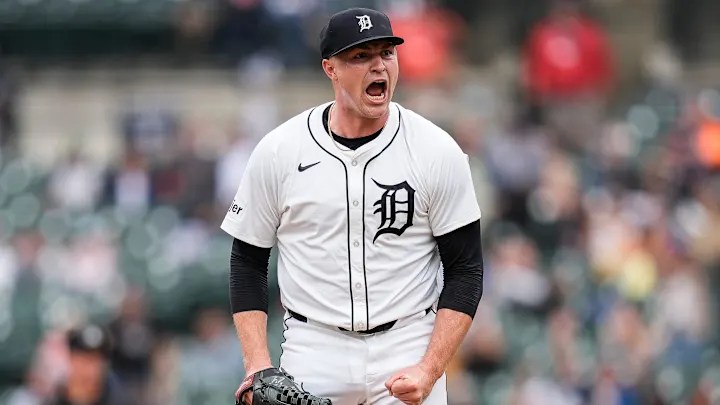
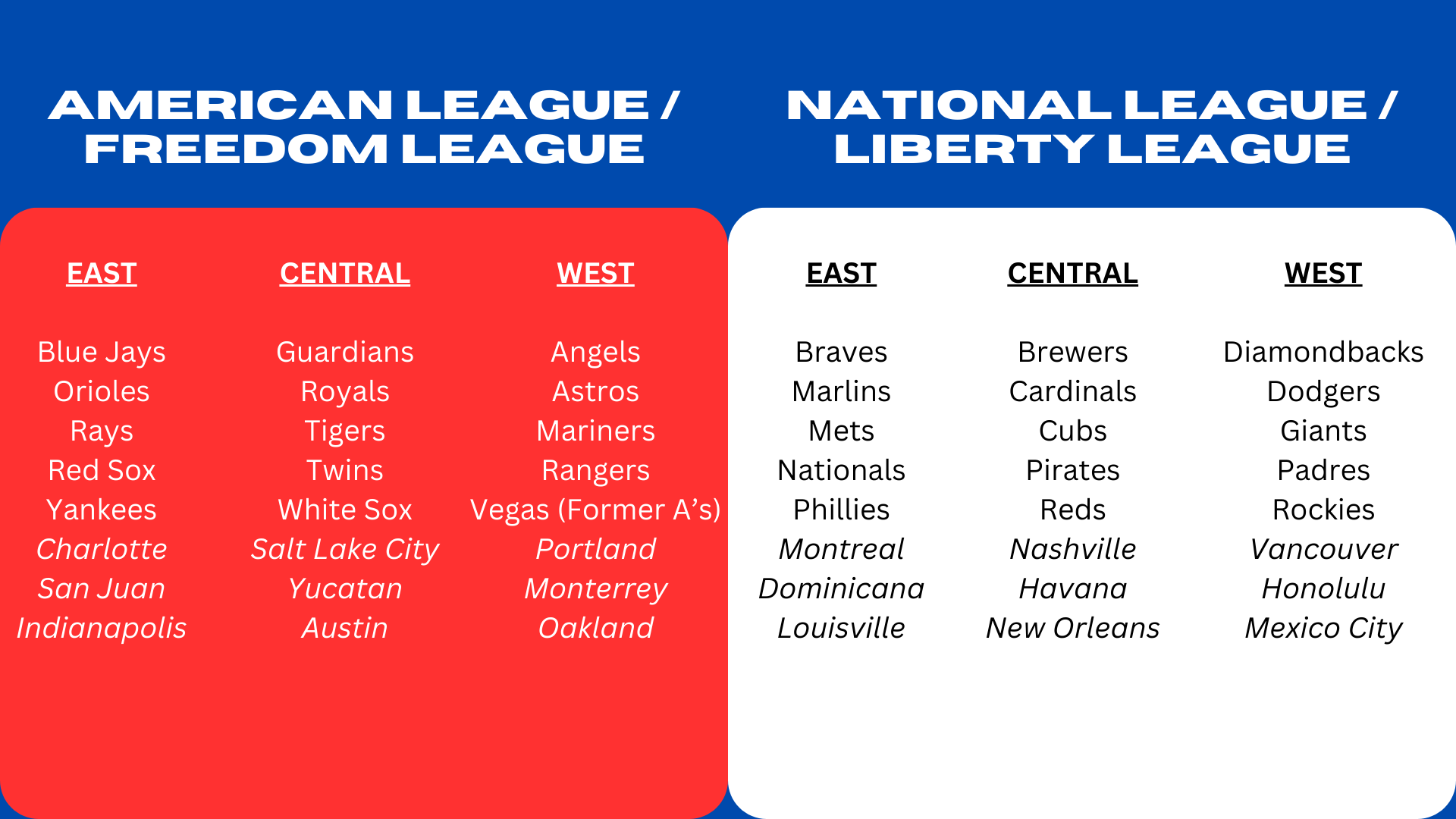
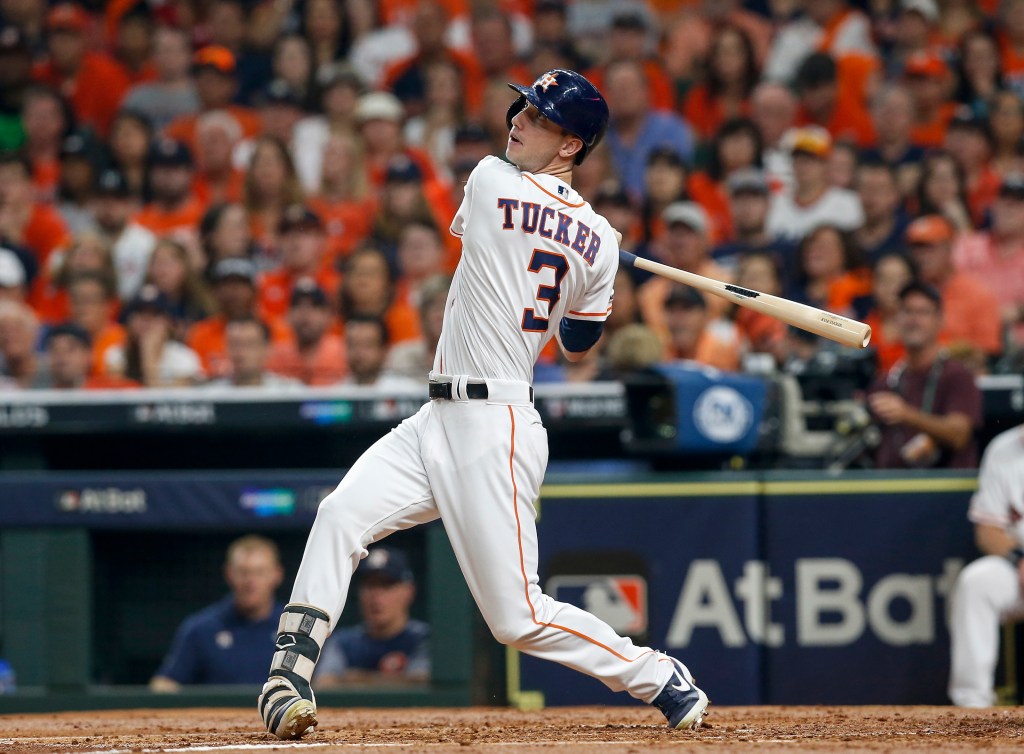
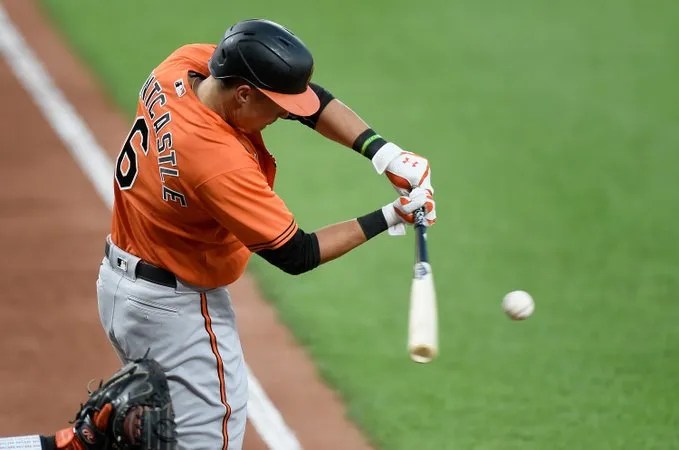

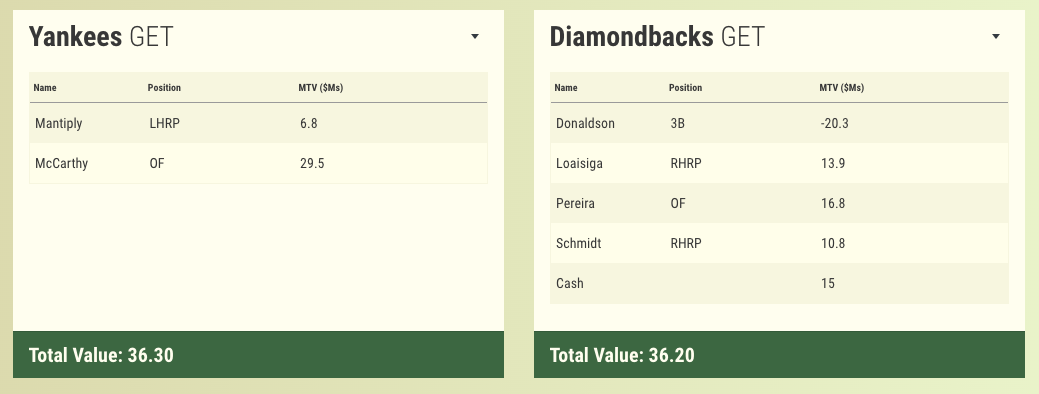
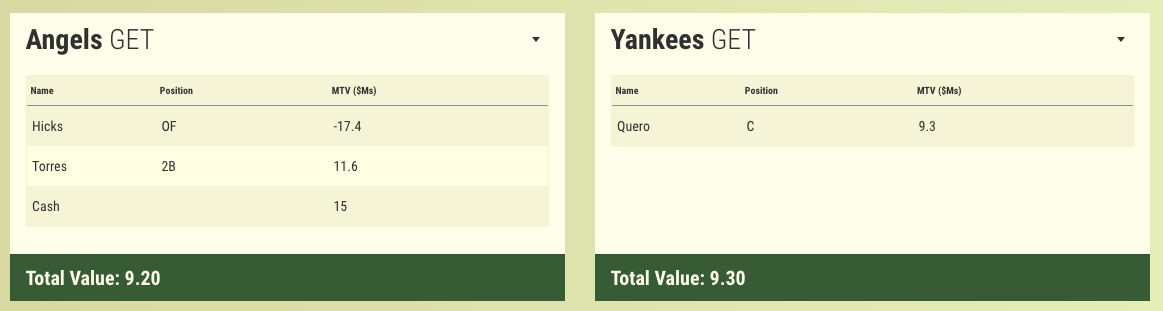
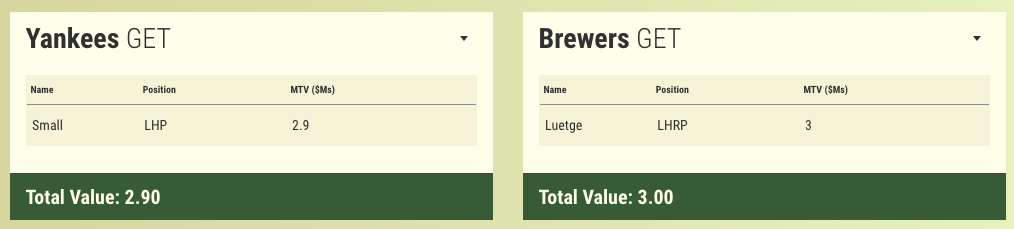
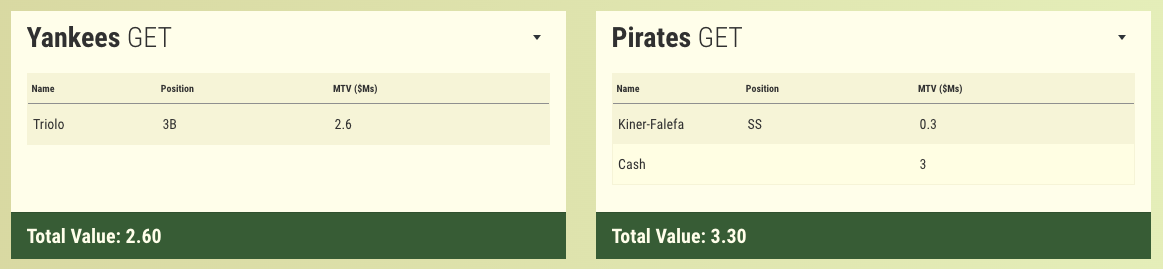
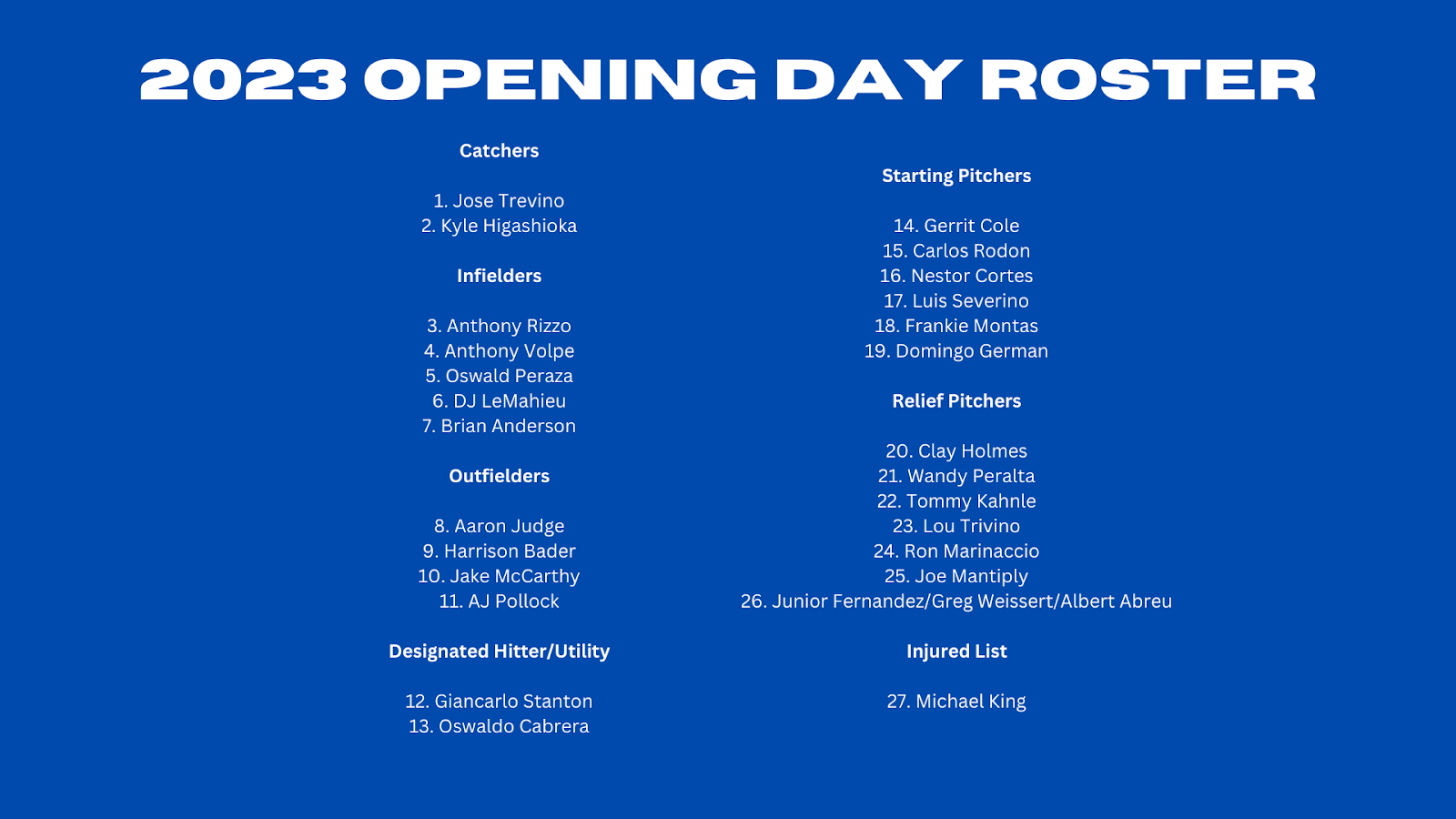
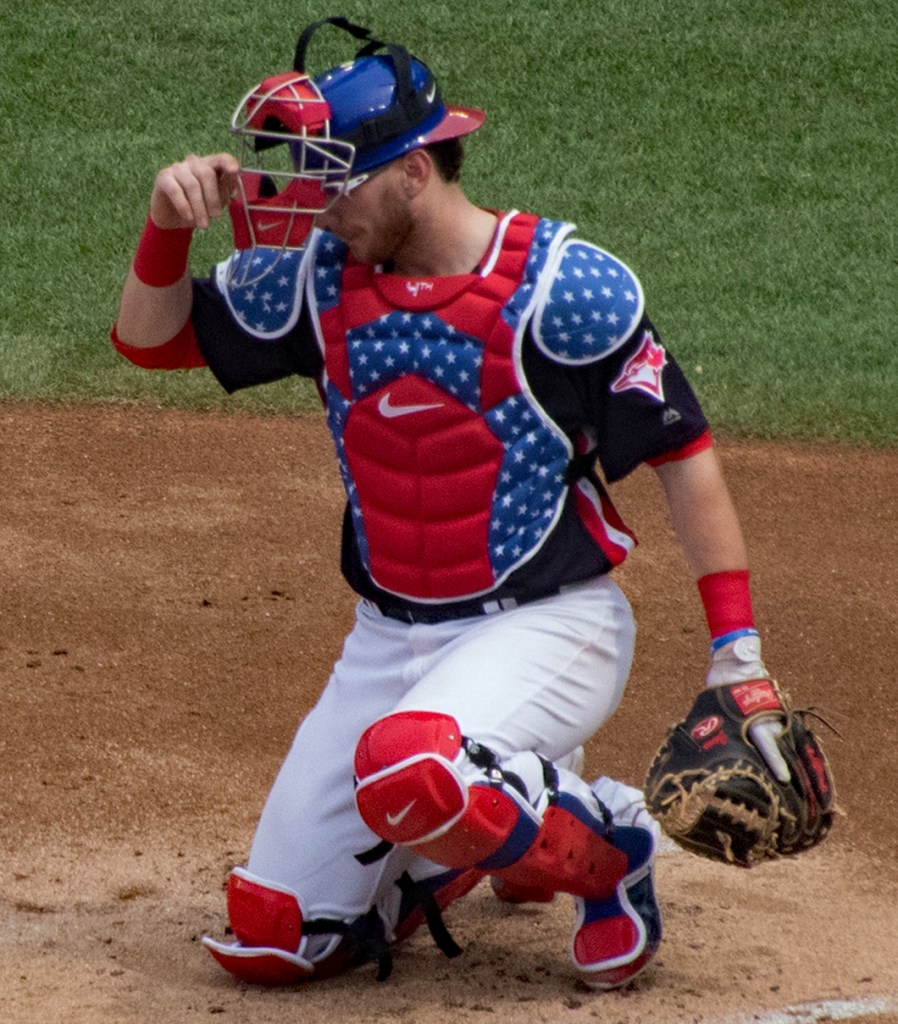

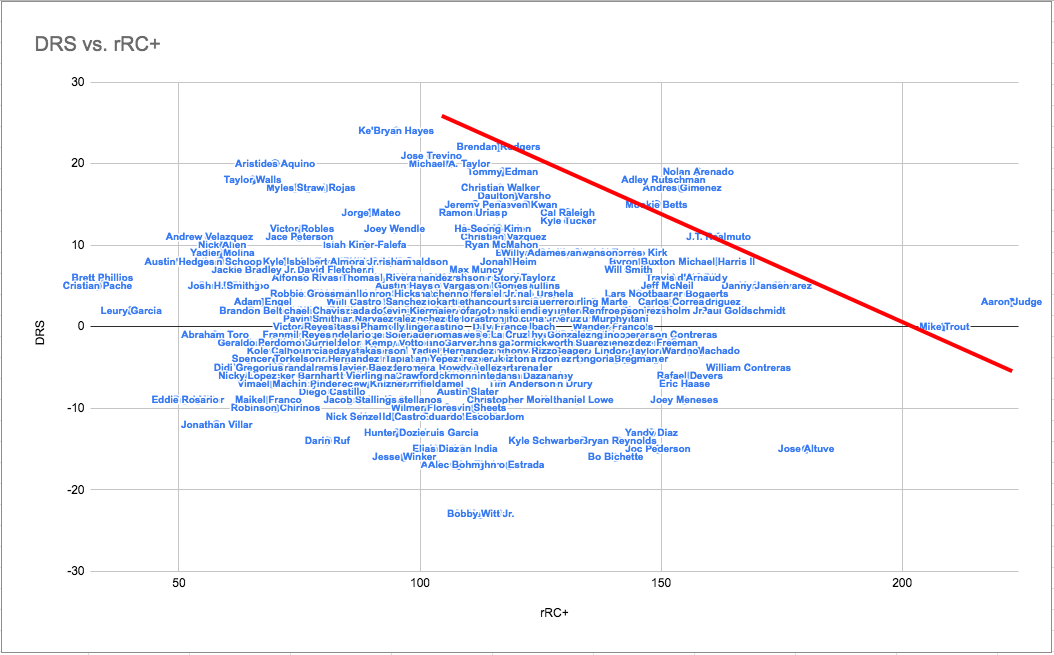
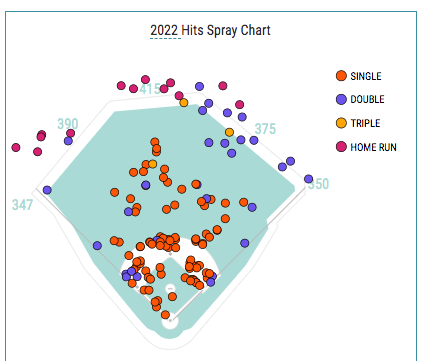
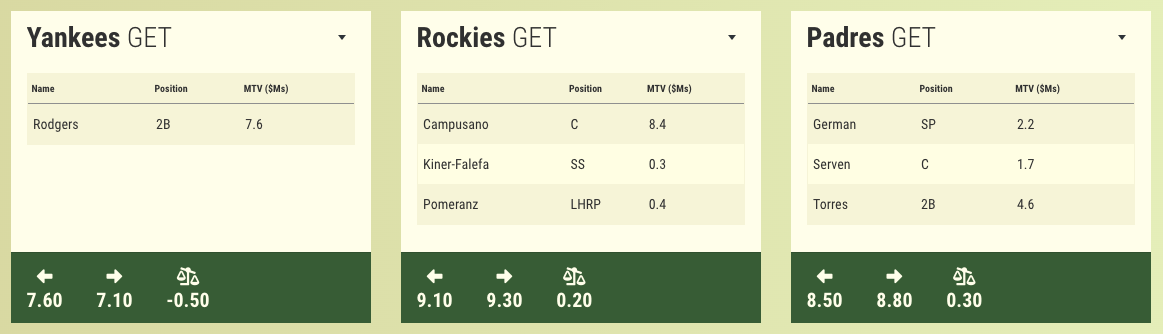
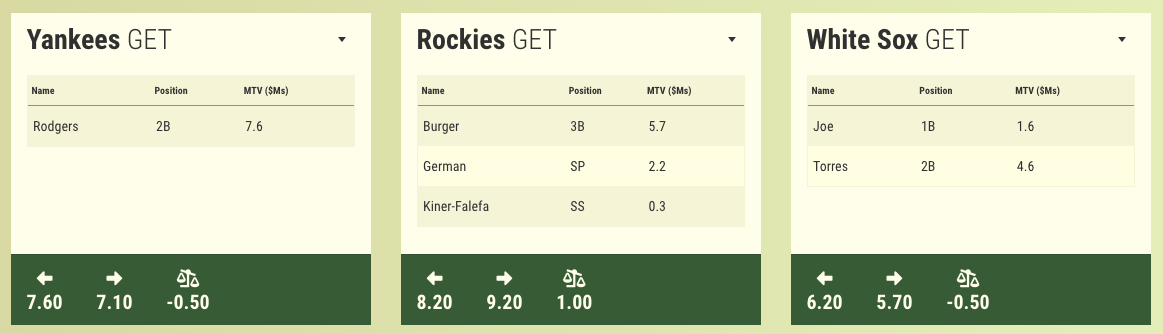
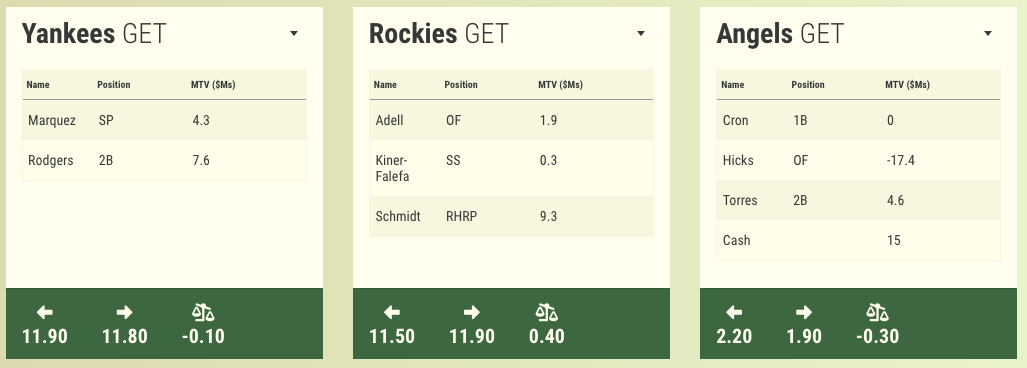


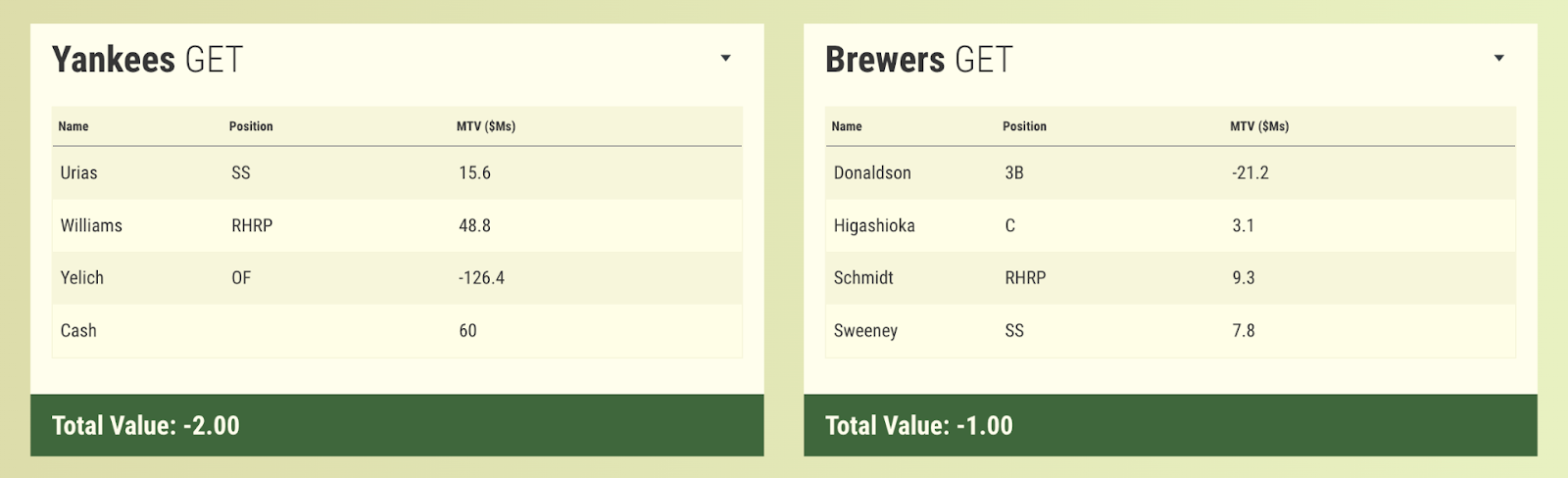
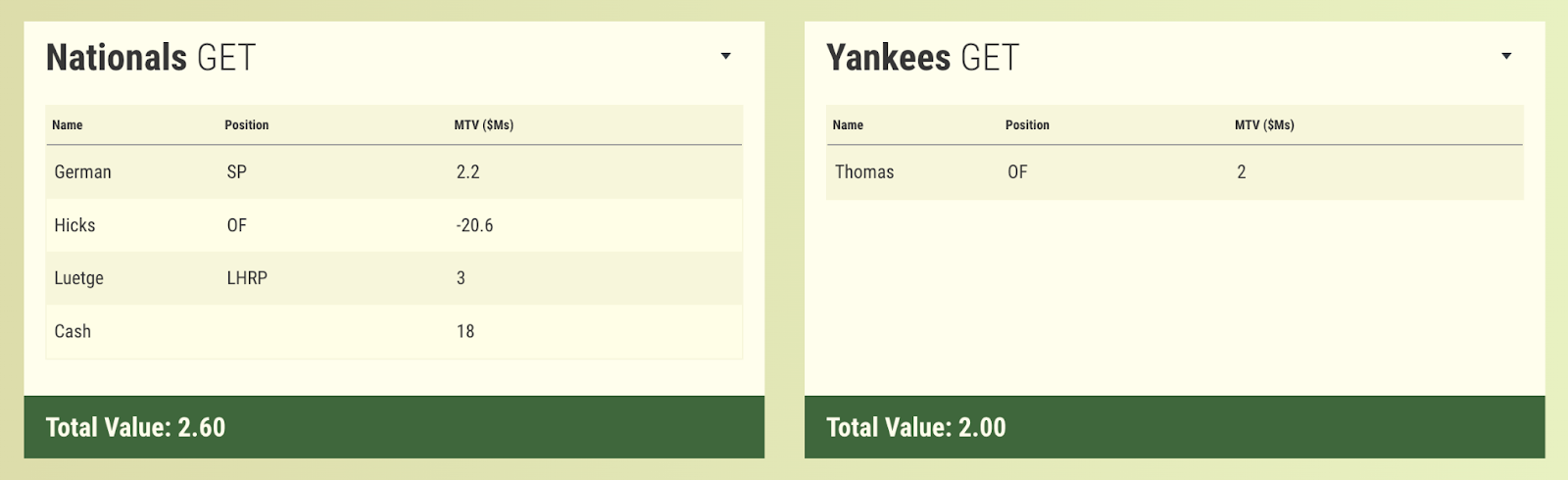

 Epiblogue