NFL, Read

2025 NFL Draft – Top 30 Big Board

  1. Will Campbell, OT, LSU

Tweet-Length Summary: Former 5-star with 3 years of battles under his belt starting in the SEC. The arm length, sure. But also 6’6, 320lbs, plus an excellent athlete. Hands are so good, crazy grip strength, naturally executes different techniques, and no doubt he’s nasty enough. This is a blue-chip.

Pro Comp: Range at OT…Jordan Gross to Joe Thomas / Range at OG…Brandon Scherff to Zack Martin

  1. Ashton Jeanty, RB, Boise State

Tweet-Length Summary: 2024 stats say enough about Jeanty’s special running talents. Where he deserves MORE credit: laughably good in 2023 too; he’s a fantastic receiver. Jeanty isn’t a freak like Herschel Walker or Adrian Peterson but in same Tier 1 as a RB with wizardry like Sanders/Faulk/Tomlinson.

Pro Comp: Emmitt Smith

  1. Travis Hunter, CB/WR, Colorado

Tweet-Length Summary: After endless discourse I still 1) prefer Hunter at CB > WR 2) don’t buy full snap counts on both sides in NFL. And yet he ranks here. Could’ve been my WR1, but instead I’ll boast that he’s a supremely smart CB with obviously good ball skills who moves like very few others.

Pro Comp: Derek Stingley Jr x Jameson Williams (as primary WR, I buy the Garrett Wilson comp)

  1. Abdul Carter, EDGE, Penn State

Tweet-Length Summary: Tenacious with absurd twitch plus remarkably high energy. Wins around corner with bend and speed, draws penalties, IOL don’t have a chance to stick with him. Bit small for EDGE and not the most dominant down-to-down player, but Carter will make at least one big play every game.

Pro Comp: Clay Matthews III

  1. Josh Conerly Jr, OT, Oregon

Tweet-Length Summary: Like another Duck in Christian Gonzalez in 2023, I’m pretty confident everyone is getting it wrong with Conerly. He’s probably going Round 1, but he’s a lottery pick talent. Former 5-star, great frame, excellent mover, on-field arrow pointing straight up. “My guy” in this class.

Pro Comp: Jammal Brown

  1. Shemar Stewart, EDGE, Texas A&M

Tweet-Length Summary: All-time athlete for DL, immediately clear ON TAPE that Stewart has the full toolkit. Skilled and powerful, sudden, quick hands, no question about effort. Ascendant 3-down player, slimmed down for Senior Bowl to show ceiling. Don’t conflate college sack total with production.

Pro Comp: Cameron Jordan

  1. Cam Ward, QB, Miami

Tweet-Length Summary: Ward is an experienced gambler who bets right more than wrong. Has a freaking whip of an arm, no throw is off the table given his skills. Strong and rugged. Will force some impossible throws and needs better consistency, but this is a natural-born QB. Round 1 pick in ANY draft.

Pro Comp: Steve McNair (Floor: Ryan Fitzpatrick)

  1. Nick Emmanwori, SAF, South Carolina

Tweet-Length Summary: After one of best Combines of all time, no hyperbole, I expected Emmanwori’s tape to be a mixed bag. Not the case. He’s a weapon in disguised coverages who can drop in an instant. Pure safety through and through despite looking like a linebacker. Smart, can hit, can cover. Buy in.

Pro Comp: Adrian Wilson

  1. Mason Graham, DT, Michigan

Tweet-Length Summary: For such a heavily debated prospect, Graham’s game is simple IMO. More stout and skilled than fast and twitchy. More of an every down nuisance than a game wrecker. Very heavy anchor, quick hands, savvy, crazy hot motor. Always finishing plays, every team would be lucky to have him.

Pro Comp: Christian Wilkins

  1. Will Johnson, CB, Michigan

Tweet-Length Summary: Johnson is composed, loose-hipped, and has great eyes with everything in front of him. Playmaker, extremely adept at passing off coverage assignments. Not that quick or fast and will compensate with grabbing. “Lose battles, win the war” type of CB, very high ceiling in right scheme.

Pro Comp: Aqib Talib

  1.  Jahdae Barron, CB, Texas

Tweet-Length Summary: Feisty and obviously smart, Barron’s 2024 tape is as good as anybody’s in this class. Holds his own as outside CB. Teams were done throwing at him by the CFP. There are gripes: not tightest man coverage, could attack ball better, iffy tackling form. But he’s a baller who’s always in right place.

Pro Comp: Byron Murphy

  1. Matthew Golden, WR, Texas

Tweet-Length Summary: Golden is SO sudden with very quick feet. Has ball skills, can go up and high point it. Actually a decent blocker for his frame. He will let balls too into his body, releases still lack nuance, and 4.29 40 speed doesn’t totally show on tape. He’s a raw but tantalizing talent.

Pro Comp: Derrick Mason

  1. Tyler Warren, TE, Penn State

Tweet-Length Summary: Athletic and fearless receiver, talented and powerful blocker. Huge catch radius, made some absurd grabs. Lacks special game speed, some teams were able to corral him (Ohio State). Right now I’d call Warren a GOOD blocker with GOOD hands. But there’s room for him to grow too.

Pro Comp: Kyle Rudolph

  1. Armand Membou, OT, Missouri

Tweet-Length Summary: Membou is extremely explosive with composed feet in pass protection. Immediately clear he’s a zone blocking weapon. Lot to work on: can find him looking where to go, vulnerable to inside pass rush, not consistently sticky with hands. Improved as season went on.

Pro Comp: Taylor Moton

  1. Josh Simmons, OT, Ohio State

Tweet-Length Summary: Don’t think Simmons is an amazing athlete but his movement is very fluid and controlled. Good in space and can definitely move people. Definitely skill > technique right now, needs to develop with his hands. Has injury and attitude question marks, but if right he’s a no doubt NFL OT.

Pro Comp: Laremy Tunsil

  1. Derrick Harmon, DT, Oregon

Tweet-Length Summary: Harmon is a pressure machine. Disruptive pass rusher who fires out of stance with strong and quick hands. Not a very good down-to-down run defender, nor is he as versatile as Oregon used him. Clearly best at 4-tech so maybe not for everyone, but easy first-rounder in right scheme.

Pro Comp: Christian Barmore

  1. Colston Loveland, TE, Michigan

Tweet-Length Summary: Loveland is young (just turned 21) so he has more to learn, but he plays at full speed. Good at being QB friendly. Even if not the most technically sound blocker, he’s a scrapper. Not sure he has NFL level strength advantage at top of routes. 2024 stats mean nothing, QB was terrible.

Pro Comp: TJ Hockenson

  1. Jalon Walker, EDGE, Georgia

Tweet-Length Summary: Loves tackling and hits like he’s made of bricks. Advanced pass rusher, especially out of full time position. Stays active throughout full rep. Walker isn’t the freakish hybrid LB we’ve come to expect in recent years. Clear why UGA played him at LB, SHOULD play EDGE but very short.

Pro Comp: Melvin Ingram

  1. Jalen Milroe, QB, Alabama

Tweet-Length Summary: Milroe is just a phenomenal runner. Arm is fine! Nice deep touch, has enough anticipation. Ball placement isn’t special but good enough putting ball on guys; he hits his layups. Yes, questionable surveying field, needs to improve diagnosing things in front of him. But I like him.

Pro Comp: Vince Young

  1. James Pearce Jr, EDGE, Tennessee

Tweet-Length Summary: Good speed, packs some punch despite weight. Length = many easy pressures. Definitely has some twitch and hand quickness. Multiple perfect snap timing jumps on film. Engages in too much contact for his frame and isn’t very good countering. Can get totally manhandled vs the run.

Pro Comp: Randy Gregory

  1. Kelvin Banks Jr, OT, Texas

Tweet-Length Summary: Banks is a likable watch, enthusiastic and plays hard. Good athlete but not a freak or anything. Fires out of his stance, fluid movement. Despite 3 years of starting experience, still a work in progress. Feet aren’t synced up enough, iffy balance/control. Could be better at OG.

Pro Comp: Laken Tomlinson

  1. Shedeur Sanders, QB, Colorado

Tweet-Length Summary: Smart QB, strong decision maker with very good internal clock. Pre-snap recognition is there, anticipatory, adapts quickly after mistakes. Good touch, can stick it on his WRs. But his arm is otherwise mediocre. Doesn’t offer much with legs, not even play extension. Floor is LOW.

Pro Comp: Jimmy Garoppolo

  1. Kenneth Grant, DT, Michigan

Tweet-Length Summary: Mammoth DT who will appeal to teams as young, durable, and capable vs run and pass. Grant has superpower of getting his hands up for PBUs. Don’t think he’s a specimen despite size. Pretty slow off the snap, not necessarily easy power. Looked nothing like first-rounder at times.

Pro Comp: Jordan Phillips

  1. Tetairoa McMillan, WR, Arizona

Tweet-Length Summary: McMillan is a fluid mover for his 6’4 size. Really good at catching the ball in stride and can deceptively change gears. Despite highlights, hands actually don’t seem all that great. Definitely slow off the LOS, maybe just flat out NFL slow. Blocking is shaky at best. X-only WR.

Pro Comp: Plaxico Burress

  1. Mykel Williams, EDGE, Georgia

Tweet-Length Summary: Let’s start low with Williams. Doesn’t play with  most juice, doesn’t go through blockers like you’d want. His hands in pass rush aren’t there yet, and he’s not even a disruptive rusher schemed vs IOL. But he’s 20 with tree trunk arms and enticing flashes at UGA. He’s going high.

Pro Comp: Preston Smith

  1. Luther Burden, WR, Missouri

Tweet-Length Summary: Burden is an easy book to judge by its cover. Former 5-star, looked like a star on good 2023 offense, looked bored on worse 2024 offense. Doesn’t do enough to help QB, needs way better understanding of route nuance. Bad blocker. Don’t love game speed. But…some elite ability, so maybe all moot.

Pro Comp: DJ Moore

  1. Jihaad Campbell, LB, Alabama

Tweet-Length Summary: Campbell is a reliable gap filler vs the run and firmly above average for a LB prospect in man coverage. Overall rock solid tackler. Being a 6’3 LB can be a disadvantage IMO and he’s not at all suited for EDGE despite that hype. But still 21, will keep getting sharper with reps.

Pro Comp: De’Vondre Campbell

  1. Malaki Starks, DB, Georgia

Tweet-Length Summary: Starks was the hardest evaluation for me in this whole class. His length and frame are a real plus in coverage, and he’s SMOOTH flipping his hips and running. But I just don’t believe in his tape + tools in a few areas: deep safety, press slot coverage, blitzing. He might be a CB!

Pro Comp(s): Rasul Douglas

  1. Walter Nolen, DT, Ole Miss

Tweet-Length Summary: Nolen has good bend and lateral movement for 300 pounds. Can explode out of stance. Like his effort. He plays undersized though, loses pad level too much for subpar height. Rarely stacks his blockers. Go-to pass rush move is just pushing with legs driving. Purely a 3-tech.

Pro Comp: Kobie Turner

  1. Donovan Jackson, OT/OG, Ohio State

Tweet-Length Summary: Rare true hybrid, Jackson cemented his status as an Ohio State legend by playing LT well. Tough, durable, even was involved in setting protections. As a prospect, he’s a great run blocker who’s long and strong. Changing direction isn’t easy for him so his ceiling is capped.

Pro Comp: Jermaine Eluemunor

NFL, Read

2025 NFL Draft – FINAL PREDICTIVE Mock Draft

  1. TEN: Cam Ward
  2. CLV: Travis Hunter
  3. NYG: Abdul Carter
  4. NE: Will Campbell
  5. JAX: Ashton Jeanty
  6. LV: Armand Membou
  7. NYJ: Tyler Warren
  8. CAR: Jalon Walker
  9. NO: Mykel Williams
  10. CHI: Kelvin Banks Jr
  11. SF: Mason Graham
  12. DAL: Tet McMillan
  13. MIA: Jahdae Barron
  14. IND: Colston Loveland
  15. ATL: Shemar Stewart
  16. ARZ: Will Johnson
  17. CIN: Mike Green
  18. SEA: Matthew Golden
  19. TB: Jihaad Campbell
  20. DEN: Omarion Hampton
  21. PIT: Shedeur Sanders
  22. LAC: Walter Nolen
  23. GB: Maxwell Hairston
  24. MIN: Malaki Starks
  25. HOU: Josh Simmons
  26. LAR: Trey Amos
  27. BAL: Kenneth Grant
  28. DET: Donovan Ezeiruaku
  29. WSH: James Pearce Jr
  30. BUF: Derrick Harmon
  31. KC: Josh Conerly Jr
  32. PHI: Nick Emmanwori
MLB, Read

The Win/Loss Project

The MVP decisions in baseball this season will inevitably go down as some of the least dramatic in the history of the sport: Aaron Judge will win in the American League and Shohei Ohtani will win in the National League. 

And yet, while Ohtani has been the NL’s frontrunner for months now, his coronation wasn’t such a sure thing a few weeks ago. Francisco Lindor kept the race alive with his excellent and often clutch two-way play leading the Mets’ late charge into the playoff picture. Ohtani shut the door on debate with his otherworldly September, but not early enough for me – and likely others – to ask the question: can we quantify Lindor’s impact on Mets wins compared to Ohtani’s impact on Dodgers wins?

It’s not only a fair proposition with Ohtani being a full-time DH in 2024 compared to Lindor being a shortstop (and an elite one); it’s also a mostly fair question to pose on the basis of the Dodgers not exactly needing Ohtani heading into this season. They have Mookie Betts and Freddie Freeman and Teoscar Hernandez and Will Smith in the lineup too, and they had made the playoffs in 11 consecutive seasons with NL West titles in 10 of them. The Mets, on the other hand, have only made the playoffs twice since 2015, and they didn’t escape the Wild Card Round in either of those years. And while they have several above-average offensive players, Lindor is basically lapping his next-closest teammates in overall value on the season.

That note on player value brings us to WAR (Wins Above Replacement), which I have zero intent of dissing in this exercise. WAR, simply put, is one of the greatest statistical advancements in MLB’s long history. It does an excellent job of encapsulating one player’s total and well-rounded worth to his team’s win/loss record compared to the average Triple-A player they could call up in his place. Award voting in baseball still has its blemishes, but WAR has led the charge away from the days of MVP travesties like Justin Morneau over Derek Jeter or Juan Gonzalez over Alex Rodriguez because the winning players drove in more runs.

And yet, it does feel like we’ve entered a realm where the pendulum has swung too far and WAR is now the end-all-be-all stat for MVP discourse. Like I’ve established, it’s a great stat, but there is admittedly something lame about a baseball stat that you can’t visualize on the field itself. Also, it’s definitely weird that WAR is defined differently, and not minor differences in some cases, by its two sources: Baseball Reference and FanGraphs. Add in the consideration that advanced defensive stats, albeit improving yet still murky at best, are a key component of WAR, and it’s not hard to understand why it would be nice to have an alternate counter for player wins.

That brings us to WPA (Win Probability Added), another imperceivable yet valuable and easy to understand stat: how much – by fractions of 100% – did a player’s directly responsible plays add or detract from his team’s mathematical odds of winning that game? Cumulative WPA is a solid stat and does receive some attention from voters during awards season, but I chose to instead investigate WPA on a game-by-game basis. Because, at the end of the day, baseball is unique in its 162-game season that still always comes down to 1 or 2 games for many teams on either the right or wrong side of the postseason bracket. 

Also, I do think it’s fun that MLB currently faces somewhat of an inverse groupthink situation compared to other sports, including football at both the professional and college levels. In those sports, to much public outcry, the MVP/Heisman is usually handed to the quarterback on the best team regardless if he was actually the “best” player in the sport. Meanwhile, largely due to WAR in baseball, MVPs are usually given to the most dominant player across all innings regardless of his circumstances. There is practically nonexistent distinction for whether WAR-generating plays occurred in the 1st vs 9th innings or in back-and-forth vs blowout contests. Moments should matter though, and – aside from usually rewarding a player from a playoff team – we have lost sight of that in recent years.

Without further ado, the Win/Loss Project aims to give “wins” to ANY player – not just a pitcher like in standard baseball scorekeeping – with the most WPA in a team win. “Losses,” therefore, are handed to ANY player with the most reduced WPA in a team loss.

Below are the standings for each of MLB’s 12 playoff teams for the 2024 season (with bonus inclusion for the on-the-bubble Arizona Diamondbacks eliminated on the final Monday of the regular season). You’ll find individual “wins” as its own category, especially worthwhile for anyone like myself who has not thought about pitcher wins in at least a decade. More significantly, however, should be the “win/loss differential” statistic; in its ideal and intended use case, you can stack that number directly against WAR to measure individual player value in a different way. (Example, Aaron Judge is an 11 WAR player and a 9 WPA W/L player.)

NEW YORK YANKEES (94-68)

TOP 5, WINS

  1. Aaron Judge: 12
  2. Carlos Rodon: 9
  3. Juan Soto: 8
  4. Nestor Cortes: 8
  5. Luis Gil: 7

TOP 5, WIN/LOSS DIFFERENTIAL

  1. Aaron Judge: +9
  2. Juan Soto: +7
  3. Ian Hamilton: +4
  4. Luis Gil: +3
  5. Alex Verdugo: +3
  6. Austin Wells: +3

BOTTOM 5, WIN/LOSS DIFFERENTIAL

  • Marcus Stroman: -2
  • Tommy Kahnle: -2
  • Anthony Rizzo: -2
  • Caleb Ferguson: -2
  • Victor Gonzalez: -2
  • Will Warren: -3
  • Clay Holmes: -5

CLEVELAND GUARDIANS (92-69)

TOP 5, WINS

  1. Jose Ramirez: 10
  2. David Fry: 8
  3. Josh Naylor: 8
  4. Tanner Bibee: 7
  5. Andres Gimenez: 6
  6. Emmanuel Clase: 6
  7. Jhonkensy Noel: 6

TOP 5, WIN/LOSS DIFFERENTIAL

  1. David Fry: +8
  2. Jose Ramirez: +7
  3. Josh Naylor: +6
  4. Emmanuel Clase: +6
  5. Jhonkensy Noel: +6

BOTTOM 5, WIN/LOSS DIFFERENTIAL

  • Logan Allen: -3
  • Xzavion Curry: -3
  • Gavin Williams: -4
  • Scott Barlow: -4
  • Nick Sandlin: -5
  • Carlos Carrasco: -7

HOUSTON ASTROS (88-73)

TOP 5, WINS

  1. Framber Valdez: 12
  2. Hunter Brown: 11
  3. Ronel Blanco: 9
  4. Yordan Alvarez: 8
  5. Alex Bregman: 7

TOP 5, WIN/LOSS DIFFERENTIAL

  1. Framber Valdez: +9
  2. Hunter Brown: +5
  3. Ronel Blanco: +5
  4. Yordan Alvarez: +5
  5. Alex Bregman: +5

BOTTOM 5, WIN/LOSS DIFFERENTIAL

  • Justin Verlander: -2
  • Kyle Tucker: -2
  • JP France: -2
  • Rafael Montero: -2
  • Tayler Scott: -3
  • Ryan Pressly: -3
  • Spencer Arrighetti: -4
  • Bryan Abreu: -4

BALTIMORE ORIOLES (91-71)

TOP 5, WINS

  1. Anthony Santander: 10
  2. Gunnar Henderson: 7
  3. Albert Suarez: 7
  4. Ryan Mountcastle: 6
  5. Cole Irvin: 6

TOP 5, WIN/LOSS DIFFERENTIAL

  1. Anthony Santander: +7
  2. Gunnar Henderson: +6
  3. Adley Rutschman: +4
  4. Cedric Mullins: +4
  5. Ryan Mountcastle: +3
  6. Heston Kjerstad: +3
  7. Zach Eflin: +3
  8. Ryan O’Hearn: +3

BOTTOM 5, WIN/LOSS DIFFERENTIAL

  • Yennier Cano: -2
  • Cionel Perez: -2
  • Tyler Wells: -2
  • Trevor Rogers: -2
  • Cade Povich: -3
  • Keegan Akin: -4
  • Dean Kremer: -5
  • Craig Kimbrel: -5

KANSAS CITY ROYALS (86-76)

TOP 5, WINS

  1. Seth Lugo: 11
  2. Bobby Witt Jr: 9
  3. Sal Perez: 8
  4. Brady Singer: 8
  5. Michael Wacha: 7
  6. Cole Ragans: 7

TOP 5, WIN/LOSS DIFFERENTIAL

  1. Bobby Witt Jr: +8
  2. Seth Lugo: +6
  3. Sal Perez: +4
  4. Michael Wacha: +4
  5. Adam Frazier: +4

BOTTOM 5, WIN/LOSS DIFFERENTIAL

  • Alec Marsh: -3
  • Sam Long: -3
  • Will Smith: -3
  • Angel Zerpa: -3
  • Chris Stratton: -4
  • James McArthur: -6

DETROIT TIGERS (86-76)

TOP 5, WINS

  1. Tarik Skubal: 13
  2. Wenceel Perez: 6
  3. Colt Keith: 6
  4. Riley Greene: 4
  5. Matt Vierling: 4
  6. Beau Brieske: 4
  7. Keider Montero: 4

TOP 5, WIN/LOSS DIFFERENTIAL

  1. Tarik Skubal: +11
  2. Wenceel Perez: +5
  3. Colt Keith: +4
  4. Matt Vierling: +3
  5. Andy Ibanez: +3

BOTTOM 5, WIN/LOSS DIFFERENTIAL

  • Reese Olson: -2
  • Will Vest: -2
  • Joey Wentz: -2
  • Andrew Chafin: -3
  • Alex Faedo: -4
  • Shelby Miller: -5
  • Kenta Maeda: -6

LOS ANGELES DODGERS (98-64)

TOP 5, WINS

  1. Shohei Ohtani: 11
  2. Teoscar Hernandez: 10
  3. Gavin Stone: 7
  4. Will Smith: 7
  5. Freddie Freeman: 5
  6. James Paxton: 5
  7. Max Muncy: 5
  8. Mookie Betts: 5
  9. Tyler Glasnow: 5
  10. Kike Hernandez: 5

TOP 5, WIN/LOSS DIFFERENTIAL

  1. Shohei Ohtani: +10
  2. Teoscar Hernandez: +8
  3. Will Smith: +6
  4. Freddie Freeman: +4
  5. Max Muncy: +4
  6. Kike Hernandez: +4

BOTTOM 5, WIN/LOSS DIFFERENTIAL

  • Walker Buehler: -3
  • Daniel Hudson: -3
  • Michael Grove: -3
  • Yohan Ramirez: -3
  • Bobby Miller: -4

PHILADELPHIA PHILLIES (95-67)

TOP 5, WINS

  1. Zack Wheeler: 11
  2. Ranger Suarez: 9
  3. Aaron Nola: 7
  4. Christopher Sanchez: 7
  5. Alec Bohm: 7

TOP 5, WIN/LOSS DIFFERENTIAL

  1. Zack Wheeler: +7
  2. Alec Bohm: +7
  3. Kyle Schwarber: +5
  4. Christopher Sanchez: +4
  5. Ranger Suarez: +3
  6. Nick Castellanos: +3

BOTTOM 5, WIN/LOSS DIFFERENTIAL

  • Seranthony Dominguez: -1
  • Connor Brogdon: -1
  • Jose Ruiz: -1
  • Johan Rojas: -1
  • Seth Johnson: -1
  • Michael Mercado: -2
  • Jeff Hoffman: -3
  • Taijuan Walker : -6

MILWAUKEE BREWERS (93-69)

TOP 5, WINS

  1. Willy Adames: 9
  2. William Contreras: 8
  3. Rhys Hoskins: 8
  4. Jackson Chourio: 7
  5. Tobias Myers: 7

TOP 5, WIN/LOSS DIFFERENTIAL

  1. William Contreras: +6
  2. Jackson Chourio: +6
  3. Tobias Myers: +6
  4. Rhys Hoskins: +5
  5. Willy Adames: +3
  6. Christian Yelich: +3
  7. Blake Perkins: +3
  8. Sal Frelick: +3

BOTTOM 5, WIN/LOSS DIFFERENTIAL

  • Joe Ross: -2
  • Joel Payamps: -2
  • Carlos Rodriguez: -2
  • Brice Turang: -3
  • Hoby Milner: -4
  • Elvis Peguero: -6

SAN DIEGO PADRES (93-69)

TOP 5, WINS

  1. Dylan Cease: 12
  2. Michael King: 10
  3. Jurickson Profar: 8
  4. Jackson Merrill: 8
  5. Jake Cronenworth: 7

TOP 5, WIN/LOSS DIFFERENTIAL

  1. Dylan Cease: +7
  2. Jackson Merrill: +7
  3. Jurickson Profar: +6
  4. Jake Cronenworth: +4
  5. Michael King: +3
  6. Fernando Tatis Jr: +3
  7. Kyle Higashioka: +3

BOTTOM 5, WIN/LOSS DIFFERENTIAL

  • Matt Waldron: -2
  • Randy Vasquez: -2
  • Jhony Brito: -2
  • Stephen Kolek : -2
  • Yuki Matsui: -2
  • Adam Mazur: -2
  • Enyel De Los Santos: -3
  • Wandy Peralta : -3

ATLANTA BRAVES (89-73)

TOP 5, WINS

  1. Chris Sale: 10
  2. Reynaldo Lopez: 8
  3. Max Fried: 8
  4. Spencer Schwellenbach: 7
  5. Charlie Morton: 6
  6. Matt Olson: 6

TOP 5, WIN/LOSS DIFFERENTIAL

  1. Chris Sale: +8
  2. Reynaldo Lopez: +6
  3. Jarred Kelenic: +5
  4. Max Fried: +4
  5. Raisel Iglesias: +4
  6. Travis d’Arnaud: +4

BOTTOM 5, WIN/LOSS DIFFERENTIAL

  • Pierce Johnson: -2
  • Bryce Elder: -2
  • Grant Holmes: -2
  • Whit Merrifield: -2
  • Aaron Bummer: -2
  • Allan Winans: -2
  • Jesse Chavez: -2
  • Hurston Waldrep: -2
  • Joe Jimenez: -3

NEW YORK METS (89-73)

TOP 5, WINS

  1. Francisco Lindor: 9
  2. Luis Severino: 8
  3. JD Martinez: 6
  4. Jose Quintana: 6
  5. Brandon Nimmo: 6

TOP 5, WIN/LOSS DIFFERENTIAL

  1. Francisco Lindor: +7
  2. JD Martinez: +6
  3. Brandon Nimmo: +6
  4. Jeff McNeil: +4
  5. Pete Alonso: +4
  6. Francisco Alvarez: +4

BOTTOM 5, WIN/LOSS DIFFERENTIAL

  • Huascar Brazoban: -2
  • Jake Diekman: -2
  • Jorge Lopez: -2
  • Michael Tonkin: -2
  • Reed Garrett: -3
  • Christian Scott : -3
  • Edwin Diaz: -5
  • Adrian Houser: -6

ARIZONA DIAMONDBACKS (89-73)

TOP 5, WINS

  1. Zac Gallen: 10
  2. Christian Walker: 7
  3. Brandon Pfaadt: 6
  4. Eugenio Suarez: 6
  5. Ketel Marte: 6

TOP 5, WIN/LOSS DIFFERENTIAL

  1. Christian Walker: +6
  2. Zac Gallen: +5
  3. Ketel Marte: +5
  4. Corbin Carroll: +3
  5. Joc Pederson: +3
  6. Randal Grichuk: +3
  7. Adrian Del Castillo: +3
  8. Gabriel Moreno: +3

BOTTOM 5, WIN/LOSS DIFFERENTIAL

  • Ryan Thompson: -2
  • Tommy Henry: -2
  • Bryce Jarvis: -2
  • Jordan Montgomery: -3
  • Justin Martinez: -4
  • Slade Cecconi: -5

For kicks, here’s how I would vote for the four major awards:

AL MVP

  1. Aaron Judge
  2. Bobby Witt Jr
  3. Tarik Skubal

NL MVP

  1. Shohei Ohtani
  2. Francisco Lindor
  3. Teoscar Hernandez

AL Cy Young

  1. Tarik Skubal
  2. Framber Valdez
  3. Seth Lugo

NL Cy Young

  1. Chris Sale
  2. Zack Wheeler
  3. Dylan Cease

NFL, Read

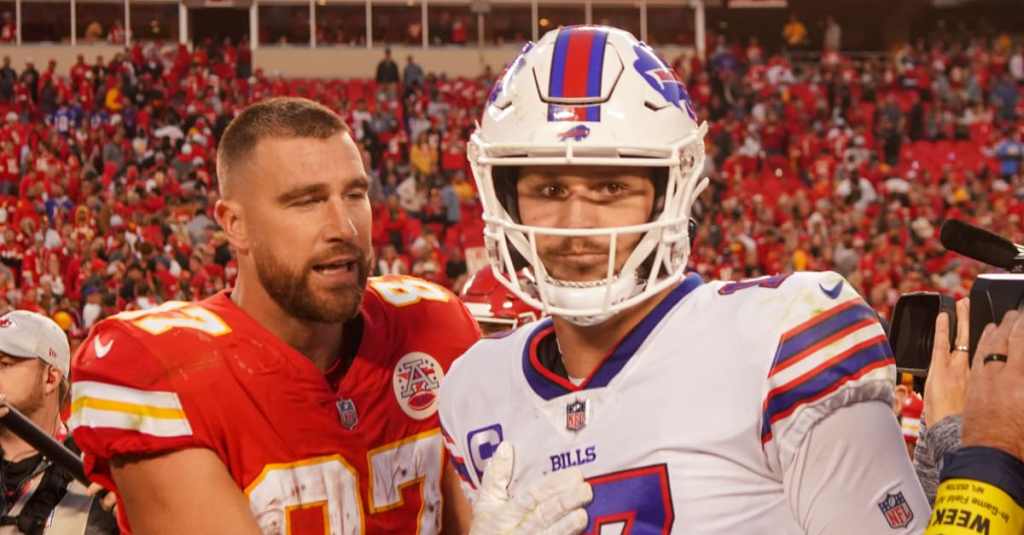
Is Josh Allen the new Travis Kelce of fantasy football? Not exactly…but kinda?!

From 2018 to 2022, Travis Kelce had one of the more uniquely dominant five-season stretches in fantasy football history. Kelce scored 1,440 PPR fantasy points across those five seasons; the second highest scoring tight end during that span, George Kittle, scored 1,005 total PPR points. That gap between Kelce and Kittle is larger than the gap between Kittle and the TE12 over that time (Mike Gesicki). On an annual basis, Kelce finished as the TE1, TE1, TE1, TE2, and TE1, respectively, among tight ends from 2018 to 2022.

With hindsight being 20/20, Kelce was worth a first-round pick in fantasy drafts heading into each of those seasons. There was no better edge than having Kelce on your roster putting up the numbers of a WR1 when your league-mates limped to 7 points per game out of their tight ends. The fantasy football collective gets a pass for not identifying Kelce’s first-round value heading into 2018, his true breakout season into fantasy superstardom; his ADP was 28th overall that year. His overall ADP (slightly) crept up over the next few years:

2019: 17

2020: 18

2021: 12

2022: 14

With the limited exception from 2021 following Kelce’s outrageous 105/1416/11 season in 2020, most drafters missed out on golden years from Kelce because they were too afraid to allocate their first picks to a tight end – even the most bankable tight end we’ve ever seen in fantasy football in his prime.

And now, only a couple of years later, it seems like something similar might be happening with another of the NFL’s biggest stars. Josh Allen has been the top fantasy quarterback since 2020 almost any way you slice it. Patrick Mahomes has done an admirable job keeping the QB1 race (somewhat) close, but he’s also masking the total dominance of Allen over every other QB. The 2020-2023 cumulative gap between Allen and the QB3 during that stretch (Justin Herbert) is larger than the gap between Herbert and the QB15 (Matt Stafford). Annually, Allen has finished as the QB1, QB1, QB2, and QB1 over the last four seasons. On the most surface level, it’s similar positional supremacy to Kelce at his peak.

This begs the question: should Josh Allen be in line for the first-round treatment that Travis Kelce deserved but only occasionally received from 2018-2022? Going off early indicators for 2024 drafts, it’s an even more controversial proposition for Allen than it ever was for Kelce; Allen’s current ADP average is 22nd overall! 

The arguments against taking a QB highly in drafts, let alone with a top pick, are well-documented: you only start one of them in standard formats, there are multiple elite options at the position (Mahomes, Jalen Hurts), etc. Mainly though, fantasy football is a game of trying to outwit the opposition at as many positions as possible rather than trying to accumulate the most points, which quarterbacks do best. Managers are looking for a game-breaker with their first-round pick, and unless there was a surefire 2010 Michael Vick or 2018 Lamar Jackson season heading into drafts, in theory it tracks to target a skill player.

To what end, though? If Josh Allen is performing that much ahead of other players at his position, when does it make sense to pull the trigger on him? Might we be getting this totally wrong?!

Let’s take names out of the equation for a moment and look at the basics for Top 10 finishers at primary fantasy positions over the last four years.

 QBRBWRTE
# of Top 10 annual finishers over 4 years24292624
# of Top 10 finishers in 4 of 4 years2 (Allen, Mahomes)02 (Tyreek Hill, Stefon Diggs)2 (Kelce, Mark Andrews)
# of Top 10 finishers in 3 of 4 years3 (+ Jalen Hurts)1 (Derrick Henry)4 (+ Justin Jefferson, Davante Adams)3 (+ George Kittle)
Standard Deviation, Top 10 Range1.19 – 3.112.30 – 3.181.91 – 2.341.65 – 3.00
Standard Deviation, Top 10 Four-Year Average1.962.712.342.43

·   Top 10 finishers by total points, THEN sorted by PPG (Half-PPR). Availability matters!

·   I am using 2019-2022 in this analysis for tight ends to mirror Travis Kelce’s four-year curve. For standard deviation measurements, the time frame remains 2018-2022.

So, what does this begin to tell us? First, do not draft Josh Allen before anyone who you legitimately believe might end the season as the overall RB1. Premier running backs will always offer the highest ceiling among players on the board in fantasy football. Especially at the very top of drafts with the Christian McCaffrey’s of the world available, the reward is likely worth the risk. (The RB cliff is STEEP though, and the bottom can just fall out for ANY running back.)

After that confirmation of elite RB value, a top observation is that QBs are, on average, the flattest position among Top 10 performers – something that, in theory, doesn’t bode well for the prospects of Josh Allen as a top fantasy pick. That said, the gap isn’t all that wide; in fact, it’s interesting to see that Top 10 WRs are positionally placed exactly between RBs and QBs in terms of four-year average variance when wideouts are much more frequently correlated with RBs than QBs. Also, while the flattest single season for one position in this span belonged to QBs – every Top 10 QB in 2020 averaged at least 21.9 PPG – the second HIGHEST variance season among all fantasy positions in this span also belonged to QBs! And if you believe in patterns, then you should note that QB has been MUCH more of a boom-or-bust position in the last two seasons than it was from 2020-2021. Just last season, Josh Allen outscored the QB10 (Baker Mayfield) by a whopping 7.5 PPG. To put that in perspective, that would be equivalent to the team with Mayfield having an extra roster spot with Dallas Goedert in it.

To start to culminate this exercise, let’s bring names back into the equation. In addition to Allen and Kelce, it’s great that we have consistent Top 10 data across all four years from Tyreek Hill and Stefon Diggs, too.

To reach the below percentages:

1.      For each season individually, I took that player’s PPG and subtracted it from the 3rd ranking player’s PPG. For example, in 2023 I took Josh Allen’s 24.2 PPG and subtracted Lamar Jackson’s 21.1 PPG from it.

2.      Whatever the difference – which could be positive, negative, or zero – I divided that by the standard deviation across the Top 10 in that particular season. Sticking with the above example, I divided 3.1 (QB1-QB3) by 2.27 (STDDEV) to reach 1.36, or 136%.

3.      I repeated the same for all four seasons in the span – five in the case of Kelce and tight ends – then also repeated against the 5th and 10th ranking players’ PPGs.

4.      I averaged out the percentages over the spans.

2020-2023 (QB/WR)
2018-2022 (TE)
AllenHillDiggsKelce
vs QB3/WR3/TE390%15%-97%130%
vs QB5/WR5/TE5172%106%-20%199%
vs QB10/WR10/TE10293%192%80%299%

These results are more of the eye-of-the-beholder type. Personally, however, I cannot ignore Tyreek Hill’s percentages here – which are indicative of the alpha fantasy wideout. Beyond being over 100% more bankable than the typical WR5 overall on a season and nearly 200% over the typical WR10, don’t sleep on how ridiculously impressive it is that Hill performed ON AVERAGE above the typical WR3 overall even when accounting for fluctuation across other performers at the position. When you look back to the first table and remember that WRs have, by far, the thinnest range of year-over-year outcomes compared to the other positions – plus the obvious consideration that most fantasy leagues require 3+ WRs in starting lineups now – it becomes harder and harder to build a good argument for taking Josh Allen over wideouts with a realistic shot at finishing as the overall WR1 – WR3 on the season.

Then things get interesting, though. For a Stefon Diggs type of fantasy wideout, a veteran with static year-over-year ADPs near the Round 1/Round 2 turn, that quite evidently is seldom a league-winning player but should return positive value as a WR1 for your particular fantasy team – just maybe not the overall rankings. Looking at current 2024 ADPs, players like AJ Brown or Davante Adams could fit this bill.

Again, this is where eye-of-the-beholder fantasy preferences and strategies take over. I wouldn’t fault any fantasy manager for taking an extremely reliable wideout like Brown with their first pick and then swinging for the fences with their second or third pick. But, I’ll also be real with this data staring me in the face, you might want to take Josh Allen instead if you are seeking a true league-winner with your top pick! (This logic would apply to the top TE too, but there isn’t a clear top dog at that position with a track record heading into 2024.)

So, let’s now answer the question that kicked this whole thing off: should Josh Allen be in line for the first-round treatment that Travis Kelce deserved but only occasionally received from 2018-2022? 

There isn’t one cut-and-dry answer, but I’d start with a “not exactly.” Kelce seriously was 1-of-1 when it came to year-over-year dominance over even the best of the best of his peers at the position. Especially in best ball formats or more casual leagues without many transactions or lineup changes, Allen doesn’t keep pace with peak Kelce as a set-and-forget fantasy machine.

When you begin to widen the parameters though, even slightly, my answer becomes more of “…kinda!” The gap between Allen and Kelce over their QB3/TE3 counterparts shrinks a lot once you zoom out to their QB5/TE5 counterparts, and then the gap is basically gone between them once you get to QB10/TE10 benchmarks! Meaning that, in redraft leagues of 10+ members, the numbers indicate that you would have a remarkably similar edge with Josh Allen that prime Travis Kelce offered over STARTERS in lineups across your league.

So yes, in the regard of being a more bankable force multiplier than the lowest tier of starters at the position, 2024 Josh Allen is right there with 2018-2022 Travis Kelce.

NFL

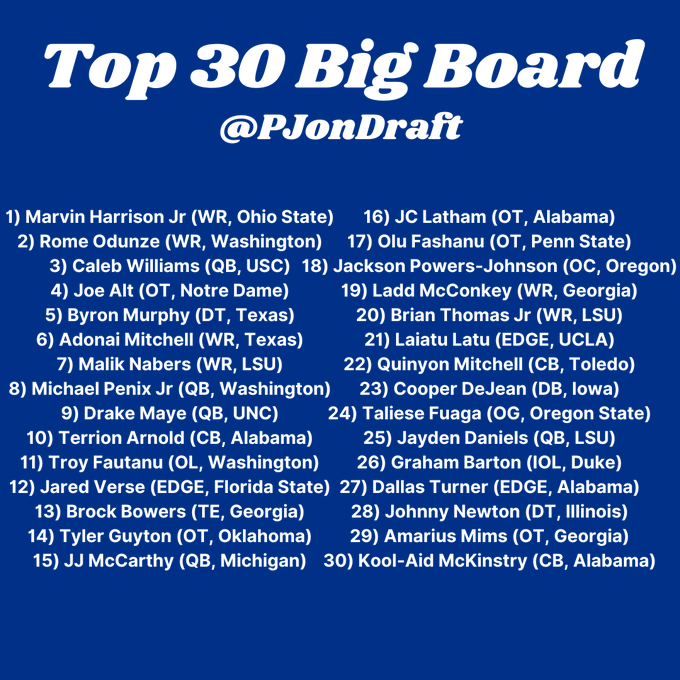
2024 NFL Draft – Top 30 Big Board

Here are my Top 30 prospects – listed in order by grade – for the 2024 NFL Draft.

While I wasn’t able to personally analyze or fully profile as many prospects as I would’ve liked this year, I did take deep dives into the college tape for the majority of prospects near the top of consensus draft boards. And while I am publishing this on the day of the NFL Draft, I still plan to study some other prospects of intrigue in the weeks ahead, and I’ll make note if any of them are late additions to this Top 30 Big Board.

  1. Marvin Harrison Jr, WR, Ohio State (Profile)

Summary: “Marvin Harrison Jr is going to connect in the NFL; it’s maybe the surest thing in the NFL Draft for wide receivers with this type of dominant profile. It’s more a matter of whether MHJ becomes an All-Pro/future Hall of Famer type or merely a Pro Bowler.”

Pro Comp: Julio Jones

  1. Rome Odunze, WR, Washington (Profile)

Summary: “Rome Odunze was a Round 1 prospect following his 2022 junior season and then leveled up in 2023 to arguably the best player in college football. There’s no ceiling on this guy, and teams should be tripping over themselves to nab him in this NFL Draft.”

Pro Comp: Larry Fitzgerald

  1. Caleb Williams, QB, USC (Profile)

Summary: “He might be the rare case of a first overall pick whose circumstances actually improve upon reaching the NFL. He’s a scrappy player and has the size and moxie to take literal and figurative hits early on in his career and come out on the other side all the better for it. Williams is a gifted passer with star potential within the right offense.”

Pro Comp: Matt Stafford

  1. Joe Alt, OT, Notre Dame

Summary: If being a 6’9 starting left tackle for Notre Dame as a true junior made Joe Alt a potential unicorn, being that with refinement cemented him as one. He is razor sharp, moves effortlessly, and packs solid power for his lean frame. Alt is a hard-working technician who’s already good enough as a blindside protector to put near perfect games on tape, and he still has space to get better and stronger. It’s a valid argument to make that Alt has the clearest path to the Hall of Fame in this class.

Pro Comp: Jake Long

  1. Byron Murphy, DT, Texas

Summary: Byron Murphy just seems like a freaking handful for any IOL to block alone. He’s an extreme athlete for the position with amazing lower body bend and torque at the point of attack. He can win immediately off the snap, and he can stack-and-shed blocks against the run as he sees fit. This a very high ranking for a dude who basically burst onto the scene in the 2023 season, but Murphy is that much of a disruptive game-wrecker from the interior.

Pro Comp: Grady Jarrett

  1. Adonai Mitchell, WR, Texas (Clips)

Summary: “I’m bullish that AD Mitchell has what it takes to better work physicality into his game. Besides that, he has it all, IMO. I get the drawbacks, and there are murmurs of non-football flags, but on tape Mitchell is a can’t-miss prospect and would’ve been my WR1 in some other years.”

Pro Comp: Justin Jefferson

  1. Malik Nabers, WR, LSU (Profile)

Summary: “I’m just not as confident in Nabers’ progression into an NFL WR1 like I am with [Harrison Jr and Odunze]. Yes, it’s definitely a possible outcome, and that best-case scenario is where the Ja’Marr Chase comparisons are fair…or maybe he’ll just be a really good option for an offense though not quite a superstar.”

Pro Comp: Jeremy Maclin

  1. Michael Penix Jr, QB, Washington (Profile)

Summary: “He’s the Moneyball quarterback. There are so many reasons to write him off in draft war rooms: he’s old (turning 24 before Week 1), he’s lefty, he’s got a funky delivery, he’s torn his ACLs, etc. But he’s tough, reliable, anticipatory, and operates quickly without cutting corners – sign me up.”

Pro Comp: Lefty Eli Manning

  1. Drake Maye, QB, UNC (Profile)

Summary: “There’s a not-so-crazy future where Maye continues to ramp up his creativity as he matures and takes more control of his offense, leading him to becoming one of the best playmakers at the position in the league. I’m coming into the clubhouse not feeling ultra optimistic about Maye’s NFL outcome, though. He still plays so young; the game moves fast for him and he just too often makes things too hard on himself.”

Pro Comp: Sam Darnold

  1. Terrion Arnold, CB, Alabama

Summary: Arnold is a ferocious DB with enough functional athleticism to thrive at cornerback. He’s ultra physical and one of the best college CBs you’ll ever see near the line of scrimmage. Arnold stops-and-starts very cleanly, and he’s instinctual with good ball skills. Arnold still could use more refinement and he’ll give up some space in coverage from time to time, so he’s not the lockdown man coverage CB1 that might usually go in the top half of Round 1 of the Draft. He’s a really good player though, one who’s very young and versatile too. 

Pro Comp: Paulson Adebo

  1.  Troy Fautanu, OL, Washington

Summary: Fautanu is a stout yet fluid scrapper with some of the best pass protection tape in this class. He’s always ready to strike and is a weapon-in-waiting for the right scheme. He’s still fairly raw and needs to operate with more of a plan in order to keep leveling up his game, and I did expect to like him more than I do at OT because of his solid length, but Fautanu remains a tough, malleable, and already very good lineman regardless of the position that he eventually calls home.

Pro Comp: Logan Mankins

  1. Jared Verse, EDGE, Florida State

Summary: Tenacious yet balanced, and explosive yet quick, Verse has the goods to thrive as an outside pass rusher in the NFL. His suddenness is potent, and he has twitchy hands and upper body movement to swim into the backfield off the snap. His lateral movement is excellent and he plays with a crazy hot motor. There is concern that Verse still doesn’t string rush moves together all that well despite his advanced age as a prospect, nor does he consistently channel his raw strength into game power, but he flashes enough at an important enough position to block out the bad stuff and just get excited for the good stuff.

Pro Comp: Olivier Vernon

  1. Brock Bowers, TE, Georgia

Summary: Bowers is a moose with the ball in his hands, and he’s a potential YAC game-changer for his future team with legit buildup speed, quickness, and power. He has the hand strength and hand-eye coordination to be a passing game weapon in the NFL, though his positional murkiness is weird and I wish I felt better about the breadth of his route tree, route precision, and downfield ability. It’s fair to wonder how much his college dominance can translate after losing physical advantages and the uber-friendly UGA offense, but this is a dude who we have seen practically win games by himself – which I doubt I’ve ever said about a college tight end.

Pro Comp: David Njoku

  1. Tyler Guyton, OT, Oklahoma

Summary: Guyton looks the part of a converted tight end when you watch him run, and he’s got the nasty streak of an offensive lineman that can’t just be taught. He is smooth and collected, and he’s already advanced at playing with his hands out in front. There is tape to back up the grand plans that some NFL play callers probably have for him as a lead blocker in the run game. Guyton’s pass sets are still a work in progress and you still can find examples of him feeling out the OT position, but I have faith that he’s a natural and that he’ll continue to mature in handling power. I’m a big fan.

Pro Comp: Ryan Clady

  1. JJ McCarthy, QB, Michigan (Profile)

Summary: “JJ McCarthy is a tantalizing prospect; that much isn’t a media creation. McCarthy is more athletic than [Brock Purdy and Zach Wilson] and has had more pro-style exposure too, but the more lowly glimpses from both of them that you see in McCarthy are also too glaring to ignore.”

Pro Comp: Kyler Murray

  1. JC Latham, OT, Alabama

Summary: It’s game over for defenders if Latham locks into them in the run game. He’s a very likable prospect with twitch for his humongous size and deliberate hands, and he’s constantly locked-in with reliable execution and no boneheaded plays on tape. There’s no denying that he’s pretty slow though, and it isn’t hard for defenders to expose Latham due to his size. He’s vulnerable but ultimately a player worth betting on with quite high upside.

Pro Comp: Andre Smith

  1. Olu Fashanu, OT, Penn State

Summary: Fashanu is a ready-made left tackle who easily clears the NFL bars for movement and raw strength. He’s good-not-great in most departments though, and he can stand to improve his consistency – particularly as a run blocker. Olu won regularly on his college tape and offers a fairly high floor to his future NFL team at a valuable position, though there’s a decent amount to clean up here before he can reach a top tier of OTs.

Pro Comp: DJ Humphries

  1. Jackson Powers-Johnson, OC, Oregon

Summary: JPJ has hilarious brute strength and really impressive functional athleticism for his heavy build at the center position. He is a quick dude, and it’s also nearly impossible for defenders to rush directly through him. JPJ isn’t very sticky nor squatty, and he’s still figuring some things out on the fly, but I view that as untapped potential in his case since he’s still young.

Pro Comp: Travis Frederick

  1. Ladd McConkey, WR, Georgia

Summary: McConkey is practically unguardable in the intermediate level of the field with his extremely sharp cuts, well-above average speed, and a sneaky catch radius. He’s a pure hands catcher who can take manufactured touches from nothing into something. McConkey has his drawbacks: he’s not an all-fields ball winner, falls short of some physical benchmarks, and has a cloudy medical history. Those are the reasons why teams will have the opportunity to draft a separator like McConkey as late as wherever he’s eventually picked, though.

Pro Comp: Christian Kirk

  1. Brian Thomas Jr, WR, LSU (Clips)

Summary: “It’s very clear why Brian Thomas Jr is going in Round 1: this is a gifted 21-year-old kid who scored 17 TDs last season. I’m wary of his landing spot though, and whoever gets him isn’t getting a finished product. There’s a bunch to clean up, starting with better using tempo and his frame to his advantage.”

Pro Comp: Braylon Edwards

  1. Laiatu Latu, EDGE, UCLA

Summary: Besides his advanced age for the college game (now 23), it makes sense why Latu racked up massive stats over the past two seasons. He possesses extremely active hands throughout the entire pass rush, and he changes direction very well – which a sneaky elite 3-cone time backed up. Latu has solid bend to him, too. He’s an effective enough run defender with a hand in the dirt and enough pad level, but Latu has a generally light lower half and won’t set a hard enough edge against outside runs in the NFL. By EDGE standards in the NFL, Latu’s speed, burst, and length are all mediocre, as is the power behind his rushes. I didn’t come away from his tape as blown away as others despite the quantifiable production, but I could see him racking up high sack and pressure counts with some added bulk in the right defense.

Pro Comp: Jason Babin

  1. Quinyon Mitchell, CB, Toledo

Summary: Mitchell has a laboratory-concocted combination of size and speed for a cornerback, and it shows on tape via his fast breaks on the ball and strength at the catch point. It’ll be tough for any wideout to beat him deep, and he has great ball skills. Mitchell holds his own in zone coverage, too, so why the relatively lower ranking? You can see impatience and mixed-up focus between the quarterback’s eyes and his assignments across his tape, and he’s got some heavy feet despite his blazing straight-line movement. I usually love coming to the defense of smaller school prospects, but the level of competition that Mitchell faced was truly terrible. I’m glad he performed well at the Senior Bowl, but I can’t allow that to catapult him too far up the board. 

Pro Comp: Bradley Roby

  1. Cooper DeJean, DB, Iowa

Summary: I very badly wanted to come to the defense of Cooper DeJean as a cornerback, but nah…this kid is a safety at the next level. I don’t have nearly enough trust in his ability to execute in man coverage against NFL wideouts flying off the line of scrimmage on the outside. That said, DeJean is a compact and explosive drive-killer with excellent recognition skills. He’s got very good size and loves to mix it up – sometimes too much at the tops of routes. DeJean will take some odd angles and I don’t know if he can change direction well at all, but any team that just lets him play loose and downhill should be happy to have him.

Pro Comp: Kyle Dugger

  1. Taliese Fuaga, OG, Oregon State

Summary: I certainly view Fuaga as a right guard despite his college alignment of right tackle. Beyond his noticeable lack of length, Fuaga takes repeated jabs over sustained blocks and looks generally stiff manning the corner of a line. He does move way better than I first expected; it’s flat-out impressive explosion for his size. He’s a very good run blocker on the move, and he packs absurd pop in his hands. Even if he’s not the bookend anchor that some have pitched him as, Fuaga is a potential Pro Bowler on the inside.

Pro Comp: Trey Smith

  1. Jayden Daniels, QB, LSU (Profile)

Summary: “I understand why Daniels will go in Round 1 of the Draft; he’s fresh off a season with 40 touchdown passes and is truly a killer runner for the position. Still, it needs to be said that Daniels isn’t a Mike Vick/Lamar Jackson “Houdini” type of QB runner. In the passing game, Daniels basically only took what was drawn up or right in front of him, and I definitely cannot say I love that we’ve seen Daniels at the age of an NFL rookie be merely ‘ok’ in college.”

Pro Comp: Kordell Stewart

  1. Graham Barton, IOL, Duke

Summary: Barton is an ultra aggressive finisher who possesses excellent body control. It isn’t always the prettiest with Barton, who’s more of a Steady Eddie than a weapon, but he finds a way to consistently win in pass protection. He’s a wrestling type of lineman whose hands can get wild and whose eyes can get glued. Barton won’t stay at his college position of left tackle in the NFL, and it’s fair to worry if his size advantage will be neutralized with that kick inside, but I trust that Barton’s skill will ease a position change – whether to guard or center.

Pro Comp: Cody Whitehair

  1. Dallas Turner, EDGE, Alabama

Summary: The on-paper appeal for Turner is obvious: he has the measurable speed of a running back and the measurable length of an offensive lineman. He’s a high effort player too, and he packs good power above the waist. He just isn’t bendy whatsoever – it’s actually shocking how upright he plays for his position and frame. Turner has a frustrating lack of effective hand usage on tape, and he does look undersized when matched up against bigger OTs. With generally ok yet low-floor run defense as well, he has the profile of a defender who might have had better odds at NFL success in an older era of the league with heavier deployment of standard base defenses.

Pro Comp: Leonard Floyd

  1. Johnny Newton, DT, Illinois

Summary: Newton was one of the tougher evaluations of this process, which wasn’t helped by a nursed injury during his 2023 campaign. Newton’s athletic tools aren’t anything special and there isn’t all that much skill to his game either, but he still wins due to the traits that you can’t teach: bend, power, determination. He always keeps his eyes forward and his body working towards the ball, and he tosses dudes if he gets to them in time. It is hard to look past Newton’s down-to-down inconsistency, which includes getting stuck on blocks that have no business slowing him down, but his appeal is clear. Newton should have a decently long career, because he’s versatile and the increasingly rare type of modern top DT prospect who isn’t a 3tech-or-bust.

Pro Comp(s): Sen’Derrick Marks

  1. Amarius Mims, OT, Georgia

Summary: Mims has laughably easy power and it’s pretty damn hard for defenders to beat him around the corner at his size. He can swallow defenders out of plays if he gets his hands on them, but that’s definitely an “if” – and that’s when Mims is healthy enough to stay on the field. Beyond obvious and extremely fair concerns over health, Mims has a long hill to climb as a run blocker and in general as a football player with some lacking instincts due to inexperience. You root for him just to stay upright, and if he does, I don’t think he’s as fast and freakish as advertised, but he’ll probably be good.

Pro Comp: Phil Loadholt

  1. Kool-Aid McKinstry, CB, Alabama

Summary: McKinstry is a smart, consistent, and scheme-proof player with plenty of production on tape. There’s a lot that he doesn’t do exceptionally, and he’s merely average when it comes to quickness, explosiveness, and instincts, but he can hang with bigger targets and runs better than he’s seemingly given credit for. Being an easy projection is boring around this time of year, but it’s a high-percentage outcome that McKinstry is a steady CB2 in the NFL, and there’s value in that.

Pro Comp: Rock Ya-Sin

NFL, Read

NFL Draft Profile: Rome Odunze

School: Washington

Position: WR

Year: Senior

The Good: Rome Odunze might not have played his college ball in the SEC, nor is he the direct descendant of a Pro Football Hall of Famer, but he is likely the most complete wide receiver in this NFL Draft – and the last few years’ worth of draft classes, for that matter. Odunze is a true 6’3, 215lb wideout who’s also a freaking elite athlete – and that athleticism is directly translatable to the field. His size is, too; Odunze usually either brakes the first tackle attempt or at a minimum falls forward. Odunze’s route running has no business being as crisp as it is for his size, and he matches his precision with the physicality to continue routes through contact. Odunze has nasty releases all over his tape – especially near goal line – very loose hips, changes directly well, and has subtle jabs in his bag to get separation against man coverage. Odunze is a natural and nuanced zone attacker, too.

Odunze is a contested catch god; his ball skills are truly as dominant as you’ll ever see from a college wideout. He boxes out defenders with ease, and from there, Odunze has tremendous hands – both fast and strong – with a very large catch radius to go along with his mitts. He can get way up with his jumps, and the timing of his jumps is consistently perfect. Once the ball is in Odunze’s hands, he has great burst; he can really get the ball and go.

The Bad: There isn’t much to write about here; like I said earlier, Odunze is likely the most complete WR prospect in this class. Odunze could improve with some of the finer elements of wide receiver play; i.e., mixing up tempos, showing urgency in route timing when it is needed, etc. (That lack of technical perfection is what could place him slightly behind Marvin Harrison Jr in rankings.) Like Harrison, Odunze isn’t a scary YAC threat; he has size and speed, but he’s not particularly elusive. Odunze can win at all three levels – see his awesome 50-yard, over-the-shoulder grab against Texas in the Sugar Bowl – but the deeper third of the field is where he can still get better due to some difficulties with downfield ball tracking – see the brutal miscommunication on a blown coverage against Michigan in the National Championship Game. Smaller stuff, but occasional drops and slips will happen for Odunze right out of his breaks, as will bigger cornerbacks occasionally having some success in slowing him down out of press coverage. 

The Bottom Line: I mean, the NFL Draft community has largely come around on Odunze over the past few weeks – he’s Top 10 in every mock draft now – but it’s still not enough, in my opinion. This kid has everything, and he’s got the right mentality and toughness on the field for an NFL WR1 too. If his Combine shattering athletic testing wasn’t enough, just look at Odunze’s 2023 game log and marvel at his production. As if a 92 rec/1,677 yard/15 TD stat line on the season wasn’t enough, Odunze had ONE game across 15 contests with less than 5 receptions, and ONE game with less than 82 yards.

His consistency is all-time stuff, and that extended all the way through the National Championship Game, where he was excellent vs. Michigan and future Round 1 cornerback Will Johnson. He was somehow even more impressive than those stats imply, since he drew so many holding and pass interference calls and split target share with Ja’Lynn Polk and Jalen McMillan. And if you’re of the opinion that Odunze is more of a bankable producer than a game-wrecker, go watch his tape vs. Michigan State and try telling me that again. Rome Odunze was a Round 1 prospect following his 2022 junior season and then leveled up in 2023 to arguably the best player in college football. There’s no ceiling on this guy, and teams should be tripping over themselves to nab him in this NFL Draft.

Grade: Top 5 Pick

Pro Comp: Larry Fitzgerald

Games Watched:

  • Kent State 2022
  • Stanford 2022
  • UCLA 2022
  • Oregon State 2022
  • Texas 2022
  • Boise State 2023
  • Tulsa 2023
  • Michigan State 2023
  • Oregon 2023
  • Arizona State 2023
  • USC 2023
  • Utah 2023
  • Washington State 2023
  • Texas 2023 (CFP Semifinal)
  • Michigan 2023 (CFP Final)

Plays That Matter [LINK]

NFL, Read

NFL Draft Profile: Malik Nabers

School: LSU

Position: WR

Year: Junior

The Good: Malik Nabers is young, feisty, and turbo charged. He’s just about as explosive as it gets at the wide receiver position with extremely rare 0-to-60 burst. It’s evident that Nabers is a plus athlete with major hops on tape, and he backed it up with a ludicrous 42” vertical jump (97th percentile). I love Nabers’ feel for exploiting zone coverages, and he basically has the vision of a running back once you get the ball into his hands. It’s not all that difficult to get the ball into Nabers’ hands, either. He can line up from anywhere – he’s a mismatch out of the slot at his solid size – and he knows how to sink his body to earn separation versus shallow man coverage. Nabers’ best level of the field might be the deepest third, though. He has a second gear for late separation on deep routes, and his statistical deep production is bankable at the next level; he wins deep with both craft and natural skill. Nabers is very physical at the catch point for his good yet not overwhelming size, and he has strong and quick hands that he can flash late against tighter coverage.

The Bad: It makes sense for a wideout like Nabers who plays like Sonic the Hedgehog, but it’s worth calling out that he lacks some route precision and has wasted movement at the line of scrimmage; his releases aren’t consistently deliberate enough yet. It’s part of the joy of Nabers’ game that he’s such a ball of energy, but that sometimes reckless play style isn’t always what you want from your offense’s WR1. Nabers’ hands won’t be a talking point as a pro, but when you’re dissecting them in comparison to his peers in this draft class, Nabers has an ordinary catch radius, fairly common focus drops, and inconsistency tracking the ball into his hands. He has a tendency to body catch, especially on quick hitting routes. His league-average size certainly isn’t an issue – in some capacity it’s a godsend when looking back on the influx of tiny wideout prospects in recent years – but the reality is that Nabers won’t force NFL DBs off their spots. And, fair or not based on his reputation, I kinda expected Nabers to be more of a tackle breaker than he is; he should post gaudy YAC numbers but that’ll be by nature of his acceleration.

The Bottom Line: It’s stupid that I feel defensive of my evaluation of Malik Nabers when I think he’s awesome and still have a damn high grade on him; I just would rank him in the tier beneath Marvin Harrison Jr and Rome Odunze. I’m not entirely sold on some reasons behind his success in that LSU offense being wholly translatable, and I’m just not as confident in Nabers’ progression into an NFL WR1 like I am with those other two guys. Yes, it’s definitely a possible outcome, and that best-case scenario is where the Ja’Marr Chase comparisons are fair. But Chase and Odell Beckham Jr are the only 6 ‘0-and-below wideouts this century to post a 1,200-yard campaign before their Age-24 season. (They each did it twice.) For comparison, 19 receivers taller than 6’0 have pulled that off since 2000. Malik Nabers will still be 20 years old when he’s drafted, so his first three pro seasons will fit that bill. Maybe he’ll turn that into a trend for LSU alumni in the league, or maybe he’ll just be a really good option for an offense though not quite a superstar. 

Grade: Top 10 Pick

Pro Comp: Jeremy Maclin

For anyone who thinks that comp is too low for Nabers…

  1. Grow up; every single highly-touted NFL Draft prospect can’t pan out as an All-Pro.
  2. Jeremy Maclin was a very, very good NFL player! He retired early but he was an uber-athletic, consistently productive wideout right from the start of his career.

Games Watched:

  • Florida State 2022
  • Tennessee 2022
  • Georgia 2022 (SEC Championship Game)
  • Purdue 2022 (Citrus Bowl)
  • Florida State 2023
  • Mississippi State 2023
  • Arkansas 2023
  • Missouri 2023
  • Auburn 2023
  • Alabama 2023
  • Florida 2023
  • Texas A&M 2023

Plays That Matter [LINK]

NFL

NFL Draft Profile: Marvin Harrison Jr.

School: Ohio State

Position: WR

Year: Junior

The Good: The kid is pretty good, and by that I mean that Marvin Harrison Jr is laughably good. MHJ at 6’3, 210lbs is an easy route runner with quick and precise feet, and his hands might be even better. He’s a pure catcher of the football, and he’s so quick to adjust his hands to off-target throws. Beyond his natural gifts, which include race-winning speed against faster defenders, Marv’s game might be most special for his technical gifts at such a young age. He puts routinely absurd releases on tape, and into his route MHJ has really subtle movements in his bag and can force plenty of physical separation at route stems. Once the ball is in the air, Marv possesses acrobatic body control and very casually expands his catch radius beyond what normal wideouts can do. All the intangible stuff is there too; go figure as the son of a Hall of Famer. Marv Jr plays with a competitive fire, has enough well-rounded skill to line up anywhere, and forces defenses to keep eyes on him for every snap. I’m confident in projecting Marvin Harrison Jr as the rare type of wide receiver who can win games on his own…because we’ve already seen him do it.

The Bad: I will say, for all of the praise like this that Marvin Harrison Jr elicits – and deserves – there are some drawbacks to his game when it comes to what’s expected of a WR1 in the NFL. Marv’s tools are excellent, and possibly underrated at this point, but he’s a subpar YAC threat. Ohio State tried to work that more into his game in 2023, too; I just don’t think he’s going to ever be that guy. Aside from that, the only other thing I’d like to see MHJ do more often is assert his physical dominance more regularly and always play to his size. He has an annoying tendency to opt for acrobatic catches instead of getting overly physical and working back to the football.

The Bottom Line: Marvin Harrison Jr going to connect in the NFL; it’s maybe the surest thing in the NFL Draft for wide receivers with this type of dominant profile. It’s more a matter of whether MHJ becomes an All-Pro/future Hall of Famer type or merely a Pro Bowler. I watched this kid manage to up his game from 2022 to 2023 playing with Kyle McCord instead of CJ Stroud, and he still has areas of his game to improve – winning deep more regularly is one. So yeah, I’ll go with the All-Pro/future Hall of Famer outcome.

Grade: Top 5 Pick

Pro Comp: Julio Jones

Games Watched:

  • Notre Dame 2022
  • Michigan State 2022
  • Penn State 2022
  • Indiana 2022
  • Michigan 2022
  • Georgia 2022 (CFP Semi)
  • Notre Dame 2023
  • Maryland 2023
  • Purdue 2023
  • Penn State 2023
  • Michigan 2023

Plays That Matter [LINK]

NFL, Read

NFL Draft Profile: Bo Nix

School: Auburn / Oregon

Position: QB

Year: Redshirt Senior

The Bottom Line: I’m bypassing my typical paragraph for ‘The Good’ and paragraph for ‘The Bad’ here, because my evaluation of Bo Nix isn’t balanced enough to even to justify that. I’m not a fan; I anticipate he’ll be the lowest graded player that I deep dive on this year, which isn’t uncommon for a quarterback but is maybe a first for me when it comes to a potential Round 1 QB. I’ll give it to Nix that he’s legitimately an above-average athlete for a QB with solid creativity and a decent deep ball in his bag. But that’s about where the compliments stop. Simply put, I do not think that Nix has the arm of an NFL starting quarterback. There isn’t much behind it and he cannot layer throws whatsoever. It’s harsh, but it seriously felt like every time he stepped back to make a pro throw, it sucked. And when I say “pro throws,” Oregon’s offense featured as much quick game as any in the country. Nix has been a low aDOT merchant with so much of his statistical production coming off screens, and on bolder passing concepts Oregon still had WIDE open receivers on so many of Nix’s touchdown passes. Nix seldom made decisions for himself under center in Oregon’s offense, and even then there were multiple instances of him not letting plays develop. Nix basically short circuits when his primary read isn’t there, and he doesn’t handle pressure well either. His footwork in the pocket is very stiff. Nix did improve from 2022 to 2023, but that isn’t saying much. I had to remove games from his 2022 watch list because I couldn’t stand to watch more. Against the 2022 Georgia defense, it felt like every single throw beyond 5 yards was either picked off or should have been picked off – and he was nearly 23 years old at the time. Nix is a known commodity for college football fans as a five-year starter across two major programs, but that doesn’t make him a quality NFL quarterback prospect.

Grade: Day 3 Pick

Pro Comp: Colt McCoy

Games Watched:

  • Mississippi State 2021
  • Georgia 2022
  • Washington State 2022
  • Utah 2022
  • Texas Tech 2023
  • Colorado 2023
  • Utah 2023
  • USC 2023
  • Washington 2023 (Pac12 Championship Game)

Plays That Matter [LINK]