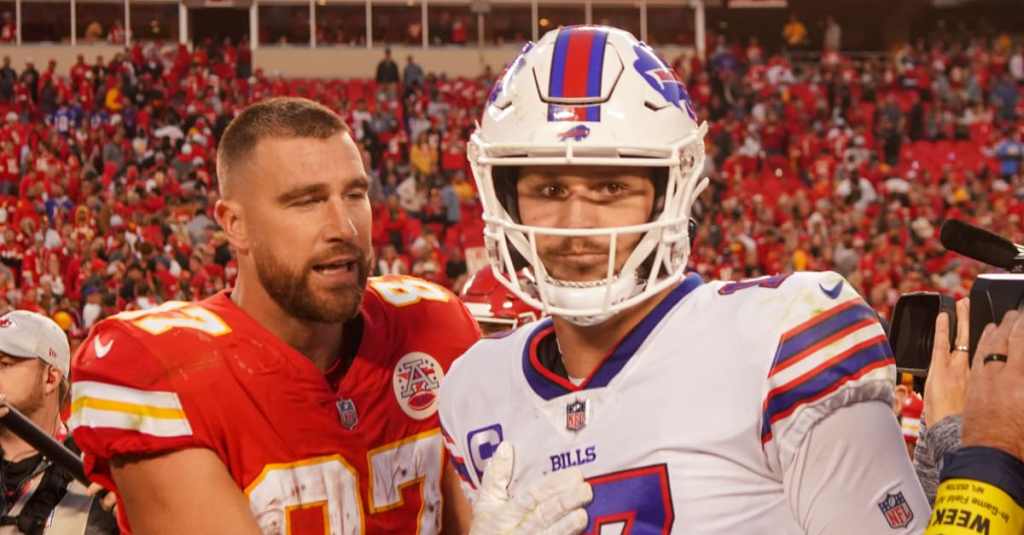
From 2018 to 2022, Travis Kelce had one of the more uniquely dominant five-season stretches in fantasy football history. Kelce scored 1,440 PPR fantasy points across those five seasons; the second highest scoring tight end during that span, George Kittle, scored 1,005 total PPR points. That gap between Kelce and Kittle is larger than the gap between Kittle and the TE12 over that time (Mike Gesicki). On an annual basis, Kelce finished as the TE1, TE1, TE1, TE2, and TE1, respectively, among tight ends from 2018 to 2022.
With hindsight being 20/20, Kelce was worth a first-round pick in fantasy drafts heading into each of those seasons. There was no better edge than having Kelce on your roster putting up the numbers of a WR1 when your league-mates limped to 7 points per game out of their tight ends. The fantasy football collective gets a pass for not identifying Kelce’s first-round value heading into 2018, his true breakout season into fantasy superstardom; his ADP was 28th overall that year. His overall ADP (slightly) crept up over the next few years:
2019: 17
2020: 18
2021: 12
2022: 14
With the limited exception from 2021 following Kelce’s outrageous 105/1416/11 season in 2020, most drafters missed out on golden years from Kelce because they were too afraid to allocate their first picks to a tight end – even the most bankable tight end we’ve ever seen in fantasy football in his prime.
And now, only a couple of years later, it seems like something similar might be happening with another of the NFL’s biggest stars. Josh Allen has been the top fantasy quarterback since 2020 almost any way you slice it. Patrick Mahomes has done an admirable job keeping the QB1 race (somewhat) close, but he’s also masking the total dominance of Allen over every other QB. The 2020-2023 cumulative gap between Allen and the QB3 during that stretch (Justin Herbert) is larger than the gap between Herbert and the QB15 (Matt Stafford). Annually, Allen has finished as the QB1, QB1, QB2, and QB1 over the last four seasons. On the most surface level, it’s similar positional supremacy to Kelce at his peak.
This begs the question: should Josh Allen be in line for the first-round treatment that Travis Kelce deserved but only occasionally received from 2018-2022? Going off early indicators for 2024 drafts, it’s an even more controversial proposition for Allen than it ever was for Kelce; Allen’s current ADP average is 22nd overall!
The arguments against taking a QB highly in drafts, let alone with a top pick, are well-documented: you only start one of them in standard formats, there are multiple elite options at the position (Mahomes, Jalen Hurts), etc. Mainly though, fantasy football is a game of trying to outwit the opposition at as many positions as possible rather than trying to accumulate the most points, which quarterbacks do best. Managers are looking for a game-breaker with their first-round pick, and unless there was a surefire 2010 Michael Vick or 2018 Lamar Jackson season heading into drafts, in theory it tracks to target a skill player.
To what end, though? If Josh Allen is performing that much ahead of other players at his position, when does it make sense to pull the trigger on him? Might we be getting this totally wrong?!
Let’s take names out of the equation for a moment and look at the basics for Top 10 finishers at primary fantasy positions over the last four years.
| QB | RB | WR | TE | |
| # of Top 10 annual finishers over 4 years | 24 | 29 | 26 | 24 |
| # of Top 10 finishers in 4 of 4 years | 2 (Allen, Mahomes) | 0 | 2 (Tyreek Hill, Stefon Diggs) | 2 (Kelce, Mark Andrews) |
| # of Top 10 finishers in 3 of 4 years | 3 (+ Jalen Hurts) | 1 (Derrick Henry) | 4 (+ Justin Jefferson, Davante Adams) | 3 (+ George Kittle) |
| Standard Deviation, Top 10 Range | 1.19 – 3.11 | 2.30 – 3.18 | 1.91 – 2.34 | 1.65 – 3.00 |
| Standard Deviation, Top 10 Four-Year Average | 1.96 | 2.71 | 2.34 | 2.43 |
· Top 10 finishers by total points, THEN sorted by PPG (Half-PPR). Availability matters!
· I am using 2019-2022 in this analysis for tight ends to mirror Travis Kelce’s four-year curve. For standard deviation measurements, the time frame remains 2018-2022.
So, what does this begin to tell us? First, do not draft Josh Allen before anyone who you legitimately believe might end the season as the overall RB1. Premier running backs will always offer the highest ceiling among players on the board in fantasy football. Especially at the very top of drafts with the Christian McCaffrey’s of the world available, the reward is likely worth the risk. (The RB cliff is STEEP though, and the bottom can just fall out for ANY running back.)
After that confirmation of elite RB value, a top observation is that QBs are, on average, the flattest position among Top 10 performers – something that, in theory, doesn’t bode well for the prospects of Josh Allen as a top fantasy pick. That said, the gap isn’t all that wide; in fact, it’s interesting to see that Top 10 WRs are positionally placed exactly between RBs and QBs in terms of four-year average variance when wideouts are much more frequently correlated with RBs than QBs. Also, while the flattest single season for one position in this span belonged to QBs – every Top 10 QB in 2020 averaged at least 21.9 PPG – the second HIGHEST variance season among all fantasy positions in this span also belonged to QBs! And if you believe in patterns, then you should note that QB has been MUCH more of a boom-or-bust position in the last two seasons than it was from 2020-2021. Just last season, Josh Allen outscored the QB10 (Baker Mayfield) by a whopping 7.5 PPG. To put that in perspective, that would be equivalent to the team with Mayfield having an extra roster spot with Dallas Goedert in it.
To start to culminate this exercise, let’s bring names back into the equation. In addition to Allen and Kelce, it’s great that we have consistent Top 10 data across all four years from Tyreek Hill and Stefon Diggs, too.
To reach the below percentages:
1. For each season individually, I took that player’s PPG and subtracted it from the 3rd ranking player’s PPG. For example, in 2023 I took Josh Allen’s 24.2 PPG and subtracted Lamar Jackson’s 21.1 PPG from it.
2. Whatever the difference – which could be positive, negative, or zero – I divided that by the standard deviation across the Top 10 in that particular season. Sticking with the above example, I divided 3.1 (QB1-QB3) by 2.27 (STDDEV) to reach 1.36, or 136%.
3. I repeated the same for all four seasons in the span – five in the case of Kelce and tight ends – then also repeated against the 5th and 10th ranking players’ PPGs.
4. I averaged out the percentages over the spans.
| 2020-2023 (QB/WR) 2018-2022 (TE) | Allen | Hill | Diggs | Kelce |
| vs QB3/WR3/TE3 | 90% | 15% | -97% | 130% |
| vs QB5/WR5/TE5 | 172% | 106% | -20% | 199% |
| vs QB10/WR10/TE10 | 293% | 192% | 80% | 299% |
These results are more of the eye-of-the-beholder type. Personally, however, I cannot ignore Tyreek Hill’s percentages here – which are indicative of the alpha fantasy wideout. Beyond being over 100% more bankable than the typical WR5 overall on a season and nearly 200% over the typical WR10, don’t sleep on how ridiculously impressive it is that Hill performed ON AVERAGE above the typical WR3 overall even when accounting for fluctuation across other performers at the position. When you look back to the first table and remember that WRs have, by far, the thinnest range of year-over-year outcomes compared to the other positions – plus the obvious consideration that most fantasy leagues require 3+ WRs in starting lineups now – it becomes harder and harder to build a good argument for taking Josh Allen over wideouts with a realistic shot at finishing as the overall WR1 – WR3 on the season.
Then things get interesting, though. For a Stefon Diggs type of fantasy wideout, a veteran with static year-over-year ADPs near the Round 1/Round 2 turn, that quite evidently is seldom a league-winning player but should return positive value as a WR1 for your particular fantasy team – just maybe not the overall rankings. Looking at current 2024 ADPs, players like AJ Brown or Davante Adams could fit this bill.
Again, this is where eye-of-the-beholder fantasy preferences and strategies take over. I wouldn’t fault any fantasy manager for taking an extremely reliable wideout like Brown with their first pick and then swinging for the fences with their second or third pick. But, I’ll also be real with this data staring me in the face, you might want to take Josh Allen instead if you are seeking a true league-winner with your top pick! (This logic would apply to the top TE too, but there isn’t a clear top dog at that position with a track record heading into 2024.)
So, let’s now answer the question that kicked this whole thing off: should Josh Allen be in line for the first-round treatment that Travis Kelce deserved but only occasionally received from 2018-2022?
There isn’t one cut-and-dry answer, but I’d start with a “not exactly.” Kelce seriously was 1-of-1 when it came to year-over-year dominance over even the best of the best of his peers at the position. Especially in best ball formats or more casual leagues without many transactions or lineup changes, Allen doesn’t keep pace with peak Kelce as a set-and-forget fantasy machine.
When you begin to widen the parameters though, even slightly, my answer becomes more of “…kinda!” The gap between Allen and Kelce over their QB3/TE3 counterparts shrinks a lot once you zoom out to their QB5/TE5 counterparts, and then the gap is basically gone between them once you get to QB10/TE10 benchmarks! Meaning that, in redraft leagues of 10+ members, the numbers indicate that you would have a remarkably similar edge with Josh Allen that prime Travis Kelce offered over STARTERS in lineups across your league.
So yes, in the regard of being a more bankable force multiplier than the lowest tier of starters at the position, 2024 Josh Allen is right there with 2018-2022 Travis Kelce.
 Epiblogue